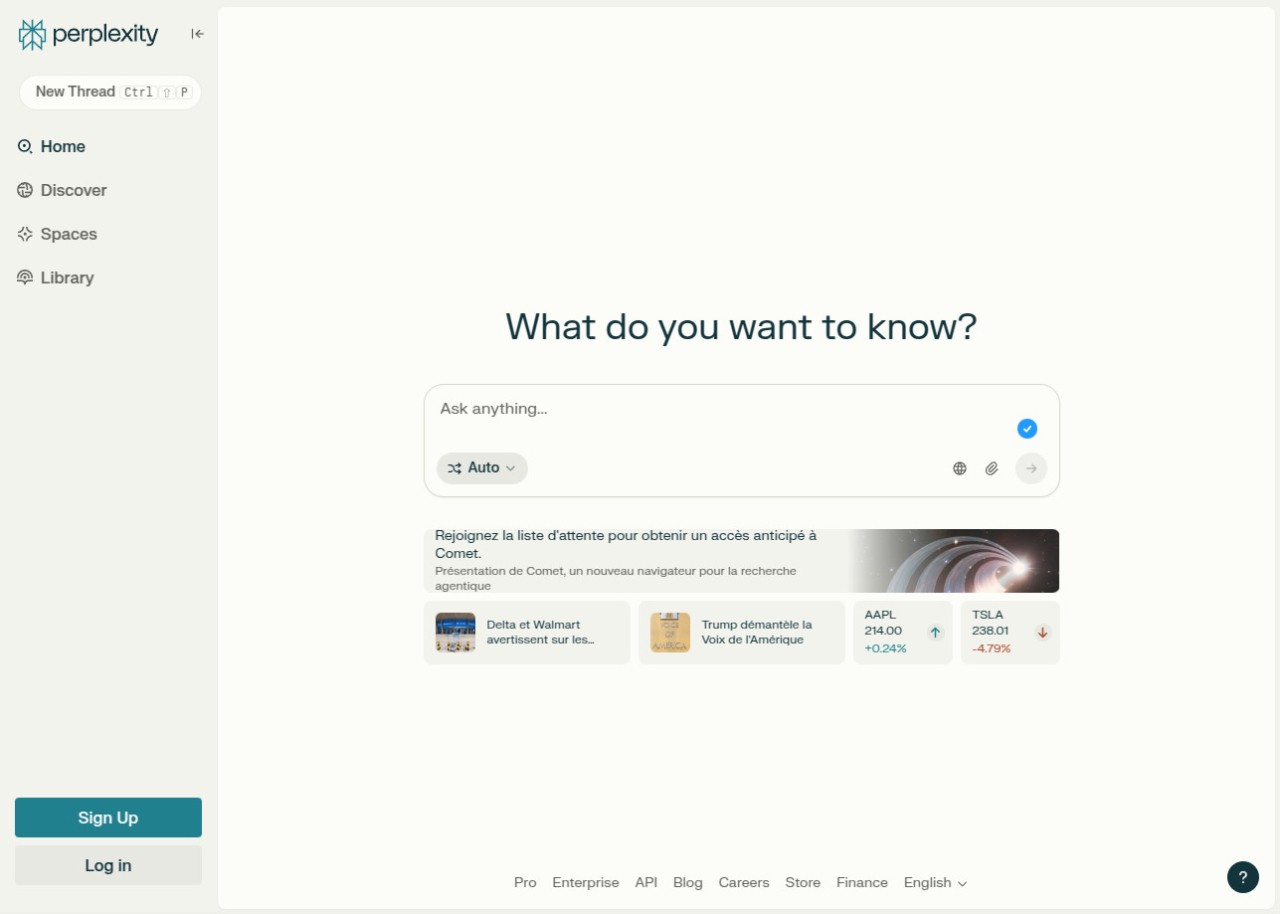
Perplexity is a hybrid solution that combines the capabilities of an intelligent search engine with those of an advanced conversational assistant. Easily accessible from a browser or smartphone, this platform provides you with clear, immediate answers, always accompanied by reliable sources so you can delve deeper into the topic. Unlike traditional search engines that simply list results, Perplexity presents a summary that’s immediately actionable, structured around the most relevant data available online.
One of Perplexity’s strengths lies in its contextual understanding of queries. No specific keywords or rigid syntax are required; the tool is capable of interpreting the query—even when phrased informally—and accurately capturing its essence. This capability is made possible by the integration of some of the most advanced natural language processing models available today, such as GPT, Claude, and Grok.
What Are the Key Features of Perplexity AI?
Perplexity operates through a series of specialized modules. When you submit a query, it is first analyzed by a conversational agent tasked with identifying your intent and information needs. At the same time, a crawling engine searches in real time for the most reliable and up-to-date sources available on the web. The collected data is then synthesized, verified, and presented as a contextualized response, accompanied by precise references.
This approach goes far beyond a simple list of links. Perplexity provides you with detailed, easy-to-understand, and immediately actionable information, whether for professional, academic, or personal use. You can also refine your results by interacting with the interface—whether to clarify a point, ask a follow-up question, or rephrase your query. This flexibility is made possible by a conversational AI system capable of adapting its responses based on the flow of the conversation.
In terms of user experience, Perplexity stands out with a clear, fluid interface designed to minimize friction. The tool adapts to your needs, whether you’re a professional seeking specialized information, a student looking for clarity, or simply curious to learn more about a topic. Its technical architecture is based on the latest advances in generative artificial intelligence and natural language processing (NLP), ensuring reliable, high-performing, and always properly sourced results.
Is Perplexity AI Free to Use?
Perplexity offers completely free access to its basic features, allowing users to take advantage of a powerful conversational search engine with no commitment whatsoever.
However, for those with more advanced needs, a Pro version is also available, specifically designed to meet the needs of professionals. This advanced plan includes tools designed to support businesses in their day-to-day operations.
The Perplexity Enterprise Pro offering, in particular, allows you to leverage cloud services such as Google Drive, SharePoint, or Gmail to ensure seamless data management within a single collaborative space. User management is simplified through a centralized structure, making team management clearer and more efficient. At the same time, branding can be fully customized, ensuring visual consistency and an experience perfectly aligned with the company’s identity.
Which Platforms Support Perplexity AI?
Perplexity is available via your browser on the official website. The web version is optimized for desktop and laptop computers, offering a clean and intuitive visual environment for smooth navigation.
For mobile users, Perplexity offers free apps for iOS and Android, available on the App Store and the Google Play Store, respectively. The app is compatible with all iPhones and can be installed on most Android smartphones.
If you use Google Chrome, an extension is available on the Chrome Web Store, allowing you to quickly access Perplexity directly from your toolbar for more convenient use while browsing.
What Are the Best Alternatives to Perplexity AI?
While Perplexity stands out for its ability to combine an intelligent search engine with a conversational agent, it is not the only tool to offer an enhanced approach to searching for and understanding information. Other artificial intelligence tools operate in a similar space, each with its own strengths and unique features.
Among the most popular alternatives is ChatGPT, developed by OpenAI. Powered by the GPT-4 language model, this virtual assistant has established itself as a leader in its field. It excels at text generation, answering complex questions, translation, creative writing, and even code development. In addition, ChatGPT is capable of adapting to each user’s style, understanding the context of conversations, and providing detailed and relevant responses.
Another notable equivalent is Gemini, the AI assistant developed by Google. Based on the same principle of natural language dialogue, Gemini stands out for its tight integration with the Google ecosystem. In particular, it allows users to retrieve information directly from the web, Gmail, Google Drive, and Google Maps.
Vibe (Mistral Chat) is another viable option, especially for those seeking precision and high performance. Based on the powerful Mistral AI models, this AI assistant is capable of handling a wide range of content, from simple general questions to the analysis of complex documents. It can read PDF, DOC, and PPT files, and even extract text from images using optical character recognition (OCR).