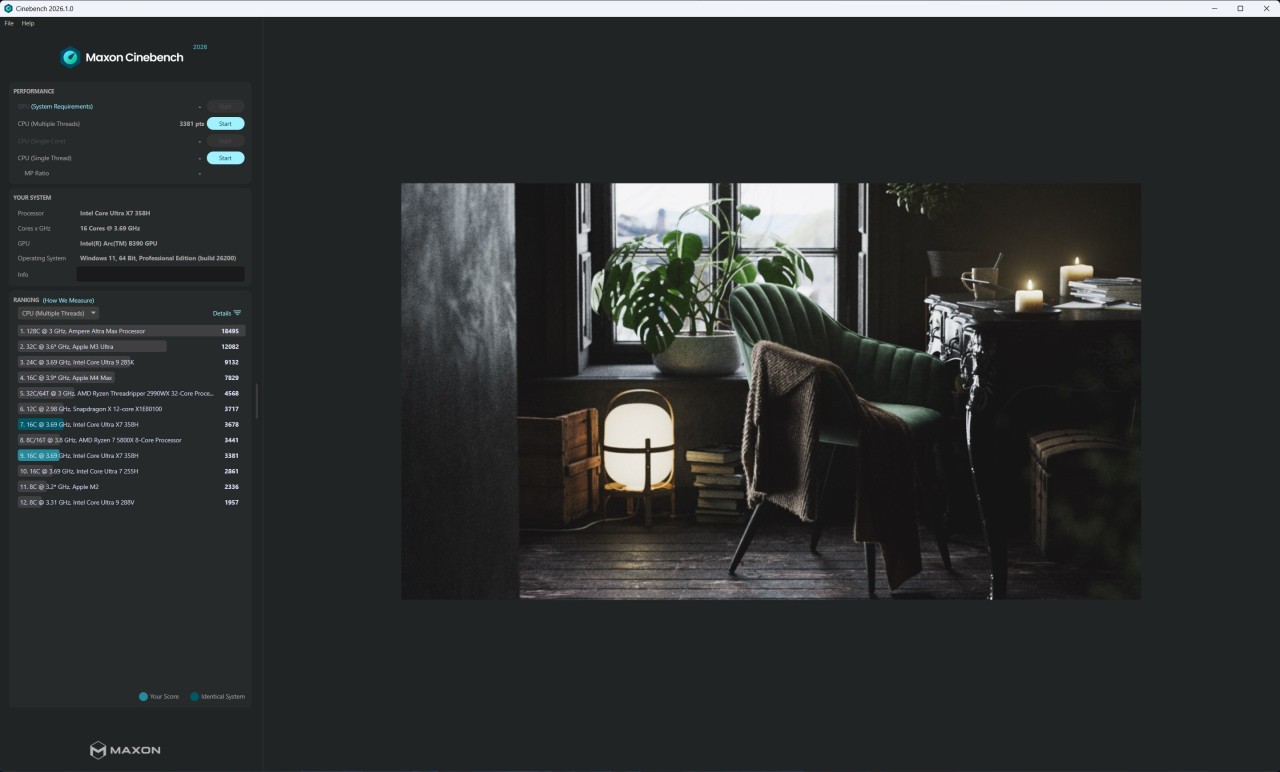
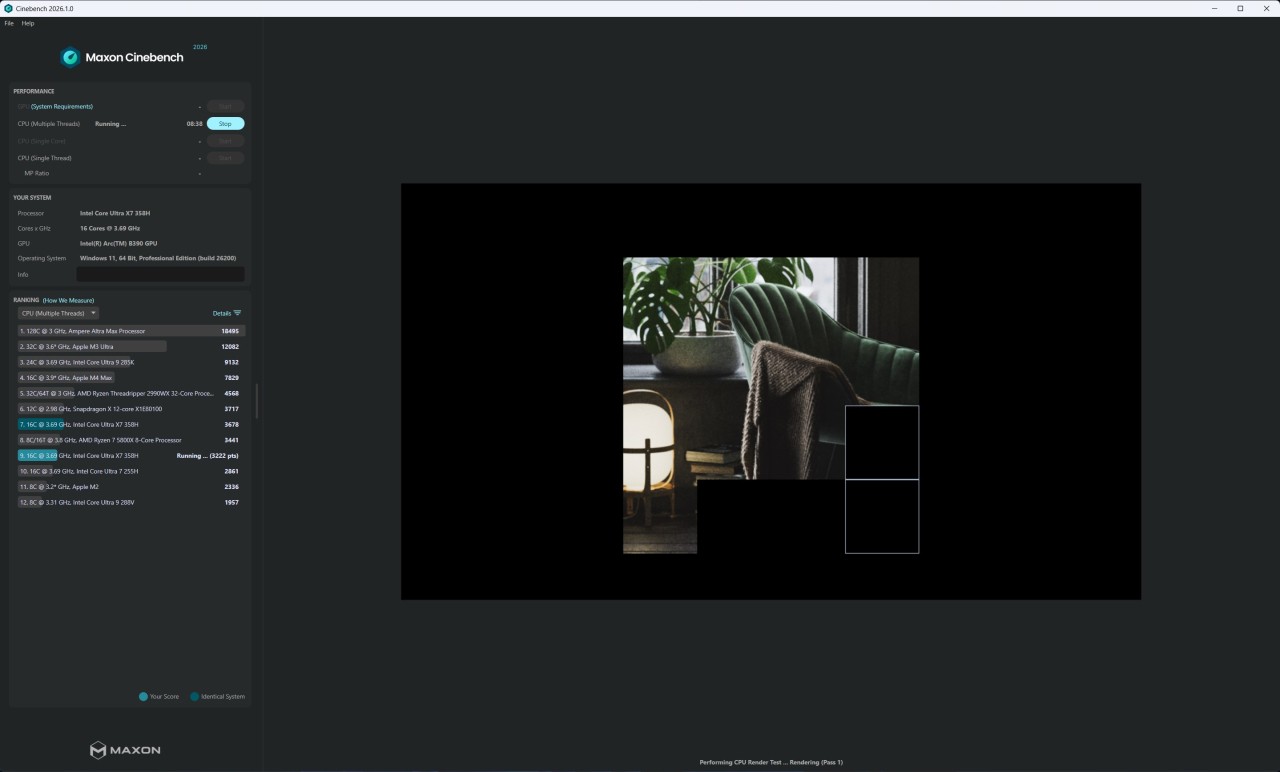
A benchmarking tool that is used to test the hardware performance of a computer is called Maxon Cinebench. It mostly verifies the ability of the CPU and graphics card to work together to support strenuous rendering activities. Cinebench measures performance by rendering a complex 3D scene rather than synthetic testing and game testing. These outcomes assist the users in observing the functionality of the system under actual creative workloads.
Cinebench 2026 offers the Redshift rendering engine, which is also included in the 3D and animation programs. This is because the test will execute the same scene using each CPU and GPU benchmark, therefore, allowing the user to compare the results without much difficulty. This is why Cinebench is often used to rank processes and graphics equipment in various systems.
It has user-friendly software. Users can do a test with minimum configuration, and in a short period of time, they can view the performance of their hardware. Cinebench is usually adopted by ordinary computer users, reviewers, the IT workforce, and hardware giants ,and has been used to test and benchmark the performance of their systems.
What Are the Key Features of Maxon Cinebench?
A major characteristic of Maxon Cinebench is that it is a real-world test. The benchmark uses a detailed 3D scene rather than synthetic stress tests. This demonstrates the performance of a system with realistic workloads as far as 3D rendering and graphics processing are concerned.
Cinebench compares the CPU performance and the GPU performance using the same scene file. Since the number of tasks remains the same, the comparisons may be made easier and more reliable. The benchmarks assist users in understanding the performance of their hardware in intensive processing operations.
Broad hardware support is also another important aspect. Cinebench Version 2026 is compatible with a wide range of current systems, including the newer processor architecture. It has the capability of supporting both the traditional and newer hardware types to ensure that results remain relevant in the face of technology.
Cinebench is small and oriented. It lacks additional tools and system-tuning facilities. It is purely a measuring tool that is handy when it needs to be done fast, a comparison, and a review of hardware without any additional functionality.
Is Maxon Cinebench Free to Use?
Cinebench Maxon is open-source. It may be downloaded and run with benchmarks by users freely. Normal use would not require any payment. This enables it to be used by a person who wishes to test their hardware without a subscription or buying.
Which Platforms Support Maxon Cinebench?
Maxon Cinebench is compatible with both Windows and macOS operating systems. This is used in 64-bit and x86 Intel and AMD processors on these platforms. It also works with macOS supporting Apple Silicon processors, so it is compatible with newer Mac systems.
Cinebench also supports Arm64 processors on Windows. This allows it to execute on more of the modern devices employing different processor architectures. The software is also meant to support a wide range of hardware designs, not only high-end systems.
Cinebench is available at the official version of Maxon and can be installed using the Maxon App. Cinebench concentrates on Windows and macOS platforms, though the Maxon app also supports Linux to operate products according to the information that is provided.
What Are the Best Alternatives to Maxon Cinebench?
AnTuTu benchmark is a test of the overall device ability, not only rendering. It is commonly installed on a smartphone and tablet, yet it also has its desktop versions. AnTuTu has a set of tests that measure CPU speed, graphics performance, memory handling, and the overall behavior of a system. The end product is one score; therefore, comparing devices is easy and quick. AnTuTu also provides an overview of performance, unlike Cinebench, which only concentrates on rendering workloads. It is commonly applied in giving a hierarchy and comparison of the devices instead of evaluating professional or creative performance. Many users choose to download AnTuTu Benchmark when they want a quick and broad performance comparison across devices.
3DMark Basic is a benchmark based on graphics and GPU performance. It applies game-like scenarios and visual workloads to interrogate a system on its ability to perform graphics-intensive activities. This makes it among the most favored games among gamers and users who desire to measure the strength of the graphics instead of the speed of the rendering. Cinebench is more focused on creative rendering performance, whereas 3DMark Basic is more focused on gaming and real-time graphics testing. It is very handy when users are interested in testing their hardware with heavy visual loads, but it does not represent the rendering performance as Cinebench does. People often download 3DMark Basic to see how their system handles demanding graphics and gaming-style workloads.
PCMark takes a different route by emphasizing daily system use. It does not involve intensive rendering or graphics but simulates typical activities (web browsing, document editing, video playback, and general multitasking). This assists the users in the sense that they are aware of the way a system performs in the day-to-day work. PCMark is a widely used test for PCs and laptops, and it is compatible with productivity. It offers a real-world perspective of performance, rather than raw rendering or processing power as Cinebench does. Users usually download PCMark when they want to understand everyday performance rather than raw benchmark scores.