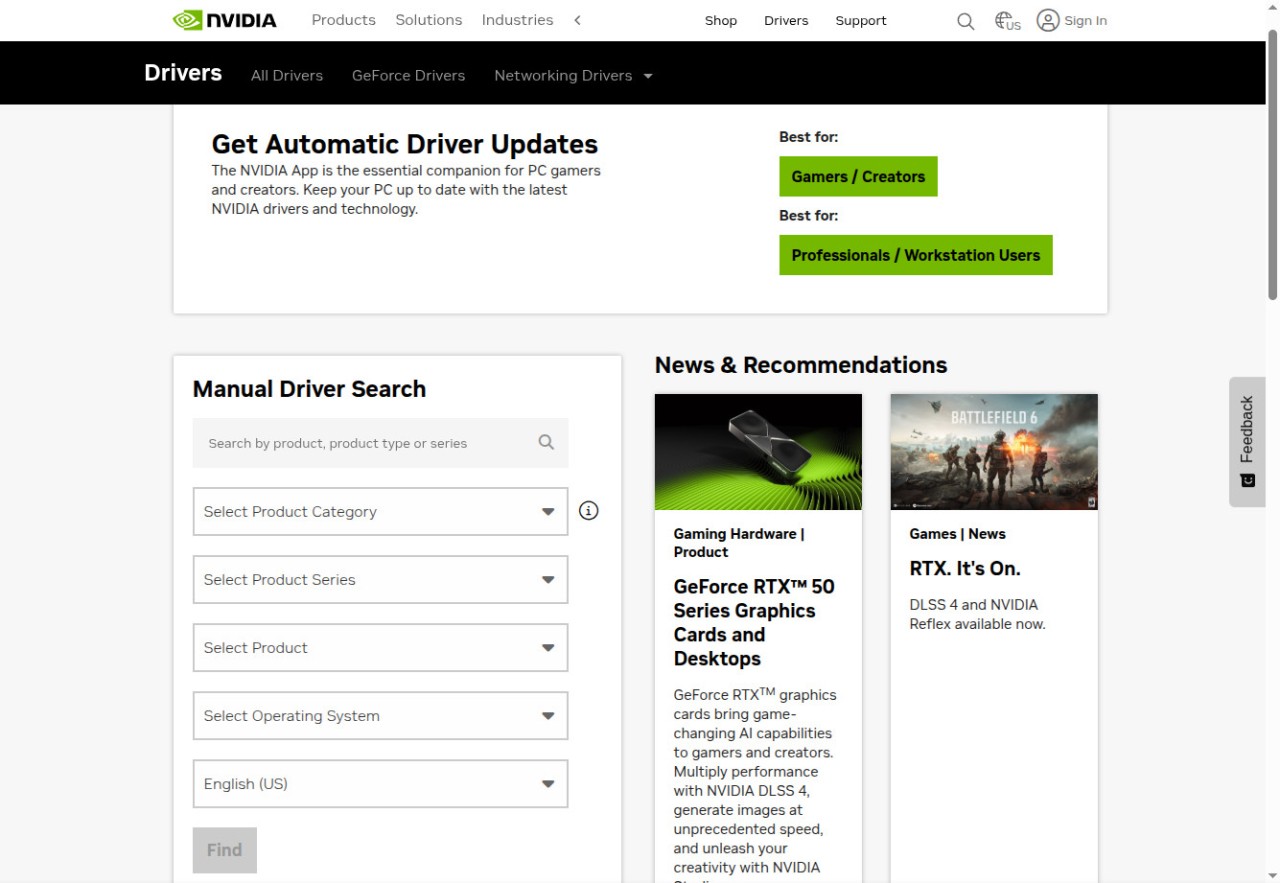
NVIDIA provides official software drivers for its graphics cards, networking hardware, and other related technologies. These drivers are known to serve as interfaces between NVIDIA hardware and operating systems to enable the system to utilize the hardware appropriately. Graphics cards cannot perform optimally or can even malfunction without having appropriate drivers.
NVIDIA drivers are regularly released to enhance compatibility, correct bugs, and add support for new hardware or software. Players install new drivers so that their computer performs better or achieves easier gameplay in new games. Animators and developers are using them to provide stability and adequate support to applications that are highly dependent on graphics processing, including video editing, 3D rendering, or artificial intelligence.
The drivers are manually installed by choosing the specific product and operating system; instead, they can be addressed using tools provided by NVIDIA that allow keeping drivers up to date. The NVIDIA drivers do not support personalizing or automatic optimization of hardware; their primary task is to make sure that all hardware functions as it is supposed to and remains compatible with the current software and operating systems.
What Are the Key Features of NVIDIA Drivers?
Hardware compatibility is one of the features of NVIDIA drivers. They are compatible with a great variety of NVIDIA graphics cards and applications, which guarantees that the operating system can communicate with the hardware in question. Such support is for gaming, creative loads, and professional.
Regular updates are the other characteristic. Every week, NVIDIA issues driver updates; these updates are aimed at resolving problems, enhancing reliability, and supporting new games/applications. These updates can also contain performance improvements or bug fix depending on user feedback. There are those drivers that are optimized to support gaming, and there are drivers that are aimed at workstation or professional usage.
There are also advanced technologies that NVIDIA has developed that are supported by NVIDIA drivers. These could entail graphics improvements, AI-driven functionality, and system-related optimization, which is dependent on having drivers that are supported properly. AMD Linux users: NVIDIA has been providing official drivers, and a number of Linux distributions have their own packaged version, which may work better with the system.
On the whole, the drivers are devoted to reliability and compatibility instead of introducing new tools and features. Their role will be to make sure that NVIDIA hardware runs properly and consistently in various systems.
Is NVIDIA Drivers Free to Use?
NVIDIA drivers are indeed free to use for standard consumer and professional systems. The NVIDIA hardware does not require the user to pay to install or update drivers. Certain enterprise capabilities might need additional licenses; however, standard drivers themselves do not carry a cost.
Which Platforms Support NVIDIA Drivers?
The NVIDIA drivers are compatible with many operating systems and platforms. They can be found on Windows gaming PCs, creator systems, and professional workstations. There can be different versions of the drivers that are based on the type of user, such as a gamer or a professional user.
Drivers are also offered by NVIDIA for Linux systems. Nevertheless, most Linux distributions carry packages of their NVIDIA drivers as native package managers. This is because the distribution-provided drivers can potentially be more seamlessly integrated with the system than manually installing drivers available from NVIDIA.
In the case of macOS, NVIDIA provides drivers related to CUDA in certain specific application scenarios, but overall graphics driver support requires the system policies provided by Apple. Enterprise environments such as virtual setups of GPUs are also supported by NVIDIA drivers, and authorized users may access the drivers and software in NVIDIA enterprise portals.
What Are the Best Alternatives to NVIDIA Drivers?
NVIDIA App is an associated alternative but an assistant tool to NVIDIA drivers instead of a substitute. The NVIDIA App assists the user in updating his or her drivers automatically. It saves the control of the need to search manually to find the right version of the driver for a particular graphics card. This will be of particular use to gamers and creators who desire to receive updates promptly, without the additional effort. The app is, however, still based on the official drivers of NVIDIA and is not a driver solution by itself. Many users prefer to download the NVIDIA App to make driver updates easier and more automated.
The other option is AMD Drivers, which are applied to machines with AMD graphics cards. The same can be said about AMD drivers, which allow the operating system to be compatible with AMD GPUs. They are updated regularly with performance improvements and bugs, as well as support for new games or apps. These drivers can only be used in a system that uses AMD hardware, but not in one based on NVIDIA. The AMD drivers are usually selected by the users when the graphics cards installed on the system are of the Radeon type rather than the NVIDIA. Users typically download AMD drivers when their system is built around Radeon graphics hardware.
The third alternative is the DriverPack Solution, which is a third-party utility that is used to install and update all types of hardware drivers in one keystroke. It may be handy in the case of establishing a new system or schools in need of drivers missing after an operating system reformat. The number of devices supported by DriverPack Solution is vast; it supports network adapters, sound cards, and graphics hardware. Proficient users also tend to use official drivers, which are more stable and controlled. Some people download DriverPack Solution to quickly restore missing drivers after reinstalling the operating system.