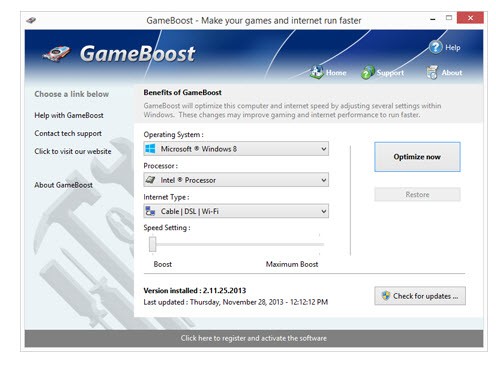
GameBoost is a Windows performance-tuning software that can be used to make games run better by tweaking the system settings rather than modifying the game files or the graphics card firmware. Since Windows is a general-purpose OS, it has numerous backgrounds and services that most players do not require when they are playing. GameBoost is an optimization utility that adjusts the registry keys, CPU priorities, RAM usage, and network behavior, and frees up more resources for the game. Neither is it a hardware upgrade; it merely makes use of additional performance on the already existing PC.
GameBoost is based on a simple concept: prioritize your game over other chores. When a game is running, it suspends or disables Windows services that are not needed and reinstates them when you are done. This has the capability of reducing frame drops, input delay, or stutters due to background activity. It comes in particularly handy when a system or a laptop is older and therefore cannot run new games, and can also be used to implement small network optimization, which will help lower the latency when playing online. GameBoost does not rewrite the game or overclock hardware aggressively; rather temporarily alters Windows into a gaming OS.
What Are the Key Features of GameBoost?
GameBoost is a combination of two conceptualizations: the tuning of system performance and network optimization. One such attribute is tuning of the system in real time. On game launch, GameBoost prioritizes CPU scheduling to ensure less important applications in the background are not granted higher priority than full-screen applications. This minimizes the possibility of random tasks in Windows capturing CPU time when playing the game. It also makes changes to registry settings to enhance memory efficiency and drive access speeds. These customizations are similar to what advanced users could technically do, but the software does it automatically.
Internet maximization is another attribute. GameBoost alters networking settings including packet handling and buffer sizes to provide users with a more predictable online game connection. It may not be able to make your internet any faster than what your provider provides, but it can be able to level out minor lag bursts generated by inefficient packet processing. It also reduces latency in particularly in multiplayer sessions, making the online experience smoother with the program.
GameBoost is user-friendly because it does not confuse users with technical terminology. You do not hand-edit the registry keys, but you simply press a boost button. The tool does not inject game files, which avoids anti-cheat problems. It also has a light overclocking-like feature that takes CPU prioritization and system scheduling to the next level by pushing more towards gaming without changing clock speeds.
This is aimed at reducing the number of interruptions at the beginning of games and running without background distractions. It does not require drivers to be installed or the firmware of the GPUs to be altered, and thus is a safer choice in the face of non-technical users who prefer smooth gameplay.
Is GameBoost Free to Use?
GameBoost is not fully free. It provides a free trial version that allows trying some features before buying a license that would provide access to all the optimization settings and automation. The free version demonstrates the preview of what the program can do, whereas the paid version provides the possibility to customize everything and use all performance-tuning options.
Which Platforms Support GameBoost?
GameBoost is aimed at operating systems based on Windows. It is compatible with both older and newer versions of Windows, including Windows XP, Vista, and 7, and Windows 8, 10, and 11. It is available in both the 32-bit and the 64-bit versions. Since it only deals with the Windows registry and system services, it is highly coupled with Windows architecture. This is why it can not be run on macOS or Linux; on these platforms, management of resources is done differently, and a tool such as GameBoost would not work in the same manner.
GameBoost will not need unique hardware. It is based on regular GPUs and CPUs and works provided Windows is present. The primary one is access to administrative privileges to enable the software to change system settings. Upon installation, the user opens GameBoost, picks the target of performance, and implements the changes. There is no need to restart, and when the gaming is finished, the user is able to switch back to the usual settings.
What Are the Best Alternatives to GameBoost?
One of the popular free alternatives is Razer Cortex, which blocks background software and liberates RAM when a game is started. It does not alter the registry settings and networking parameters, as GameBoost does, but seems to free up memory and processor resources efficiently by temporarily terminating non-essential processes. Cortex is also an interface that can be used to access a game library and is integrated with Steam and other launchers, and with a cleanup tool and FPS monitor. It does not require any payment and performs well in middle and low-end PCs.
The NVIDIA App is also available, but instead of enhancing the work of Windows, it is dedicated to the performance of GPUs and driver configurations. It allows users to update drivers, adjust GPUs, and apply filters of DLSS or Freestyle, and have it capture gameplay through ShadowPlay. Although it is not able to control background services and tune networking, it takes full advantage of the potential of the graphics card and stabilizes the frame rates of NVIDIA-GPU owners. It is more sophisticated and can be offered to gamers who desire to have direct control over graphics quality and performance.
PC Game Booster (GameFire) is equal to GameBoost, as both of them work by disabling services and reallocating the system resources to provide a more comfortable gaming experience. The software provides comprehensive control over Windows services and processes, allowing the user to select which tasks remain active when playing games. It has utilities such as disk defragmentation and performance monitoring. GameFire makes more drastic system changes, similar to GameBoost, whereas background processes are only suspended by Razer Cortex. It targets users who prefer a more hands-on experience, as well as users who are not afraid to tweak more settings.