It’s being reported that Valve could be on track to make $20 billion this year from Steam. Claims by Alinea Analytics suggest that Steam made $1.7 billion in September 2026 alone, $5.5 billion in Q3, and $16.5 billion so far this year. And these figures appear to be just from game sales alone, not hardware. So what’s a private company making the same money a year as the entire nation of Madagascar to do with all that cash? We have a few ideas.
Valve has, to its credit, never gone public, meaning the company has never had shareholders to answer to. That also means that all that money and the resulting profit (given they’re private, we have no idea what the company’s outgoings are) gets to stay within or get paid out in dividends. There’s a reason Valve founder Gabe Newell not only owns luxury yachts, but owns a company that makes luxury yachts. The point is, Valve is not short on money, clearly spending nowhere close to the amount that’s coming in.
And let’s be very clear: the vast majority of what’s coming in is money taken from the developers and publishers making and selling the games. 30 percent of every sale on Steam goes directly to Valve, a figure that’s been heavily criticized for many years, but one on which Valve appears immovable. And with 20,000 games launching on Steam every year, and something that could be described as a monopoly on the PC games market, it’s hard not to see such astonishing profits as coming at the expense of tiny independent development teams in ways that are potentially predatory. It’s not unusual, it’s how stores work, but then capitalism is by its very nature predatory. It’s kind of the point. But at the same time, Valve presents itself as something other, something different, and relishes in its moments of altruism or community championing. And, given it’s a private company that depends on the developers who have little choice but to sell on its store, I’d like to see those profits making real change in a very broken industry.
This isn’t about being naive. Clearly the big bosses that Valve lies about not having do exist and want to stay rich, and obviously the company has some astonishing bills to pay. But twenty billion dollars in a year. There’s a fair amount of wiggle room here. So what could Valve do with that cash that would make a real difference?

Reduce the 30-percent cut
Many have tried to get Valve to reduce its 30-percent fee, and all have failed. Epic was the most recent big name to have a go, launching the Epic Games Store with its 12-percent cut that now only kicks in after a game has made its first million dollars. Which means, for the majority of indie developers, the store is essentially free to use. The downside is, you also don’t sell many copies because few people buy anything from the Epic Games Store other than Fortnite. For many years, developers would go there not because of the better sales deal, but because Epic would (and the company has never acknowledged this, but I’ve been tipped off by plenty of developers) sometimes pay the entire development budget of your game if you gave them a year’s exclusivity over Steam. It would be ludicrous to turn down a deal like that, and the option has extended the lives of many an indie studio to a second or third game. But those good times are over, as this year Epic laid off 1,000 employees, and Epic itself says that profits from the store are “low.”
But there’s a middle ground. And it’s one that Valve has not only never explored, but actively rejected in the most disgraceful way. In 2018 the company announced that all games would be charged 30 percent until they made $10 million. After that, the cut would be reduced to 25 percent, and then down to 20 percent at $50 million. So the way the store operates is that the smallest games get charged the largest fees, while the most outstandingly successful AAA games hand over less and less the more money they make. What?
Clearly, given that the bulk of Valve’s profits are certainly not coming from the 30 percent it takes from the bedroom developer who sells 5,000 copies of their $20 game, why not free that person from such onerous fees? That $30,000 Valve takes from that dev could make a life-changing difference, while for a larger corporation, it’s simply the cost of doing business. Epic’s model is clearly designed to cause more headlines than profits, but it’s hard to imagine Valve becoming at all impoverished by freeing indies from paying the tithe on their first $100,000 or even $200,000.
Create a developer panel
There are, at any time, a long list of indie developers and indie publishers who are known for their passion for helping other indies succeed. There are those who create entire suites of tools to aid them, deliver seminars on their own best practices, personally mentor, and so on. Ask any indie developer who they are and you’ll get a list of names. Valve needs that list of names.
Invite those people onto a committee, a panel, whatever you want to call it. And then just listen to them. Hear what developers need, and then scoop from the infinite money mines to try to put it into practice. Listen to their feedback, respond quickly when told it’s not working, lean in further when told that it is.

Curate the store in-house
This is always one of the most controversial suggestions, but it’s crucial to remember now that Valve, at one point, was extremely active in curating which games could appear on Steam. Soon after the service first launched in 2003 it was companies Valve hand-picked, beginning with Rag Doll Kung Fu and then the likes of PopCap and Introversion, before a gradual trickle of bigger-name publishers started slowly adding their back-catalogs to the store. Activision, Eidos, Ubisoft, and EA were all very wary of Steam, unsure whether it would cut into their launch sales in a way they weren’t ready for, only trusting Valve with classic games that were no longer selling in boxes.
By 2012, the Greenlight system was added, a deeply flawed system by which indie developers could pitch their games as worthy of being on Steam. These would then would be let through in batches of around 100 based on voting interest from potential customers. In 2017, Valve switched to Steam Direct, where absolutely anyone could submit a game to Steam with a small fee and almost everything got through. And that’s pretty much where we still are now, a near free-for-all where thousands of games appear every month, with human involvement seemingly minimal and irrationally deployed, while the store is flooded with questionable content.
If there were a good answer for how to stem the flow of absolute bilge onto Steam, Valve would likely have implemented it by now. But there is a way to better allow the good stuff to surface, and that’s active human curation. At the moment Steam primarily relies on its algorithms, and every other month we get a new story telling us how badly or how well these algorithms are currently supporting smaller games. But why not just get more people involved? Valve could employ 50 people at $100,000 a year, for a cost of $5 million. That’s a lot of money, until you calculate that this is 0.025 percent of 2026’s potential income. And make sure those 50 people have wildly different tastes, with folks among their number who love the weird sex stuff too.
It’s easy to spot what’s an asset flip and what’s a vibe-coded knock-off, let alone what’s a two-color “platform game” that someone inexplicably paid $100 to upload to the store. Ignore those, and look at what might be interesting. It takes less than five minutes to know if something is utter bilge, and enough people being paid to play enough games each day could easily allow for a behind-the-scenes boost to visibility, before you even start considering something as overt as “Valve Recommends.”
Do something about reviews
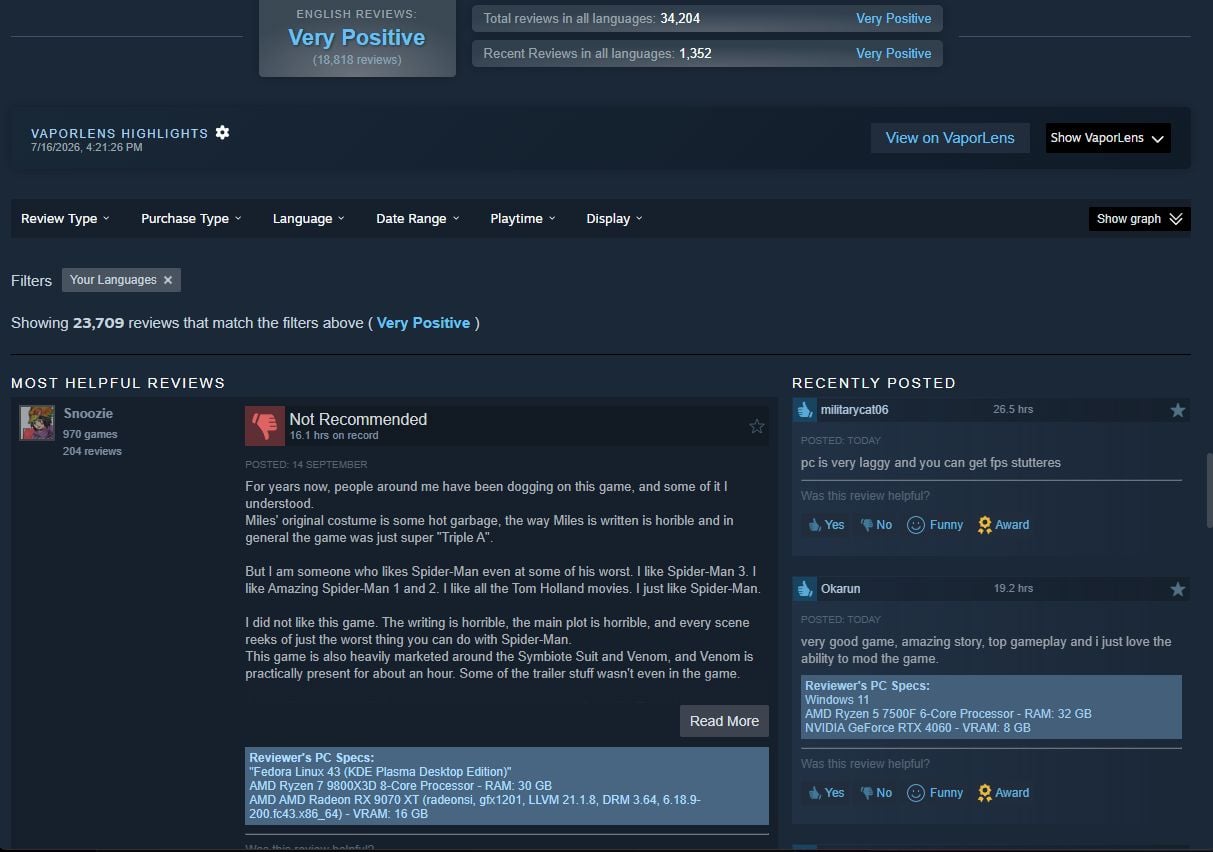
Valve’s review system is poor. You can either say a game is good or that it’s bad, a binary choice that leaves no room for nuance. And while five-star rating systems are also generally very flawed, with the vast majority of people opting for five or one stars, there surely has to be room for a middle ground. A “fine.” An option for a game that someone doesn’t love, but also doesn’t hate. Steam’s current system averages scores out to report such a middling view anyway, despite that number being artificially constructed from a mad confusion of 100 percents and 0 percents.
The question the review box asks is a good one. “Do you recommend this game?” So offer sensible replies to that. At the very least, Yes, Unsure, and No. There are so many ways to prevent review-bombing from being the first thing people see when they glance at a game’s store page. There’s room for so much more inventiveness in how Steam can allow reviews to be delivered. There’s so much scope for A/B testing, for throwing ideas at the wall (while still maintaining the current system for continuity). Use the panels. Survey the people who successfully use the store. Spend some of this vast fortune finding out.
Invest in inventiveness
So much of “how to fix Steam” has yet to be thought of. But imagine having near-infinite resources, having more data on gaming sales than anyone else in the world. Imagine all the potential that lies in that data to point to great new ideas!
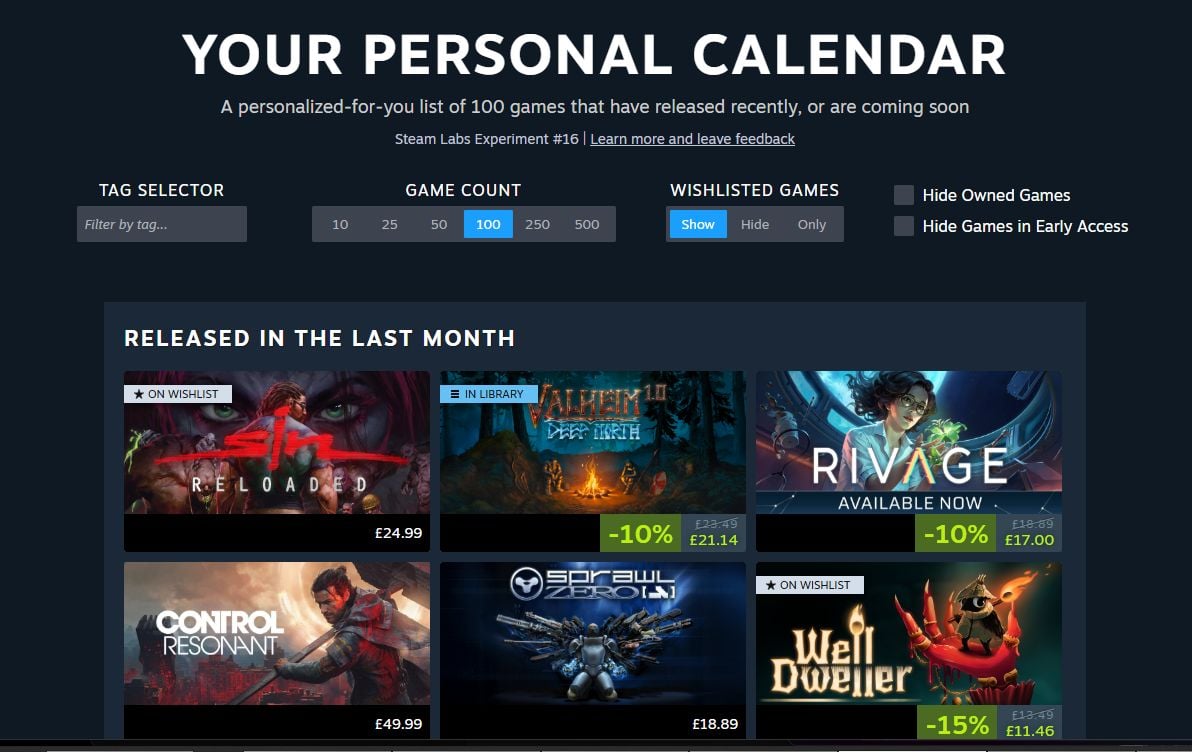
Occasionally, Valve does have successes in this area. Personal Calendar, rolled out this time last year, shows customers the recently released and upcoming games the algorithm thinks they might be interested in. Indies are saying it’s an effective way of getting their games in front of the right people. It’s essentially a Steam Sale-style page that’s just for games you’re likely to be interested in, grouped by releases in the last month, the last seven days, and games coming soon to add to you wishlist. And it works great for me. The only real problem is that you kind of have to already know it’s there to find it.
You’ll find it if you click on the “Recommendations” tab near the top of the screen, but that’s not a big bright button and hardly draws your eyes. This could be featured so much more effectively on everyone’s Steam front page, especially during the incessant sales that shove absolutely everything new about three billion scrolls down the screen. And yet, even in this form, it’s reportedly helping.
There’s so much more like this that can be done. What? Well, Valve can pay me to think those up. Or ideally a team of people. Try so many things, and vitally, listen to the developers when they say it’s a disaster, or how it could be better. In fact…
Actively make the world a better place
Hand a billion dollars over to Médecins Sans Frontières.