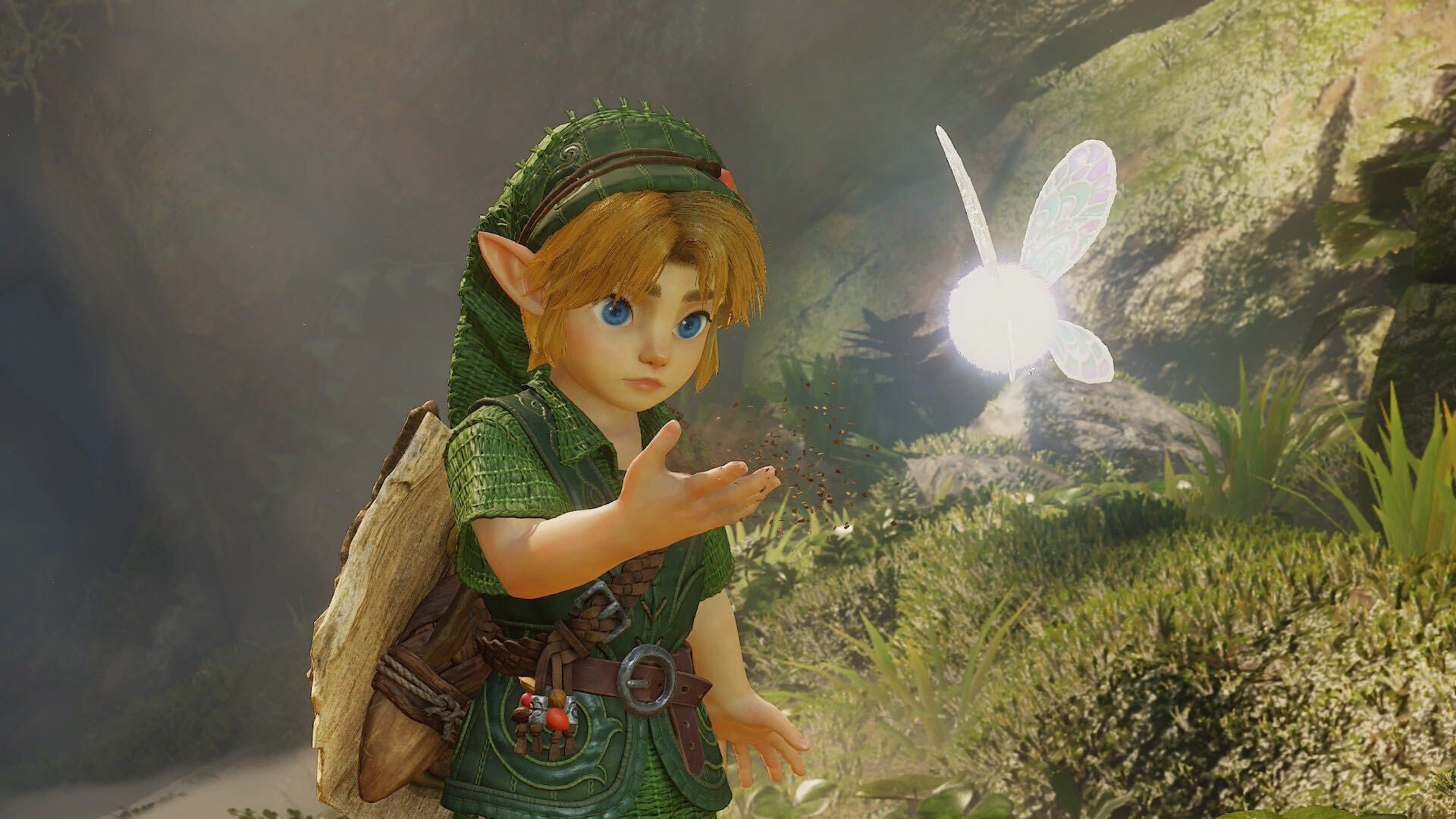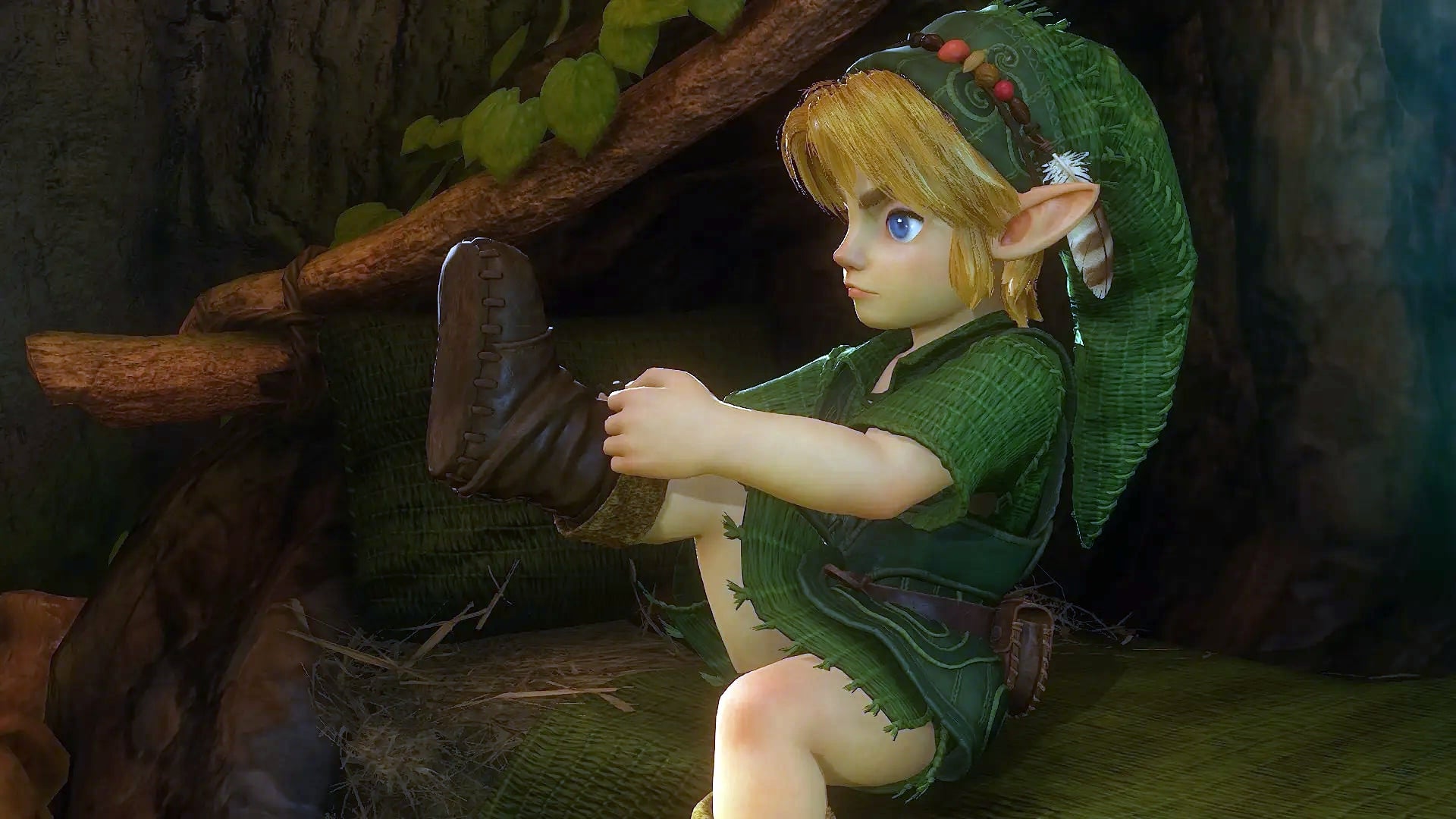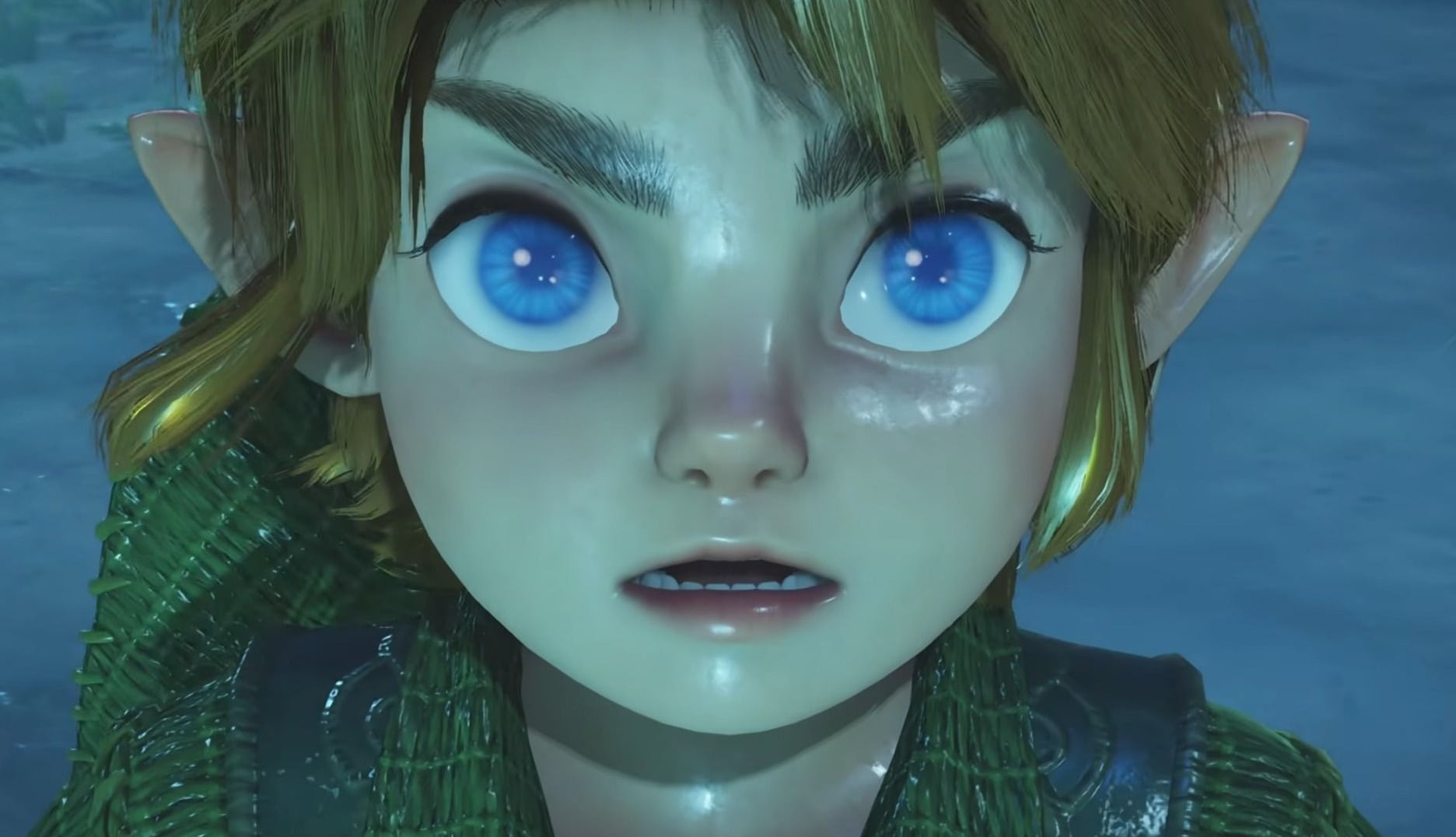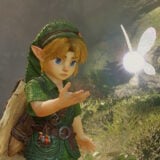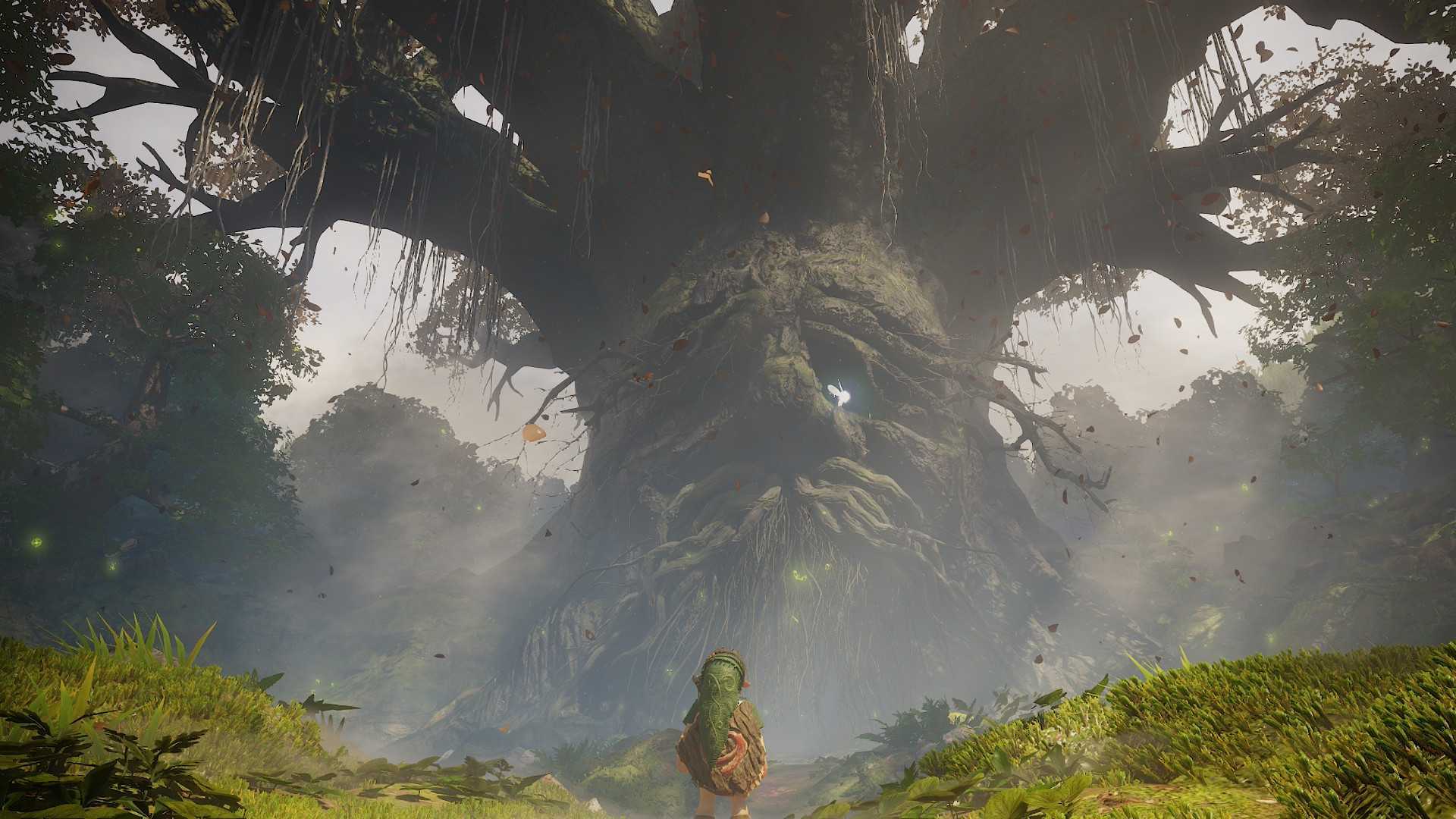
Wow! The Legend of Zelda: Ocarina of Time is beautiful, yes, certainly the loveliest game Nintendo has ever made. The details, the colors, the sounds, the constant movements of individual leaves in light breezes, the ripple of water…wow! It’s dazzling! The stitching on Link’s tunic. All the unique bits of foliage that rustle as you walk through, the way nothing seems to obviously clip into anything else. The gentle reactions when you bump into NPCs. The attention to detail, everywhere, in the characters, the pacing, the way dungeon mechanisms work, everywhere you look, so much.
One of the Kokiri has a line at some point about how they and the fairies all sparkle and shine, and these visuals have committed to that descriptor. I didn’t want to leave the forest. But also I really, really did, especially after a little over an hour playing last night. Because it almost feels extravagant, like a just slightly uncomfortable excess, especially after having played the sparse original so recently. This new visual density fills in gaps where the imagination used to do the work. I stop more than short of shaking my fist at this, decrying kids these days for having no creativity. I think the abundance of Kokiri Forest, rendered this way, is wonderful, but it also leaves me with a wistfulness for something a bit less much. I don’t know where the line of “exactly the right amount of everything” is, and I certainly think toeing it would be a worse decision than this. I just can’t help but feel a bit unnerved by it.
And the dialogue! At first, my gut reaction is that everyone talks too damn much. The game’s introduction felt interminable. Saria strikes me as corny and tedious. Why? I sat down and compared the dialogue from the original to this, and most of it isn’t much longer in the new version. Some of it is even basically the same. So what’s the difference?
Is it the presence of voice acting? Maybe. I love a good voice performance, but I have historically struggled with remakes that add voices where previously there were none. You’ll never stop hearing the characters as they were originally heard in your head, and the “real” voices will never feel right. But more regrettably, adding fully voiced cutscenes means that Nintendo felt compelled to make sure every character got to participate. Especially Navi. No matter how useless it is to the conversation that she speak.
Here, compare. This is the dialogue of the Deku Tree to Navi in the original game, before sending her to get Link. Navi does not say a word until after she leaves:
Navi…Navi, where art thou? Come hither…Oh, Navi the fairy…listen to my words, the words of the Deku Tree. Dost thou sense it? The climate of evil descending upon this realm…Malevolent forces even now are mustering to attack our land of Hyrule,….For so long, the Kokiri Forest, the source of life, has stood as a barrier, deterring outsiders and maintaining the order of the world. But…before this tremendous evil power, even my power is as nothing. It seems the time has come for the boy without a fairy to begin his journey…The youth whose destiny it is to lead Hyrule to the path of justice and truth. Navi…go now! Find our young friend and guide him to me…I do not have much time left. Fly, Navi, fly! The fate of the forest, nay, the world, depends upon thee!
Here’s the comparable version in the new game.
Deku Tree: It would seem…I have but a little time left…My heart feels heavy. Soon I will no longer be able to protect the forest. I must ensure its safety. I will entrust everything to the child. Navi…Little Navi, where are you?
Navi: Yes, Great Deku Tree. I’m here! How can I be of service?
Deku Tree: Ah, there you are. I have something to ask of you. I hope it is not too much. There is someone with whom I must speak. bring this young one to me.
Navi: Of course. But…who is it?
Deku Tree: The only child in the forest without a fairy companion. His name is Link.
Navi: Understood. I’ll go get him!
The first version is certainly fantastical. No one talks like that, with thees and thous and such, and it’s very much video game writing of its time in its unnecessary grandiosity. I won’t pretend that’s high literature or anything. But I hate the new stuff more, which comes off like an overwrought children’s play. I feel the same way about the Deku Tree’s later lines to Link (with Navi’s interjections), all the conversations with Saria, and Kaepora Gaebora’s truncated greeting of Link at the entrance of Hyrule Field. Pretty much any major story cutscene I’ve seen so far has felt off to me like this, full of unnecessary detail and oddly stilted ways of speaking.
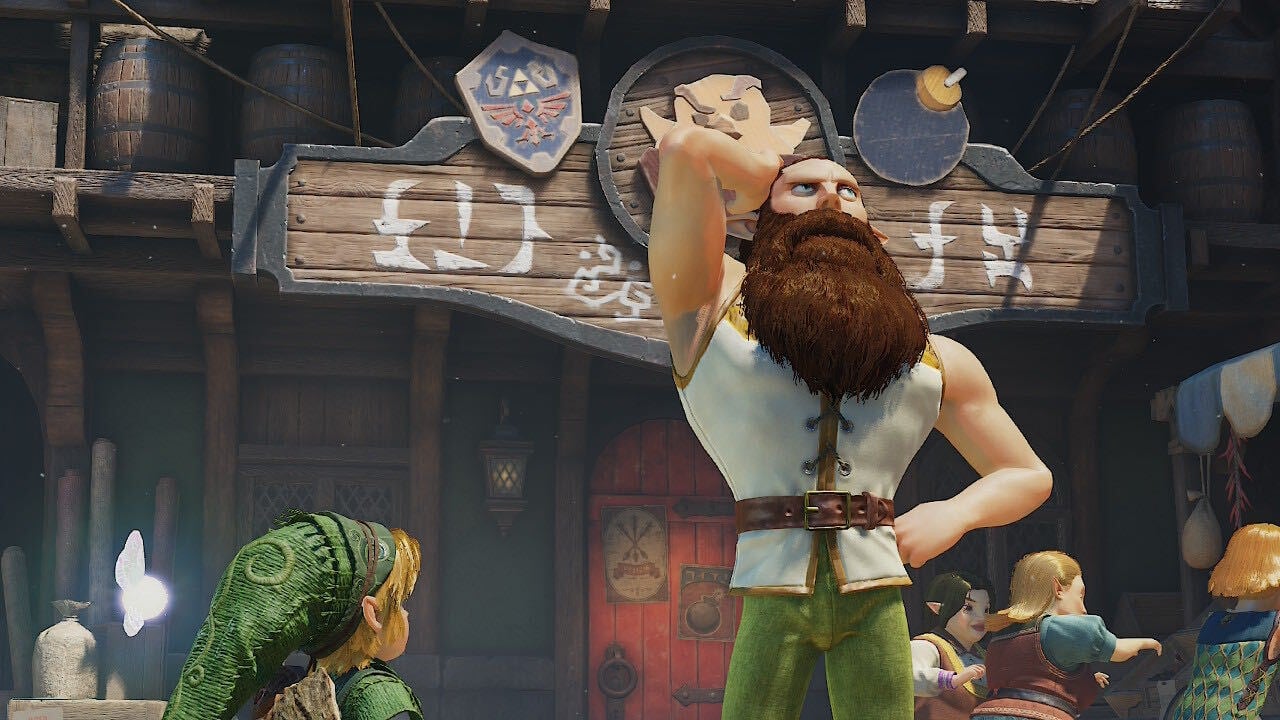
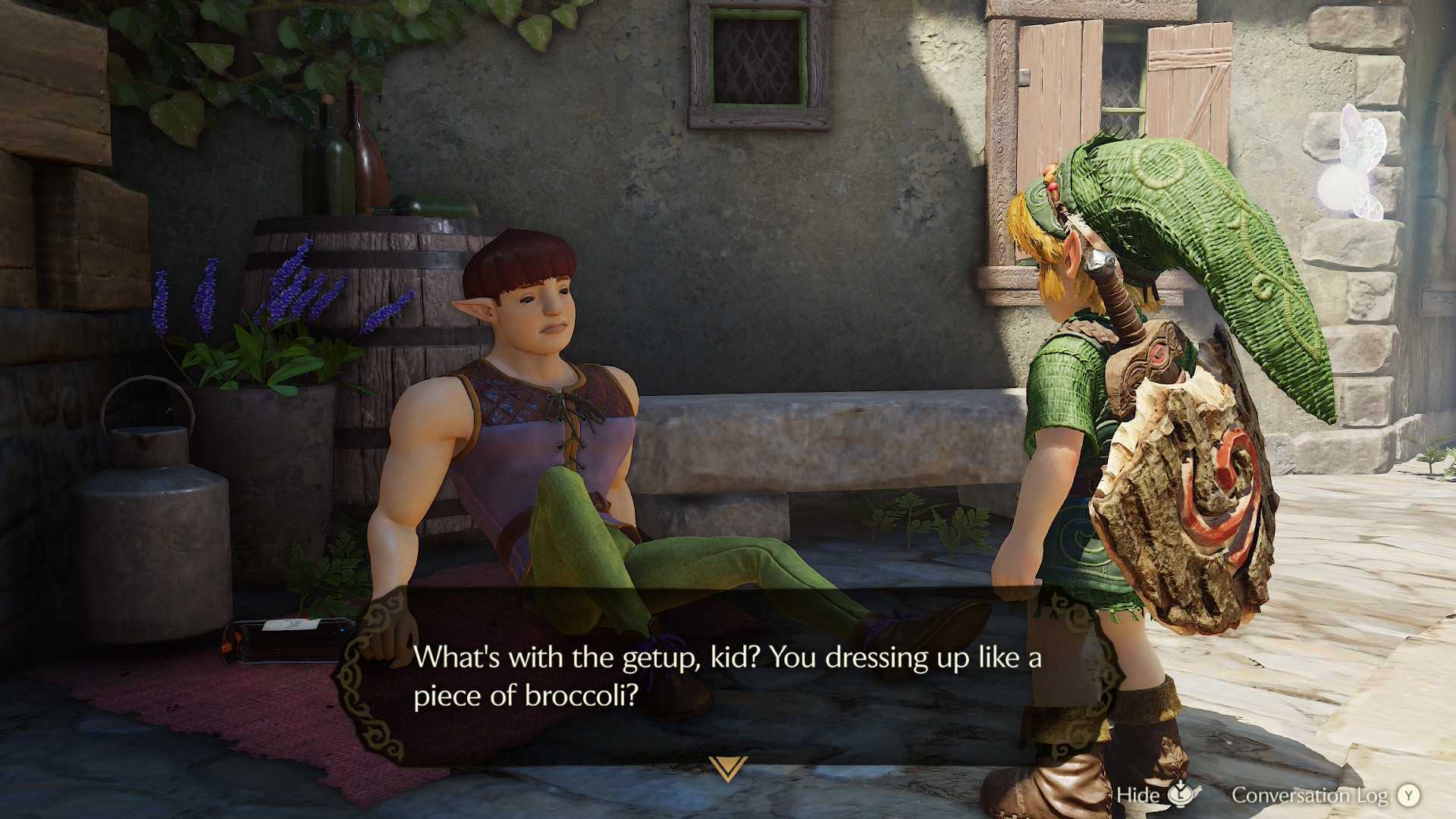
The NPC dialogue in between all this is, of course, far better, and thank God for that, because I love Ocarina‘s cast of weird freaks. It helps that most of their lines audibly sound the way they did in the original, even if the words have been tweaked, because they get some sort of vocal exclamation (“Ah!” “Oh!” “Ohhhhh?” “Aha!” etc.) and then written text for you to fill in as you like mentally alongside appropriately over-the-top animations. Mido remains a delightful loser, road signs are still rife with great jokes, and the developers somehow managed to improve the beggar who desperately and with wild gesticulations pleads for you to sell him something. There are even some new guys, like the beard guy in Castle Town, who I feel would have fit right in in the original game even if he’s very clearly like Guy #10 in a lineup of NPCs intended to encourage Link to follow the story and go to the castle, just in case you hadn’t figured out that’s where you were supposed to go yet.
I also can’t fully knock the effect that a more detailed game has on the gravitas of Ocarina of Time‘s story. After you’re finished with his dungeon, the Great Deku Tree dies. In the original, this was sad, but visually it was hard to convey anything meaningful was really happening here, and I’m not even sure I fully clocked how significant things were when I played. In the new Ocarina, there’s no doubt. I found this scene very beautiful, and I think I understand better now why a highly detailed 3D model of the Great Deku Tree was part of the main inspiration for the remake’s look and feel. Go watch this one for yourself, please.
Heading into the meat of the game’s main quest as I reach Hyrule Castle, I’m thinking a lot about what it means for a remake to be “faithful.” By any definition, this Ocarina of Time is a faithful remake. There are slight changes to item positioning and mechanics, but the core remains the same. Even so, my impression thus far is that the Ocarina of Time remake is tonally quite different from the original in a hundred small ways, all of which add up, but not into a single coherent something. I don’t think it’s as simple as saying it’s a lighter game, or more child-friendly, more fleshed out. I can’t sum it up, not yet. And I’m already feeling how reductive it will inevitably be to try and call this better, or worse, or anything more or less than its 28-year-old predecessor. They’re one story, but two totally different experiences, as if made for two different worlds, or even timelines—thank Hylia, I guess, that that’s the sort of timeline nonsense Link has been messing around with for decades now.