
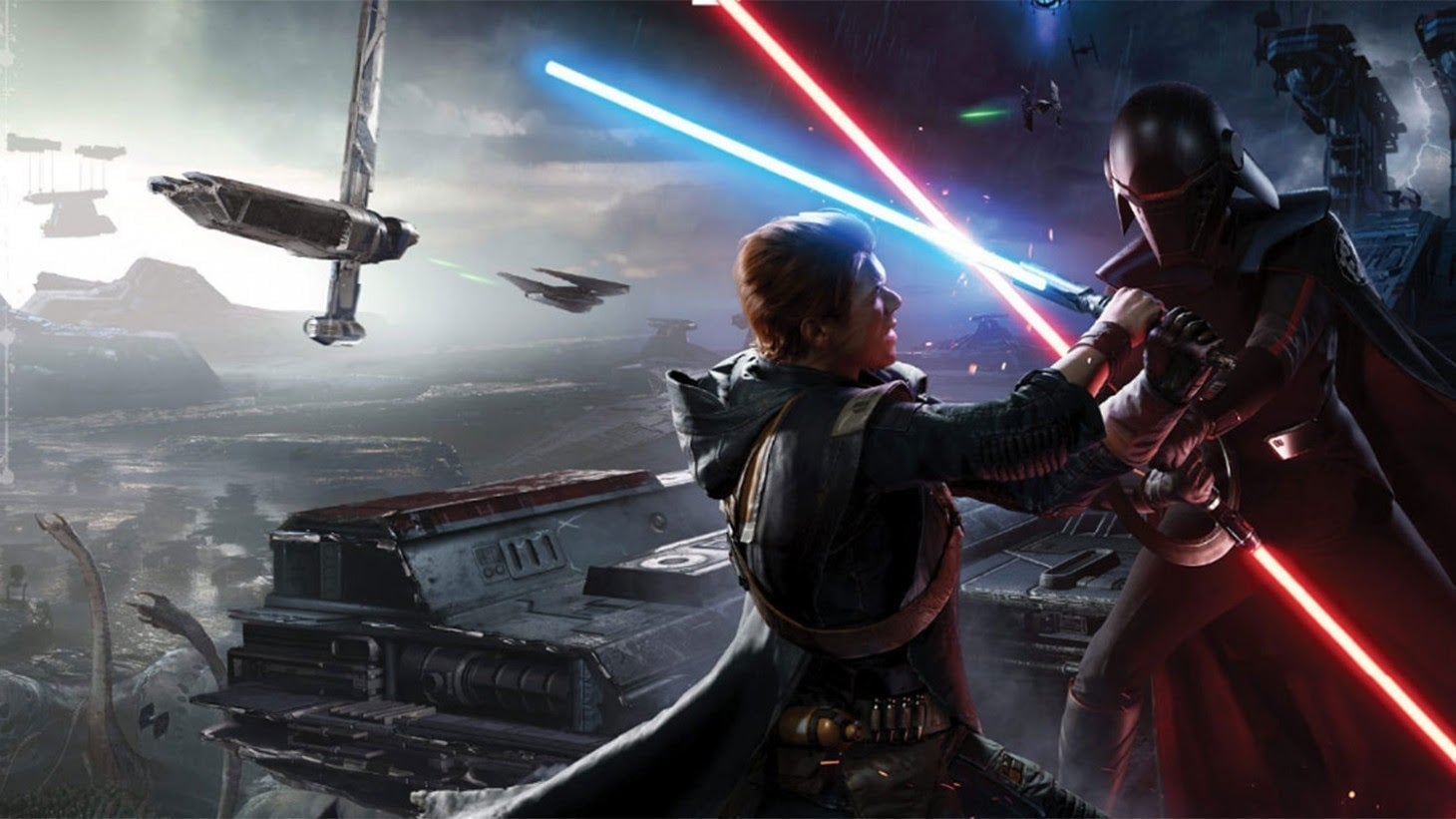
Star Wars Jedi: Fallen Order combines the DNA of various games into its own unique blend of action and exploration. When it comes to combat, that means pulling lessons from games like Dark Souls, like pattern heavy bosses and resting points for upgrading abilities. As I explore distant planets there’s a sense that something feels off.
Dark Souls and games that have followed in its footsteps have a reputation for difficulty. In these games, enemies hit hard, and it’s easy to get overwhelmed. Combat is a combination of focused duels where you lock on to dangerous enemies and more freeform battles where you attack with wide sweeps to take out groups of disposable minions. The ebb and flow of these games, which Fallen Order often emulates, involves running into pathways of enemies that test a player’s ability to swap and move from one form of combat to another. A large clearing with a singular monster will lead to a tight corridor with one dangerous melee foe and a few blaster-firing goons. Fallen Order gives players plenty of tools for dealing with these types of enemy arrangements. You can use the Force to slow enemies down, or you can parry at the right time to then counter with a powerful strike, or you can block incoming laser bolts or even send them back at your enemies. You have more tools in Fallen Order than in a game like Dark Souls or Nioh. Yet, playing last night, I felt oddly disadvantaged.
Some of this is certainly due to the fact that I’m still learning the combat’s quirks. Some of this is because I played late at night after having a handful of drinks at a bar. Some of this is because I went to Dathomir first, which I was told is the “hard” option of your potential planetary sojourns (I wanted a challenge). But as I played, a defining problem began to emerge: Fallen Order lacks consistency. You cannot rely on its world, or in the efficacy of your tools, in the same way that you can rely on these things in a game like, say, Sekiro
While playing Fallen Order, I’ve seen a considerable amount of delay in enemy spawning. This means that I can enter an area or leave a safe point, travel down a path, and then have enemies spring into existence behind or around me. Fallen Order’s combat works best when you’re locked onto enemies, a design choice that makes it much closer to Nioh or Sekiro than Dark Souls. Finding yourself suddenly surrounded by poisonous bug-mite beasts or cudgel-swinging Dathomiri Nightbrothers is a problem, and one that’s made worse by the fact that optimal parrying only can happen when you center yourself and focus on what’s in front of you. I’m sure some readers might quibble, since Fallen Order’s actually really good about letting you block laser blasts from every direction, but I stand by this assessment. Overall, the game’s combat encourages locking on, which requires a consistent world wherein you know where enemies will be, even if you die and respawn. Fallen Order, in my initial experience, doesn’t have that.
In the clip above, I’ve just died to an enemy ambush after a few baddies popped in around me. Dismayed and a little inebriated, I moved from the respawn point up to the stairs where I knew the enemies ought to be. I waited, as it took a few moments for them to spawn in—I’ve been playing on a PlayStation 4 Pro—and I responded by gracefully flailing about. As I attempted to turn and lock on to an enemy, pressing the right stick in instead forces my character to turn around to inspect a locked door. I cannot cancel this animation, so when I eventually try to dodge away, I am smacked in the head and die.
Dathomir eventually proved conquerable with some persistence. If you go to Dathomir as soon as it’s made available to you, you can’t really explore too much, except to gain access to your double-bladed lightsaber. Again, what made the process of exploring unbearable was how inconsistent the world was. I’ve played all sorts of “hard” games for Kotaku from Cupheadto Nioh and other games. While I’m unsure if they’ve ever been as difficult as some people seem to claim, they do provide challenging encounters. But these experiences feel fair because fights and exploration are repeatable under largely the same conditions, even if you die a few times. You can learn an enemy’s tells; you can understand when you’ve done enough damage to move into the next phase. Fallen Order’s lacked that in my experience. Enemies spawn randomly, a stray button press may or may not initiate an interaction that you didn’t want, locking onto targets might snap you to a monster on the other end of the room instead of the one in your face. When everything works, it’s an amazing experience. But because it often breaks in unpredictable ways, it somehow feels less “fair” of a challenge than even supposedly difficult games.
I adore Star Wars. I love Respawn Entertainment. Fallen Order is often a match made in heaven, the sort of Star Wars game I’d been craving since the halcyon days of Jedi Knight and Jedi Academy. Still, I’m not convinced that it’s delivered the sort of action it might have if all the pieces were working neatly. Instead of working through repeatable challenges, enjoying incremental but steady progress, each new room and encounter feels like a gamble. Will something break? How much can I rely on my memory of the last attempt? I can’t trust my experiences. I guess I’ll just try trusting the Force.