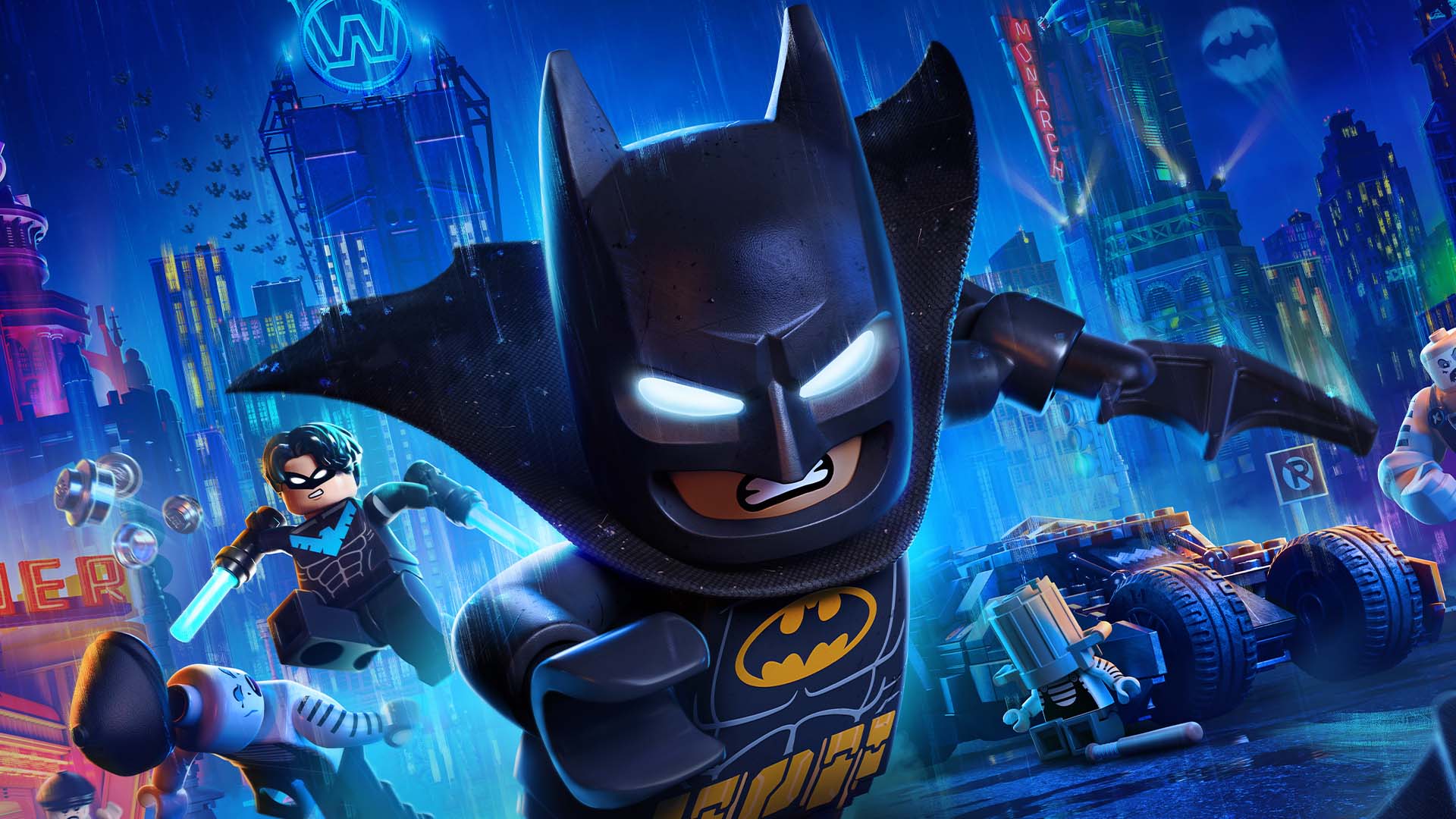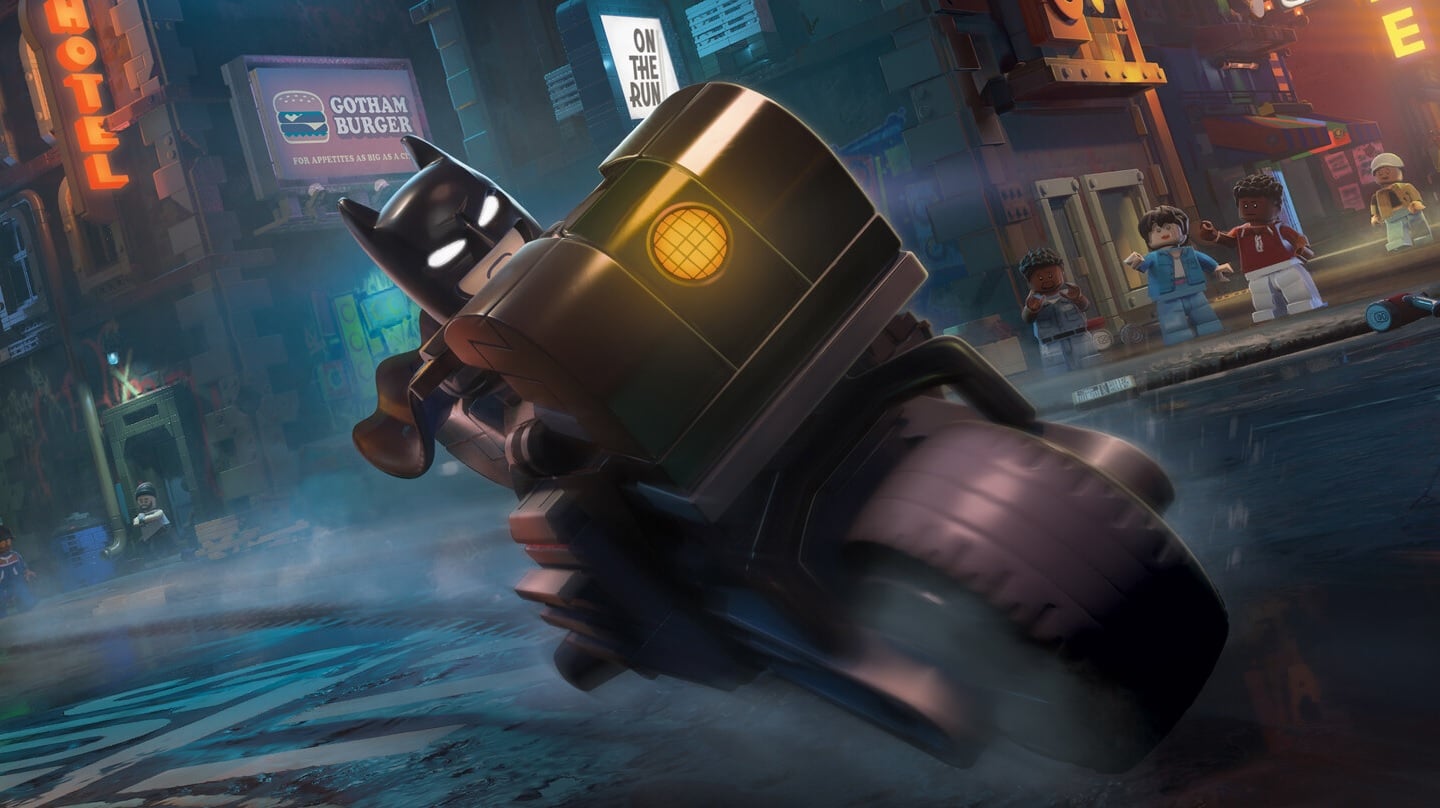
“The characters are powerful—the stories are powerful—because of the emotional connection that comes with those stories and with the character…The iconography that comes with it—the bat, the cowl, the bat signal—really hits home.”
This is what Jonathan Smith, Strategic Director & Head of Development Team at TT Games, tells me when I ask about the emotional element of Batman stories. I had just finished an hours-long preview of the new Lego Batman: Legacy of the Dark Knight, and while I had a great time, I came away unsure of how this quality might come through. Smith tells me it’s there, but that it’s leveraged through the presence of characters, vehicles, suits and other things that Batman fans already have an attachment to.
At that moment, I doubted him. I couldn’t see how references would satisfy my desire for the narrative to have some kind of emotional core. I was worried that mere recognition of familiar things from across Batman’s history wouldn’t be enough to draw me into Lego Batman’s story. Eventually, though, driving home from the interview later that day, I would be convinced.
I was also worried that Legacy of the Dark Knight’s inclusion of elements from Rocksteady’s Arkham series would compromise the core Lego experience of linear and cooperative play. Luckily, within the opening minutes of my preview session, Lego Batman revealed itself not as a game existing in the shadow of Arkham’s legacy, but as a game that fuses elements from the Arkham games with familiar Lego game principles to create something new.
Cristian Macias: I’m curious about the marriage of the Arkham elements with the more classic Lego gameplay, specifically co-op. Did the influence of single-player Arkham complicate the inclusion of co-op in the development of Lego Batman?
Jonathan Smith: The short answer is yes but let me give you a better answer. We knew with this game that we wanted to deliver a completely new kind of Lego combat experience. Batman’s the world’s greatest hand-to-hand fighter. We had to deliver an experience that matched that and rewarded players who wanted to live up to that standard of skill and tactical awareness—a combination of stealth and use of gadgets surrounded by many enemies. How do you react?
To do that we drew upon not only our heritage of action in previous Lego games, but other games, some of whom—I’m just going to talk specifically about the work of our friends and colleagues at Rocksteady—have so definitively embodied the experience in a video game of being Batman. But we had to make our own version of that developed system that worked for Lego characters in a Lego game with the gadgets that we’d chosen, with the enemy types that we’d chosen, and crucially, coming to your question, that worked well in co-op as well. It’s a very distinctive set of challenges, not just balancing. It gives a whole new dimension of capabilities to players to switch from one character to another, to move in their embodiment across the combat arena, and then to combine the effects of different gadgets, one on the other—to use Jim Gordon’s foam spray to incapacitate enemies and then use a concussive batarang from Batman to send them all flying. So much through painstaking prototype, iteration, and balancing the team was able to discover—synthesize—in the systems as you experienced today, and co-op is always in our minds.
There’s a fair amount of complexity here for a Lego game, particularly with the combat mechanics and the character upgrades. Was it difficult striking a balance between that mechanical depth and the approachability Lego games strive for?
Smith: We have to make deep, rich, interesting systems that will reward long-term gameplay. We have to do that because those are the games we enjoy playing. We’ve got a broad audience of players of all ages, and we want to deliver a rewarding, high quality experience that requires that depth. We also need to present those systems in a way that’s legible and accessible and straightforward for everybody. We offer a choice of difficulty settings, so you can play the game however you want. You can have a low-stress, very forgiving experience, notice the button prompts, stay on the main path; you’ll progress, you’ll feel like Batman. That’s fantastic. Or you can dial it up to Dark Knight mode where you’ll really need to use your understanding of the systems, use stealth to approach enemies from unexpected directions, use the gadgets in effective ways, use your upgrades to then give you even more power and capability in your combat encounters. Because if you don’t, you won’t progress. You’ll run out of hearts, you’ll be set back. That’s a completely new feature for Lego games.
I believe this game was developed in Unreal Engine 5. Were there challenges for the team in transitioning over to a new engine?
Smith: Correct. It’s always a challenge to do new things and we’re always doing new things. So for the last 20 years making Lego Games, challenge is the job, because you are always making something new, on new hardware, with new technology, going to new IP, expanding and developing new skills within the team. That’s the nature of the video games business. We’ve found Unreal Engine 5 has been a fantastic environment to make this game in, to deliver that rich, immersive Gotham City, and we are really, really proud of the results we’ve had with that.
I’ve been playing Lego games for a long time now. I grew up playing them. For me, when I look at Lego games now, there’s a fair bit of nostalgia that’s at play, leveraging all these sorts of bits for your inspirations. Obviously, this is the case for Lego Batman. Talk to me about that balance of leveraging nostalgia while still shaping your own story. I believe you called this game the “definitive Batman story” today in your presentations, but I’d just like to hear more about that.
Smith: So we are connected to the past with the characters that we play with. Batman’s got a history of over 80 years. We know that character from our past times. We read those comic books, we saw those movies, we played those Lego games when we were younger. So when you do a new game with Lego Batman in it, you are immediately connected with that past. You reactivate it, but you then have to make it new again, make it relevant, make it fresh. And we had a couple of really important approaches and starting points that gave us the confidence and the platform to do that for this new game.
One was the foundation that we built with Lego The Skywalker Saga as a really big, immersive game that changed the camera system from what it had been in the older Lego games, that aspired to offer more depth in the combat. We wanted to go further than that. That game was received really well and we really appreciated the reaction of fans from that game. That gave us confidence to go further with the next game. And the second aspect that fueled us in that was looking now, today, at Batman. Once we had the framework of the whole story from origin to legend, taking you on a story over years that would weave in such a breadth of diverse source material, but make that story both essential and unique—I don’t think it’s ever been represented in this way before, as a progression the player’s going to go on from young Bruce to the Caped Crusader. It was a really good idea and that gives you confidence then to build off and build out from that.
As a follow-up, growing up, a lot of my understanding of Batman was filled in by the cartoons. There was the fear, the melancholy aspect of him, but also a bit of a warmness to him. I’m curious with the Lego format leveraging humor, did you still find space to hone in on a bit of emotion to him as well throughout the story?
Smith: The characters are powerful—the stories are powerful—because of the emotional connection that comes with those stories and with the character. And the deeper we went in this game, the more we felt that. And I think the more that comes out in the story sequences that we have, in the immersion in the world, from the intensity of some of the cinematic sequences to every little throwaway animation and offhand voice line, we are affected by the character. We are immersed in that world. Bruce’s journey to transmute childhood trauma into a capability, a calling to justice to improve his city is really, really powerful. The iconography that comes with it—the bat, the cowl, the bat signal—really hits home, and I think we’ve been able to deliver that in this game in a way that we’ve never approached in some of our past meetings with this character.
Yeah, my demo ended today with a direct reference to The Animated Series—the camera changes to the 4:3 ratio, there’s the framing of it in the same way as the introduction of the cartoon—and I found just that iconography pulled me in closer, abit further into that emotion you were talking about.
Smith: The attention to detail that the team has in every aspect is I think what then activates some of that power. It makes you pay attention as well. It makes you see some of these things again that maybe you thought you knew or you took for granted. And that comes through, I think, in so many aspects of the game.
Though I’d initially been skeptical of the idea that nostalgic references would be enough to pull me into Batman’s story here, I realized on my drive home that Smith was right. While watching a Lego version of the opening titles to Batman: The Animated Series, I was transported to a place that now only exists in my mind. In those seconds, I saw the CRT television set that used to sit on the green carpet floor of a Southern California apartment. I tasted the cool gulps of chocolate milk that went with watching my favorite cartoons. I felt the tactile rolling of a toy Batmobile I’d soon lose in a childhood home fire. It was all there.
Smith’s answer was enough.