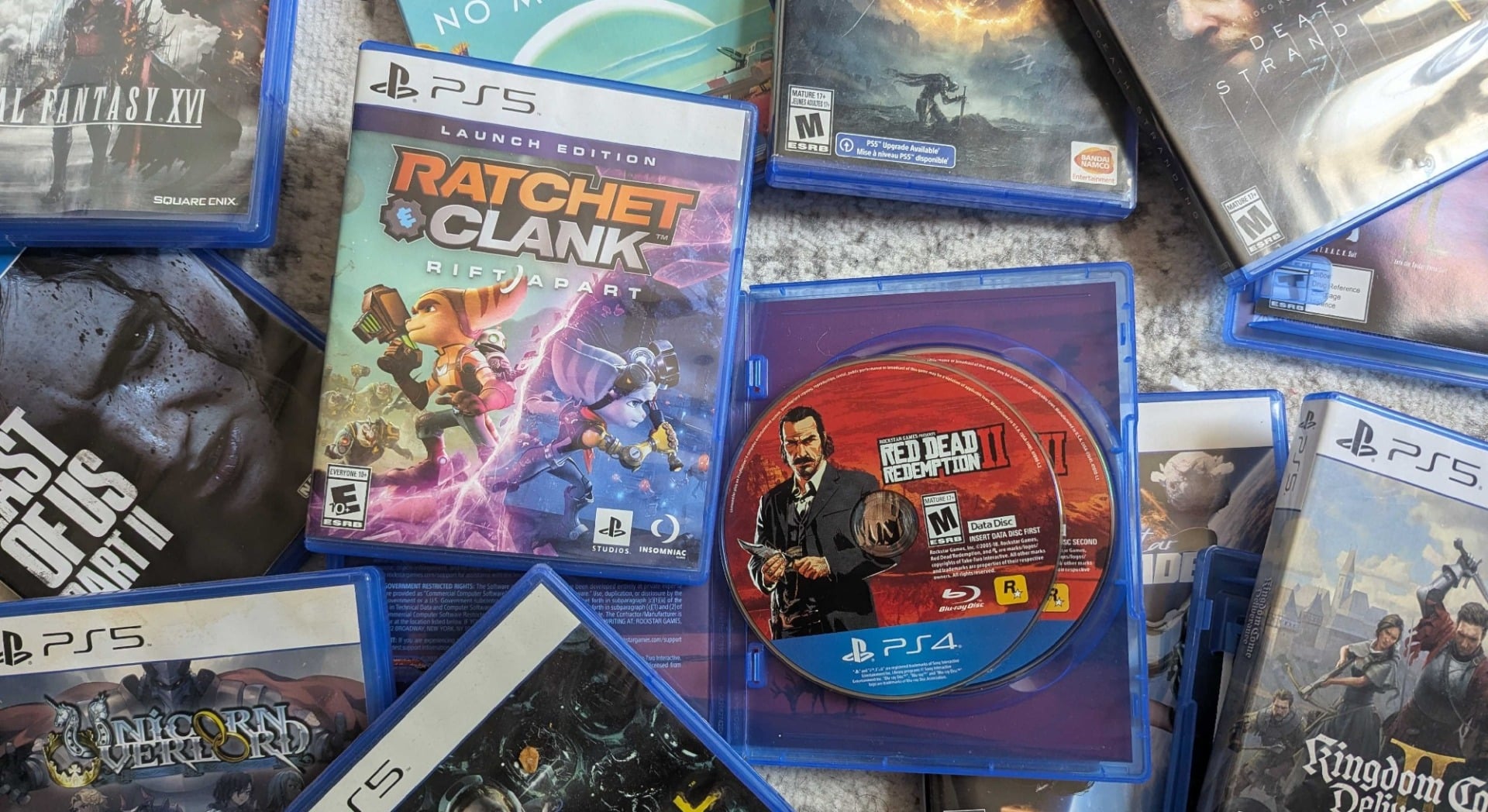
Everyone knows physical game sales have become an increasingly slender slice of the market. With each passing year, more players opt for the convenience of digital downloads. But seeing real numbers can put that decline in stark contrast. A new data point shared by the Circana Retail Tracking Service shows just how marginalized physical game sales have become in the U.S., and what kind of challenge fans who are urging Sony to preserve PlayStation discs are up against.
“Two PlayStation video games sold more than 10k physical units in the US during week ending July 11, 2026,” Circana director of game research Mat Piscatella shared on Bluesky yesterday. “Seven have sold more than 100k physical units year-to-date.” These are two very interesting, if slightly vague, statistics. That’s not Circana’s fault; the group is not supposed to disclose specific sales figures for individual games. But let’s break down what these new data points do suggest.
The list of best-selling games year-to-date in the U.S. is led by Resident Evil Requiem, followed by Crimson Desert, MLB: The Show 26, 007 First Light, Forza Horizon 6, Pokémon Pokopia, Lego Batman: Legacy of the Dark Knight, Tomodachi Life: Living the Dream, WWE 2K26, and Call of Duty: Black Ops 7. We also know that Resident Evil Requiem sold over 7 million copies, Crimson Desert sold over 6 million copies, and 007 First Light has sold over 3 million copies.
Now lets make some assumptions. First, let’s assume the top seven best-selling games year-to-date are also the seven that sold over 100,000 PlayStation disc copies in the U.S. Second, let’s assume a roughly 90-percent split in favor of digital sales. That would suggest the total physical sales of Resident Evil Requiem, for example, would be 700,000 for the whole world. Only part of that is PlayStation discs vs. Xbox, and only part of that is discs sold in the U.S.
What this thought experiment drives home pretty quickly is that even the top-selling games of the year probably haven’t sold much more than 100,000 PlayStation disc units. It seems very unlikely that any of these games broke 300,000 PlayStation disc sales, let alone half a million. Even if those numbers double by the end of the year, it seems unlikely that any of those games crack 1 million physical sales in the U.S. alone. In a way, this also reinforces the larger point about physical games that analysts have been making for years.
Even as most consumers opt for digital downloads, the total sale of physical games each year still isn’t nothing. According to Daniel Ahmad, director of research and insights at Niko Partners, Sony sold roughly 70 million physical PlayStation games in 2025. That is still a lot of revenue each year, but it’s also an extremely small number for any particular new game in any particular territory. A further wrinkle is that first-party releases tend to have a higher ratio of physical sales as hardcore fans opt for a permanent copy they can add to their collection.
The math is not in the pro-disc crowd’s corner, even if sentiment, nostalgia, and the broader vibes around gaming culture are. Piscatella’s argument is that it will take more than tens of thousands of angry comments on PlayStation’s YouTube channel to get the platform holder to change course. It will take a real boycott movement and the mass cancelation of PS Plus subscriptions. In the meantime, a petition demanding Sony reverse course appears to run out of gas at less than 400,000 signatures.