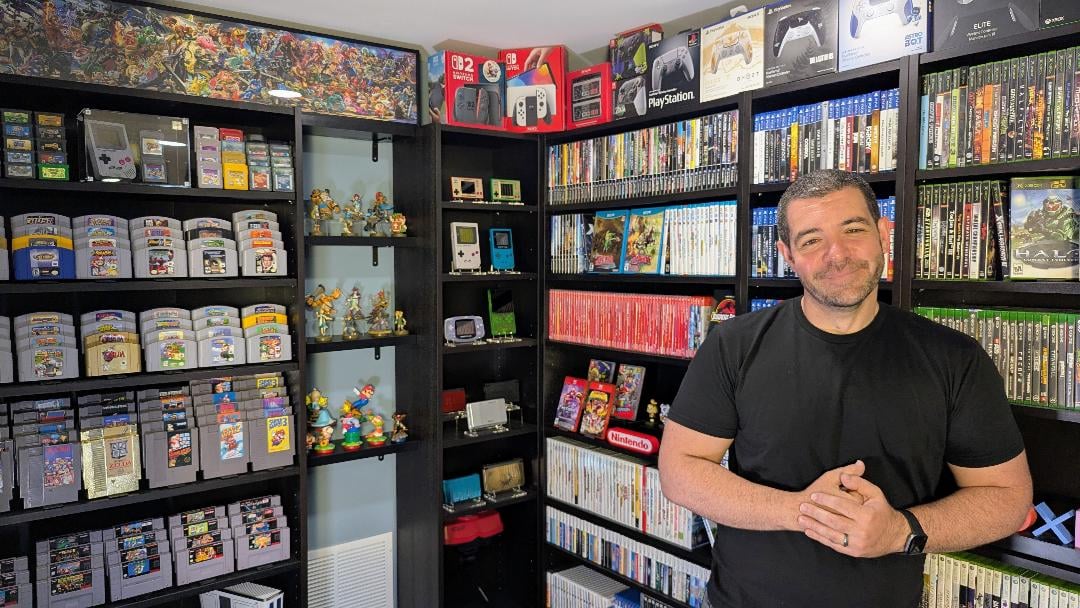
PlayStation’s plan to cease production of game discs by 2028 will have wide-ranging ramifications. Players are losing one of the only reliable ways to preserve games, retailers are losing a core product they put on their shelves to bring in customers and create community, and collectors are losing a major pillar of what makes video games so special. In the end, the only party that truly stands to gain anything from this is Sony, which will now require players to buy games solely through its digital storefront.
For some, a physical game collection is just that, a bunch of discs and cartridges we put in consoles to unlock access to the experiences inside them. For others, they transcend their mere utility and become something much more symbolic. Saurav, an HR employee for a multinational corporation in India, has been collecting games since high school during what he considers to be a golden era for PlayStation, specifically citing The Last of Us Part II and its steelcase edition as one of his prized collection pieces.
I know physical media is a losing battle. I'm fighting it anyway. Long live the shelf.
byu/SauryReddit inps5collectors
“I remember going to my friend’s house and seeing his wall filled with the books he had read,” Saurav tells Kotaku. “I found it romantic in a way. Just a wall full of books that meant something to you. For me, games were that so I moved completely to have a physical copy of the games I played.”
Carsten, a web developer in Belgium, recalls starting his collection in earnest a decade ago after getting his first full-time job. It has since become a centerpiece in his home.
“There have been several occasions when we had friends over that they just walked over to the collection and were checking out all the games there,” he says. “And then you know you’re going to be talking about games for the next hour or so. That is something you can’t do with digital games, nobody ever boots up your PS to go through your library to see what kind of games you like.”
Matt Welsh, a content creator and father of two budding gamers in Pennsylvania, has been collecting games since the ‘90s, and has plenty of core memories of buying them from local stores, including during midnight releases.
“I remember Halo 2 having a Limited Collector’s Edition that really felt special,” Welsh says. “The drive home from the store that night felt like I really had a premium item that I could not wait to get home and play.”
Most people who have been collecting physical games over the years have stories like this. Attending a Mass Effect 3 midnight party and being handed a special edition the second the clock struck 12:00 a.m. is still a memory I cherish, and that copy remains on my shelf 14 years later, even if I haven’t turned that passion into a broader collection.
As a New Yorker with limited space, I haven’t been buying quite as many physical copies, especially after moving to a city with decent internet after decades of living in the boonies. In the past, physical games were often the only way I was able to play new releases in a reasonable time frame since it would take me days to download a AAA game. Now, my physical collection only grows maybe once or twice a year when a series I really love puts out a new game. But I’ve lived in a place where physical games were more than just a means to an end, they were the only viable way for people to play, trade, and sell games. So I get it.
“I prefer physical games because I enjoy the tangibility of it,” Welsh says. “I can lend my games to my friends, I can trade them in, or I can display them on my shelf to remind myself of the good times I had with them. With digital games, there is no special feeling of removing the shrink wrap and popping in a disc for the first time. It’s just a slow, uneventful install process.”
In general, physical spaces for people to find community are going away. At least, the ones people have typically flocked to. The “third spaces” where they could go beyond their homes and work are disappearing. Many are looking to online spaces as a replacement, but the lack of real human contact has a way of depersonalizing people on the other side of the screen. Hobbyist video game stores have been a watering hole for collectors to meet like-minded fans. They also are an agnostic space not controlled by companies like Xbox, PlayStation, or Nintendo, meaning that the messaging isn’t as controlled. Although there will still be a market for retro games and consoles even after Sony pulls the plug on PlayStation discs, it will have been dealt another immense body blow.
“I do think gamers will find a way to connect regardless but communities like PS5 collectors and such will die of course,” Saurav says. “This also means no more midnight releases at game stores. It’s a huge thing, it means a lot to some people. Sad to see it all go just because a corporation wants to make more money. It’s scummy–they’re taking a big part of the community away. I don’t have many friends who game so whenever I chose to buy a pre-owned disc from a seller, I got to interact with them and talk about games. I’ll miss that.”
Though many collectors and pundits assumed this day was coming for years, many thought there was at least one last console generation left to make their peace with the shift.
“It’s honestly a stab in the back from Sony to their customers,” Saurav says. “I do not regret buying physical because of this, but I do feel betrayed by the platform I’ve spent a lot of time and money on.”
If the PlayStation 6 is a digital-only console as many speculate, that will mean that even if it supports backwards compatibility for players’ digital libraries, the physical copies collectors have made room for on their shelves and in their lives will become ultimately obsolete on the new hardware.
“I’ve got dozens of games that I still need to play and I don’t plan on buying them a second time in the PS6 store,” Carsten says. “But I guess that just means that my PS5 is going to used for quite some time and I don’t have to buy a PS6 on release date”
Though the actual items collectors covet and display might change, Carsten believes that the communities of people buying and selling novelty games and merchandise will still persist, they might just look different years from now.
“I mean people are still collecting vinyls, comic books and so on,” he says. “The death metal band in which I play, even has the latest record on cassette tape and they sell quite well. The cassettes come in four colors, one of which is white with (red paint) blood splattered on it. If it looks cool, people are going to collect it. I know I’m not going to stop anytime soon.”
Every attempt corporations make to cut out the middle man of physical retail spaces wages a war on physical ownership. Without physical products for people to buy, hold, and keep forever, there’s nothing to safeguard against the looming threat that any purchase on a digital storefront can be delisted and taken away at a company’s whim.
“I am hugely disappointed,” Welsh says. “I’m fearful of what this means for video games moving forward. We frequently see games removed from digital storefronts due to licensing expirations, especially those games with licensed music. Now I’m fearful that every purchase I make could only be temporary and might disappear from my library in the future. After this announcement, I can’t see a future where any consoles moving forward continue to support physical media. It means that to play my existing PS4 or PS5 physical media I’ll need to leave my PS5 plugged in, essentially removing the potential feature of backwards compatibility for me. It will feel like I’m starting over from scratch.”