Today is Street Fighter II’s 20th birthday. Happy birthday, Street Fighter II! In honour of the venerable fighting game’s anniversary, then, we’re going to look back at its predecessor. You know, Street Fighter I. The one nobody ever talks about.
There aren’t many franchises where a sequel is so successful that it so dominates discussion and popular memory. You could say Final Fantasy is one example, with many people’s introduction coming with the seventh game. Likewise for Zelda and either Link to the Past or Ocarina of Time.
But even in those cases the original game is still around. Revered, honoured and cherished for its contribution. Yet despite clearly carrying the numeral “II” after its name, few ever seem to remember – and many have never bothered playing – the first Street Fighter game.
Released as an arcade game in 1987, Street Fighter is home to a ton of “firsts”. It was Capcom’s first ever one-on-one fighter. It was the first Street Fighter game, a series that has spawned over a dozen sequels and successors. It was the first fighting game to feature the special attacks that are now a genre staple (think down + up + punch, etc). It was the first fighting game to use six buttons. And it was, believe it or not, the first game Mega Man creator Keiji Inafune ever worked on for Capcom (he drew the game’s character portraits).
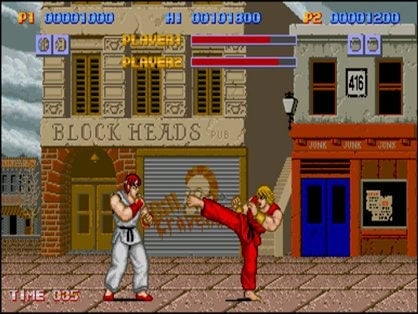
For those who have only played Street Fighter II (or the games that came afterwards), Street Fighter I is – in one of its two versions – a fairly similar game. You’ve got the same six-button layout, there’s the same concept of travelling around the world kicking some ass and even some of the characters are the same: you can play as either Ryu or Ken, and the game’s final boss is Sagat. Ryu and Ken look the same, and also have the same special moves like the Dragon Punch (except in Street Fighter I the required combos for these moves wasn’t printed on the arcade cabinet, meaning you either had to fluke them or learn from an experienced player).
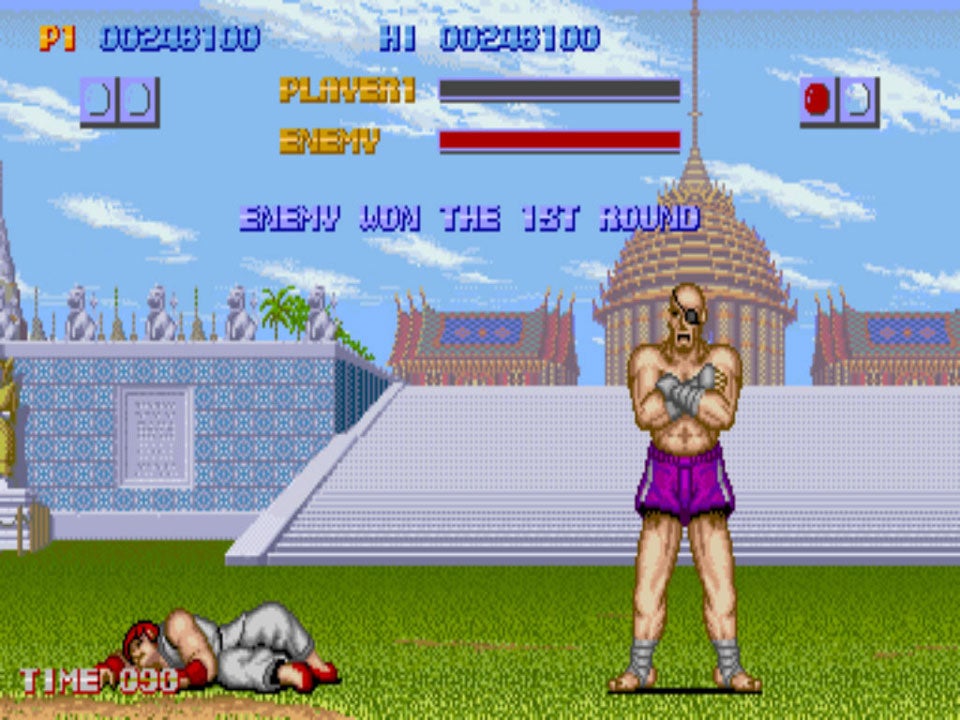 That’s not to say it’s entirely the same. The other nine characters from the game’s twelve-character roster are a fairly forgettable lot, and unlike later games, you can only play as Ryu or Ken. Actually, you could really only play as Ryu, as to play as Ken you’d need to play a two-player match first, win and then go onto the AI opponents.
Things were even weirder if you were playing the other version of the game. The original arcade edition of Street Fighter shipped in two variants: one with the six-button layout and one that featured two pressure-sensitive rubber “pads”. These pads would measure how hard you whacked them to determine the strength of your attack; hit them hard and Ryu would perform a heavy attack, etc.
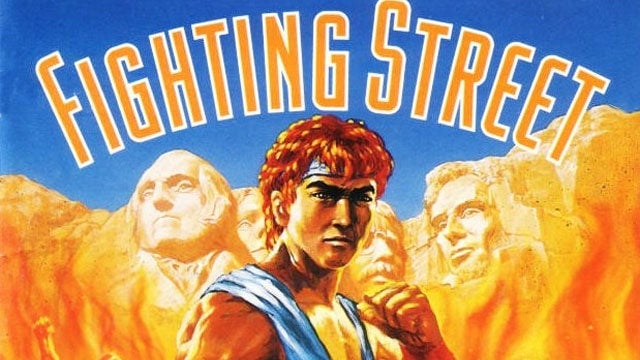
The arcade release would later be ported to several home consoles and computer platforms, including the Commodore 64 (which is where I first encountered it), Amiga, PC and TurboGrafx-CD, where the game underwent a name change and was known as…Fighting Street.
 Interestingly, the two men key involved in the creation of the game – Takashi Nishiyama and Hiroshi Matsumoto – would leave Capcom a few years after the game’s release, and move to SNK, where they would be responsible for the creation of nearly all of the Street Fighter series’ competitors throughout the 1990s (like Art of Fighting and the King of Fighters). So in that way, these rival franchises had more in common than you think!
Tying the whole thing up nicely, both Nishiyama and Matsumoto would then move to the developer Dimps, with whom they would end up contributing to Street Fighter IV.
Why, then, does the original Street Fighter not get its dues as the originator of a series of conventions and characters that have dominated the fighting game genre for two decades? It’s not because it was a bad game, or that it was unsuccessful; it’s simply that Street Fighter II was so big, so important and perhaps most importantly so culturally dominant that it overshadows other games in the series. Those who regard Street Fighter III as the series’ peak, for example, can use the same argument.
At the end of the day, it doesn’t matter. Street Fighter was a pioneering title that led to one of the all-time greats not just of its genre but of all video gaming itself, which is more than most other games can say about themselves. And if you’ve never played it and want to check it out, it’s actually available right now on the Wii’s Virtual Console!

TOTAL RECALL
Total Recall is a look back at the history of video games through their characters, franchises, developers and trends.