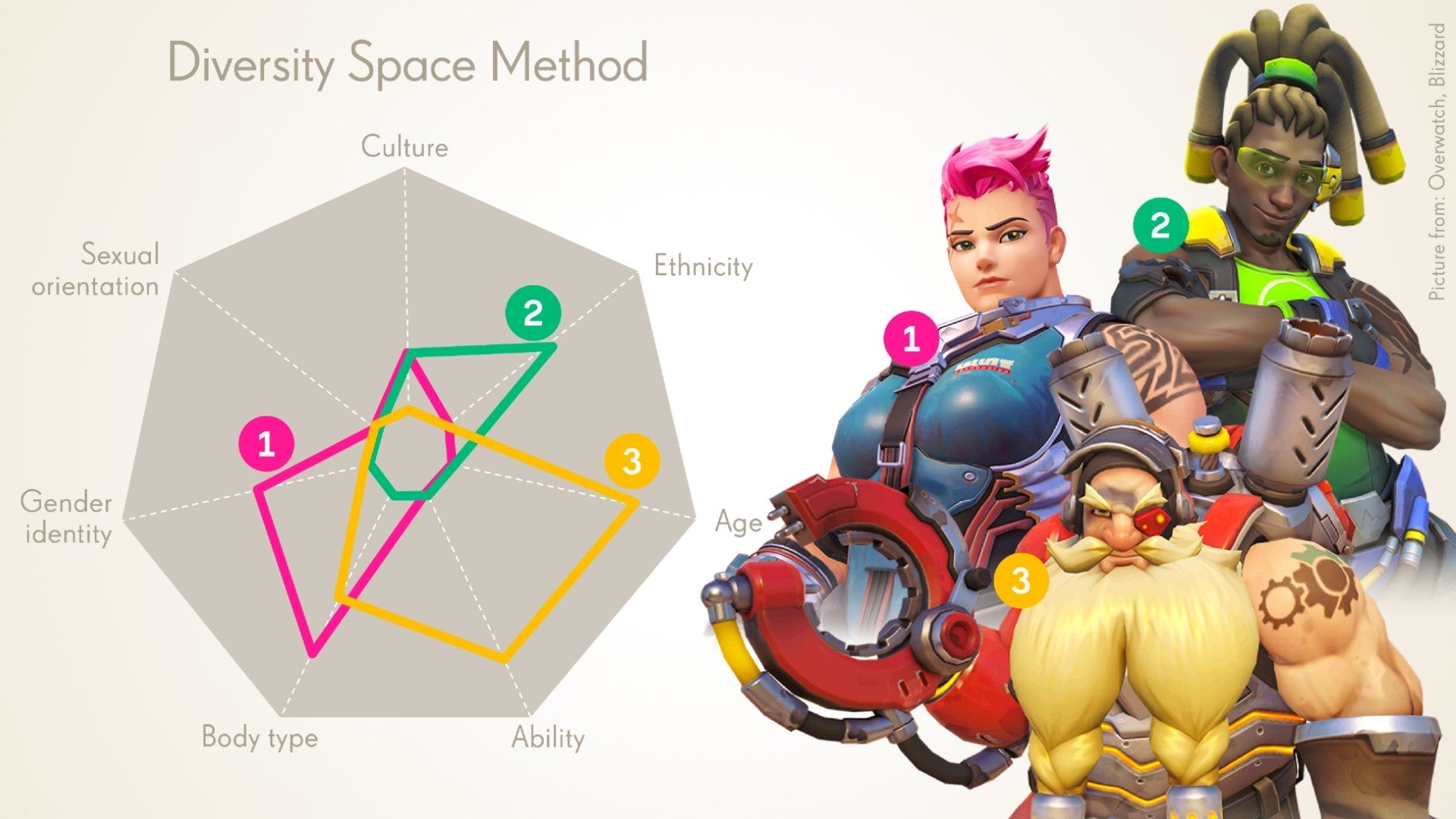
Today Activision Blizzard fulfilled its daily oopsie quota by blogging about how the publisher’s subsidiaries have apparently been using a special tool to help develop more “diverse” characters. It apparently thinks it can accomplish this without, I don’t know, actually talking to or hiring marginalized developers. Why rely on pesky, fallible humans when we have powerful data to tell us we’ve reached enough Diversity Points to start a new video game culture war? Numbers do not lie. I mean look at this. It’s obvious, isn’t it? The well-designed graph tells all, clearly and calmly.
Damn, I’m glad technology let us solve racism, sexism, ableism, and every other issue facing video games. Who knew it was so easy? When former Overwatch director Jeff Kaplan said that he “would hate for the diversity to ever feel pandering, like we just had this spreadsheet with a bunch of checkboxes,” Activision Blizzard really took that to heart. Okay, not really.
I’m being sarcastic, but in many ways it’s hard to contain how galling this is. It’s not just that someone thought a problem this complex could be solved with a glorified Dungeons & Dragons character sheet that makes no goddamn sense. And it’s not just that Blizzard is in the middle of a wide number of ostensible “diversity” disasters right now, including allegations of sexual harassment, inability to recruit or retain marginalized talent, and ongoing union-related tensions
But a number of people likely not just built this thing, but also wrote the blog, got interviewed for it, and then signed off on it to share with everyone else. The reaction on the internet to the post and the tool it describes has been complete disbelief, and rightly so. Consider the fact that nobody there saw this coming, amid all the other complete PR disasters. What does that say about Activision’s actual ability to address the rampant problems that have come under public scrutiny over the last year, and that the publisher has repeatedly vowed to fix? Right now, it seems like nobody in charge is truly capable of that, if this is what they’re coming up with.
And make no mistake, this is a PR disaster. I’m not just saying this because I disagree with the basic premise that you can, as the blog post states, use one handy-dandy tool to magically and quickly “dissect their own assumptions,” avoid “token characters,” and achieve “true representation” by identifying “more diverse character narratives” that go beyond “appearance alone.” Humans have difficulty with these things not because we are mere mortals who can’t fathom the pristine logic of 1s and 0s, but because achieving a better world is a process, and a painful one. You can’t expedite it. The moment you try to take a shortcut is the moment you’re no longer engaging with the actual problem.
While solving these problems can involve tools, Activision Blizzard has repeatedly proven that it’s at the stage where it needs more education, guidance, and mentorship from actual people with soft skills to help establish a basic understanding of what diversity even means before it can even think about creating a tool like this. When a company like this takes years to introduce a Black woman into a video game, I cannot in good faith believe that it has the capacity to “measure” what the hell diversity is or means, much less implement it well.
But even if we take the thing on its own terms, it makes no goddamn sense. Can you look at any of the visualizations shared in the blog post and tell me what they might mean?
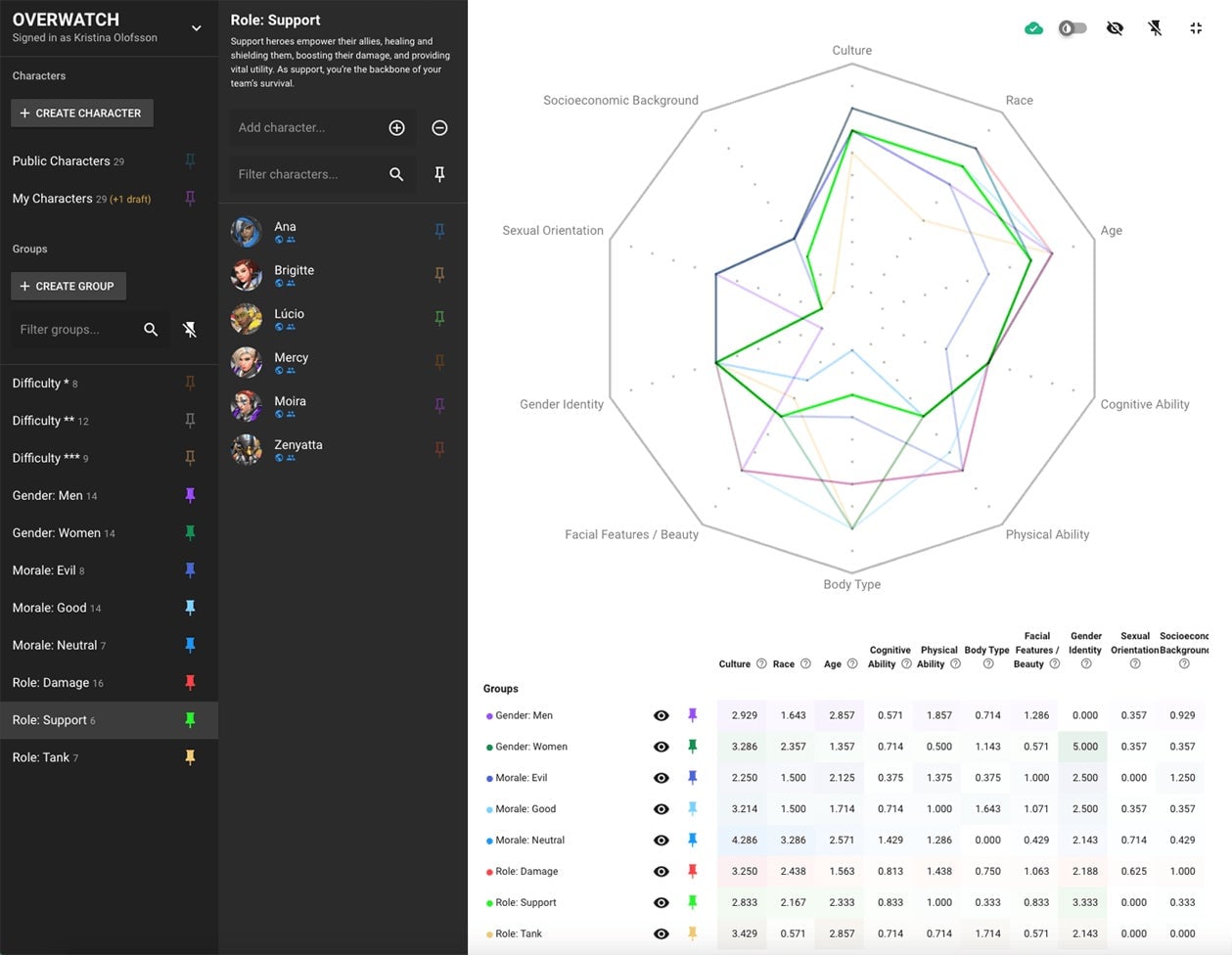
I assume there’s some logic to it, possibly one that is only explained and known to the people regularly using the tool, but even suggesting that you can enumerate something like “ability” is completely batshit. What is ability 0? What does it mean when the picture in the blog post says that someone is “sexual orientation: 0.357″?
How do you even put that in front of someone and not feel fuckin’ weird about what you’ve done or what you’re saying?
While this is hardly important, the example use cases cited in the blog post won’t be compelling to the average person. There’s Call of Duty Vanguard, a game that Activision not only has tried to distance itself from, but one which chuds actively hate because it has diversity. Then its other example is Overwatch 2, a game that has nearly everyone asking, “Why does this exist?” Are these fair reasons to dismiss a thing? No, admittedly not. But they are adding on top of an already shitty-looking pile. Nobody is going to go, “Ooo, they used this for the Call of Duty that disappointed everyone!” Again, the levels of marketing fail here are unfathomable.
So, yeah, not the most compelling way to package what is already a hard sell for people who want change but don’t think it can be achieved through representation alone. Nor for those other people who think that just putting a woman in a video game is inherently too political.
Perhaps this was inevitable, though. Tech in many ways is the most extreme manifestation of whiteness and capitalism, structures that have an active investment in defining, codifying, and filing away markers of identity for the sake of maintaining power and profit. The marginalized are not perceived until it’s useful, and then only on the most degrading terms, for shitty purposes. Identity is key to achieving those aims. After all, if you can develop a system to, say, define things like gender or race, you could use that information to “inform” larger choices, like making sure your character designs are diverse in more complex ways.
In actuality, more often than not, data like that is used to surveil, imprison, and police the identities that get put under the microscope, often by people outside of their own communities. In this case, whether the entities collecting the data realize it or not, its most direct effect will be better equipping them to deflect criticism from the very parties they claim to want to empower. Funny how that works.
Why hire more people of color when you have a bit of software that already tells you what you need to consider, or worse, might make you believe you already know what’s what? Do you really have to reflect on your biases if the character you came up with spits out a 3, 4, and 5 on the computer’s diversity scale? Those are pretty good numbers, my man! Now that we’ve got that out of the way, time to spend some quality time developing realistic horse balls. Polish is king.
“The traits and measures are applicable to wider entertainment verticals including TV, film, and literature,” reads the blog. “The only change required if used in these verticals would be the baseline traits, which would need to be calibrated to be relevant to the genre and universe each character exists in.”
Activision Blizzard’s blog post does end by saying that ultimately, it’s just a tool, and that at the end of the day it’s still up to the people at the wheel to make the choices. But not before betraying a grander vision of a world that lives under the rule of its tool, and therefore its master logic.
Update, 5/14/22, 9:15 a.m. ET: Sharing that the publisher“regret[s]” any “offense” that the original post might have inspired, Activision Blizzard has updated the original post that has set off a firestorm. A new introduction states that the tool is not being used in “active” game development right now, though it’s worth reiterating that one of the original examples both pictured and cited was Overwatch 2, a game currently in development. It also brings into question why the publisher would have initially been celebrating a tool that by its own admission it is not currently using.
The blog post, which postulates how a tool that apparently isn’t being used is meant to be used, now says:
The tool isn’t meant to be used in isolation; teams would sit down with company DE&I staff to identify existing norms and then discuss, educate, consult, and collaborate on how a character’s representation is expressed beyond those norms. This process is intended to create a conversation where our developers, assisted by the tool, challenge assumptions, assess choices, and find opportunities for authentic representation to be fostered in our games.
Activision Blizzard is committed to reflecting the diversity of its millions of players around the world through representation and inclusion in its games as well as its employees. Our intent with this blog entry was to share an in-progress piece of our journey in this endeavor.
The post has also pulled all previous pictures that showed how the tool quantified things like ethnicity.