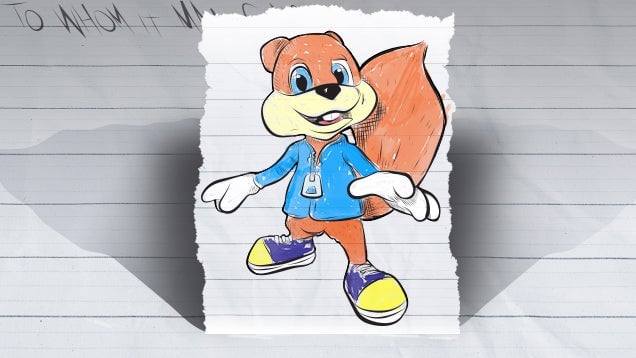
What drives a person to make up a video game rumor and spread it around the internet? They might do it for the fame or the infamy. Maybe for a laugh. Sometimes, it’s… to get a good grade on a college paper.
In early March, a Reddit user going by the name certain_ability posted a juicy threadon r/gaming, the biggest gaming community on Reddit at around 7.5 million subscribers. He said he used to work for Microsoft and wanted to spill some details, going on to claim that the folks behind Xbox had asked the independent studio Insomniac Games (Ratchet & Clank, Sunset Overdrive) to develop a reboot of the old platforming series Conker. But Insomniac had turned it down because of time concerns, certain_ability said.
“The Conker project has been pretty much canned,” he wrote. “No one wants to make it, because Microsoft wants to rush it out. I’m not sure if those other reboots will continue as planned, or if they wanna wait for someone to tackle Conker, like I said, I no longer work for Microsoft and have been out of the loop for a little while, but as is, don’t hold your breath for a new Conker game.”
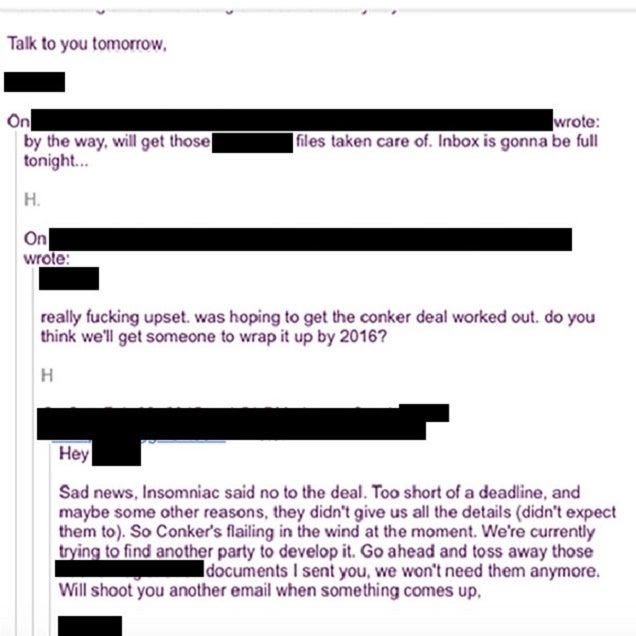
At the end of the post, certain_ability even included a screenshot of an e-mail exchange he said was between him and another employee:
 Of course, the internet is full of people claiming to know things, and new video game rumors pop up on Reddit every single day. But what made this post particularly interesting was that the moderators of the r/gaming subreddit said they had corroborated that “certain_ability” was indeed a former Microsoft employee, even going so far as to stamp the post with a big red “VERIFIED” sticker.
In the comments, one r/gaming mod elaborated: “He provided us with some additional credentials (Which for privacy’s sake are left out here) that verify his position.”
As of today, the “VERIFIED” tag is still there:
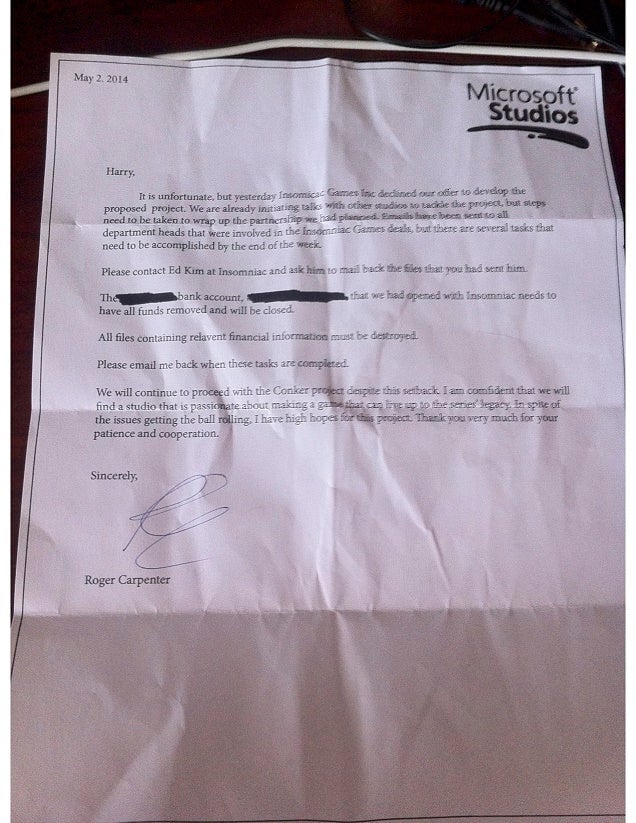
 But as I would later find out, those “additional credentials” were actually just a photograph of an official-looking piece of paper with a forged signature.
It looked like this:
 We’ll get back to that in a bit.
A few hours after certain_ability wrote that Reddit post—which had already gotten a few dozen replies by then—he reached out to Kotaku, e-mailing our tips line in hopes that we’d write a story about his claims. “I can guarantee [Microsoft] was committed to rebooting Conker, as well as other Rare IPs in the future,” he wrote, going by the name Harry Mason. “If you have any questions, please email me back.”
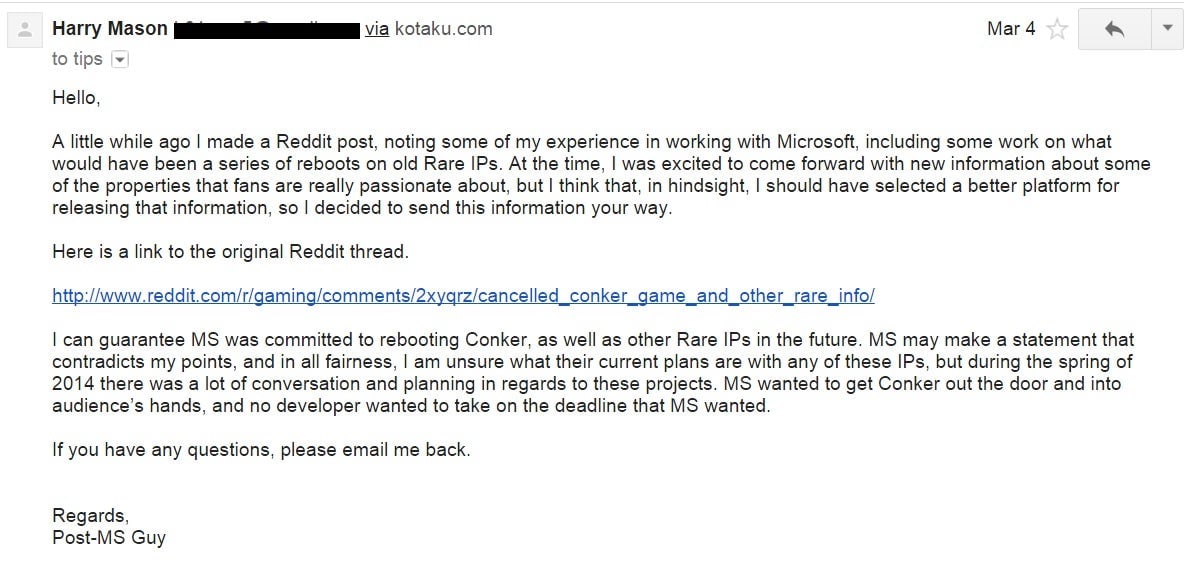 So I e-mailed him back, asking who he was and how long he’d worked at Microsoft. He responded saying he’d been there for five years, and he sent over that signed piece of paper as proof.
I didn’t really buy it—it’d take about ten minutes to make something like that in Microsoft Word—so I kept probing, and we exchanged e-mails for a little while.
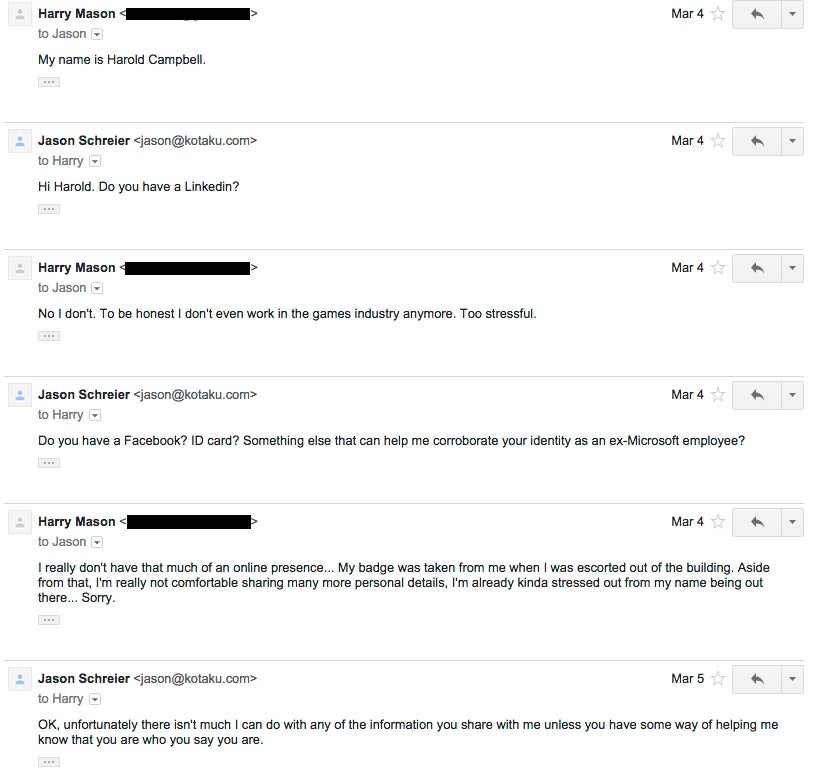 The next day, the rumor hit the influential gaming message board NeoGAF—as most rumors do—and eventually got posted on a number of media outlets, too, including Engadget, Gamerant, and our friends over at Kotaku UK. Our tipster didn’t get back to me with proof that he was who he said he was, so we passed on the story and moved on. (I also mentioned in the GAF threadthat I’d been corresponding with this guy and didn’t believe he really worked for Microsoft, which likely put some water on the rumor fire.)
It might’ve all ended there—yet another anonymous internet rumor goes mostly forgotten because it doesn’t have a shred of truth—if Harry Mason hadn’t contacted me again a month later with a curious confession.
“Hi Jason,” he wrote in an e-mail on April 10. “I spoke to you a while ago about the Conker leak I made on Reddit.
“If it wasn’t already incredibly obvious, I made the whole thing up.”
Interesting. As it turns out, our tipster’s name isn’t really Harry Mason or Harold Campbell: it’s Taylor Clysdale. He’s a student at the University of Guelph-Humber in Ontario, Canada. And he came up with this whole plot not just to fool people but to fulfill an assignment for a media studies class. Their task: “go viral.”
“The professor said that as long as we didn’t do anything illegal, we could do anything (although I’m really not sure if impersonating a fake Microsoft employee is legal or not… oh well),” Clysdale said. “I decided to use Microsoft as a good target because… well, Microsoft is a good easy target. Everyone already hates them for what they did to Rare. This comment also made them particularly easy to target, since vague, half-announcements from people who probably don’t know what they’re talking about seem easier to work off of.”
If you’re not fully versed about what Microsoft “did” to Rare, it goes a bit like this: beloved British game development studio Rare spends much of the 1990s and early 2000s making great games with Nintendo including the all-time classics Donkey Kong Country and GoldenEye, gets sold by Nintendo to Microsoft, makes some weird and not-very-beloved games for Microsoft’s Xbox 360, and winds up churning out motion-controlled sports games for the controversial Xbox Kinect sensor. Rare’s fall from making classic games may actually have been due to internal Rare issues or to a lack of Nintendo influence, but, fairly or unfairly, some gamers simply blame Microsoft.
Clysdale went on to explain that he’d modeled his plan after two stories— the 2013 “X-Surface” rumor that set out to fool the tech press and a Reddit post from someone who claimed to have worked on Assassin’s Creed III. He thought Insomniac would make for a good pretend developer given their pedigree and recent history with Microsoft.
“The Insomniac thing was just to make people think it would’ve turned out great if it hadn’t been cancelled,” Clysdale said. “They were prime targets because of the similarities between [ Conker and] Ratchet and Clank, and because they’d already done Microsoft’s Sunset Overdrive. It was a moment of sheer brilliance when I thought of Insomniac as potential developers. It was almost Epic, but I figured that would be significantly less believable.”
Of course, given that Clysdale had just confessed to lying in an attempt to fool the media, I was skeptical, even after he sent me a copy of the five-page paper he’d written about this whole sequence of events. So I tracked down his professor, Stuart Robertson, who told me during a brief interview yesterday that yes, this was his assignment. Laughing, Robertson said it was too bad he’d already given out grades; this Kotaku story might have bumped up Clysdale’s final score by a few points.
So this part, at least, is true. In the paper, Clysdale outlines the entire scheme, starting with a theory that the world of video games is full of fake rumors ( true) and an explanation behind how he’d try to con everyone.
Clysdale writes:
I decided that Reddit was the platform that I was going to use for my project. I developed a script that sounded believable enough to be true, as well as a fake email chain from two employees that worked at Microsoft, and an internal document that claimed to be an announcement of the cancellation of the game. This document featured a forged signature of a known, but not famous, game developer who worked for Microsoft Studios. This document would not be posted in the thread, but would instead be used to successfully get the moderators on Reddit to believe that I had I had worked for Microsoft. On March 4th I posted the thread on Reddit.
The thread received a few comments, but did not garner much traffic on the first night. In order to speed up the process, I decided to contact someone in the game’s media to inform them about the Reddit post. I contacted a journalist at Kotaku, a well-known games media site, via their anonymous tip services. Unfortunately, in order to verify whether or not I was telling the truth, they needed some form of evidence that I had worked for Microsoft. I provided the document that I had created, but expectedly, the journalist did not believe me, and communications between us ended shortly afterwards.
However, the next day the thread exploded with comments and upvotes. A thread had been made on NeoGaf, another forum-based website, which featured over 150 comments, as well as other threads on sites such as 4chan and Amazon. Several gaming news sites had published the story, including such notable entries as Kotaku UK, Gamerant, and Engadget. By the end of the second day the story had been shared and commented on over a thousand times, and likely seen by a thousand more.
Clysdale’s little scheme might have not garnered as much attention as, say, the dress, or a big viral video, but it’s yet another look at how easy it can be for nonsense to spread around the web like wildfire, even in today’s skeptic-filled age.
He got a 90%.
You can reach the author of this post at [email protected] or on Twitter at @jasonschreier
Illustration by Sam Woolley.