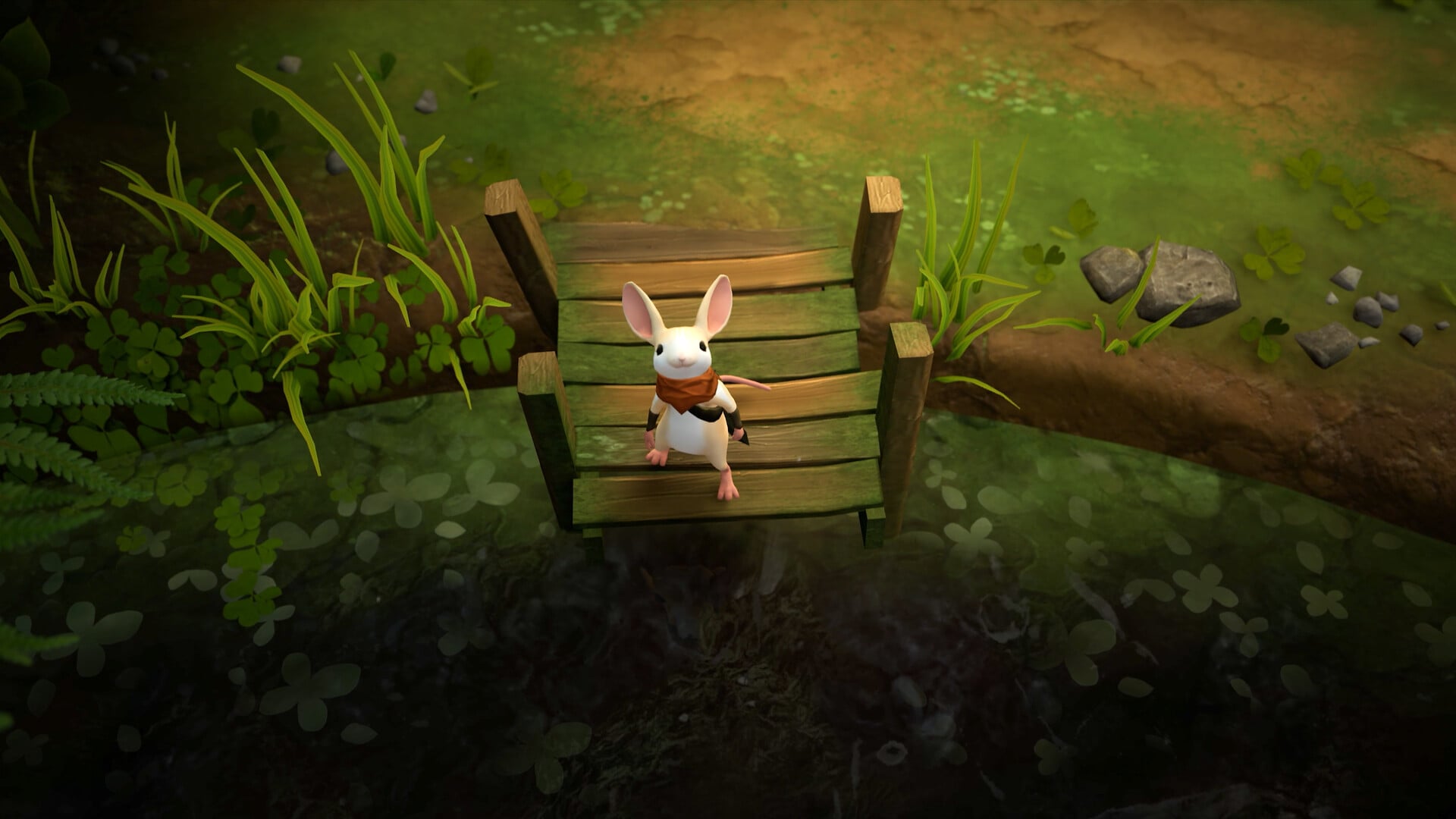
The very first time I ever put on a VR headset was at E3 2017, in a tiny booth off the main hall hidden behind some generic paneling. I was there to see Moss, the debut game from Polyarc, which had just been announced earlier during the show. All I really knew was that it was a game about a little mouse. There may have been some banners promoting the game or something outside the little booth, but I remember it being a bit tucked away from the lights and music of the rest of the show, unassuming and unpretentious.
And it was there in that cramped, simple booth that I had one of the most genuinely surprising and emotional video game experiences I’ve ever had.
Look, VR is a pain, and now, almost a decade later, we know that it was never going to have the mass-market appeal that was being pitched back then. But you still have to admit, once the headset is on, that it’s pretty cool. I slid on the massive, clonky PSVR headpiece, spent a few minutes trying to make it work with my glasses, and with some setup help from the devs I was dropped into a gorgeous fantasy world. I reached out my hand, and gently turned the pages of an ancient tome. A forest grew up around me, filled with birdsong and insect chirps. Through the mists ahead, I could see the silhouettes of deer grazing in a clearing. And just below me, tucked in between some tree stumps and mossy stones, was a tiny white mouse named Quill, wearing a sword and pack in Redwall fashion and smiling bemusedly up at me. I loved her immediately.
In Moss, you guide Quill through the world using sticks and buttons as you would in any other game. But what makes Moss so special is the way it embraces virtual reality and its capabilities. You are not playing as Quill. You are a Reader, someone looking in on Quill’s world through a book, and assisting her on a journey. You can reach out with your hand, grasp objects like rune-covered blocks and big, heavy doors, and move them into place so Quill can proceed through the world. You can adjust your position, leaning your head around obstacles or standing up to see hidden treasures that might not be apparent from your usual spot. Each “screen” is a little diorama you can tinker with: your hand motions make the grass rustle as you pass through, water responds to your touch.
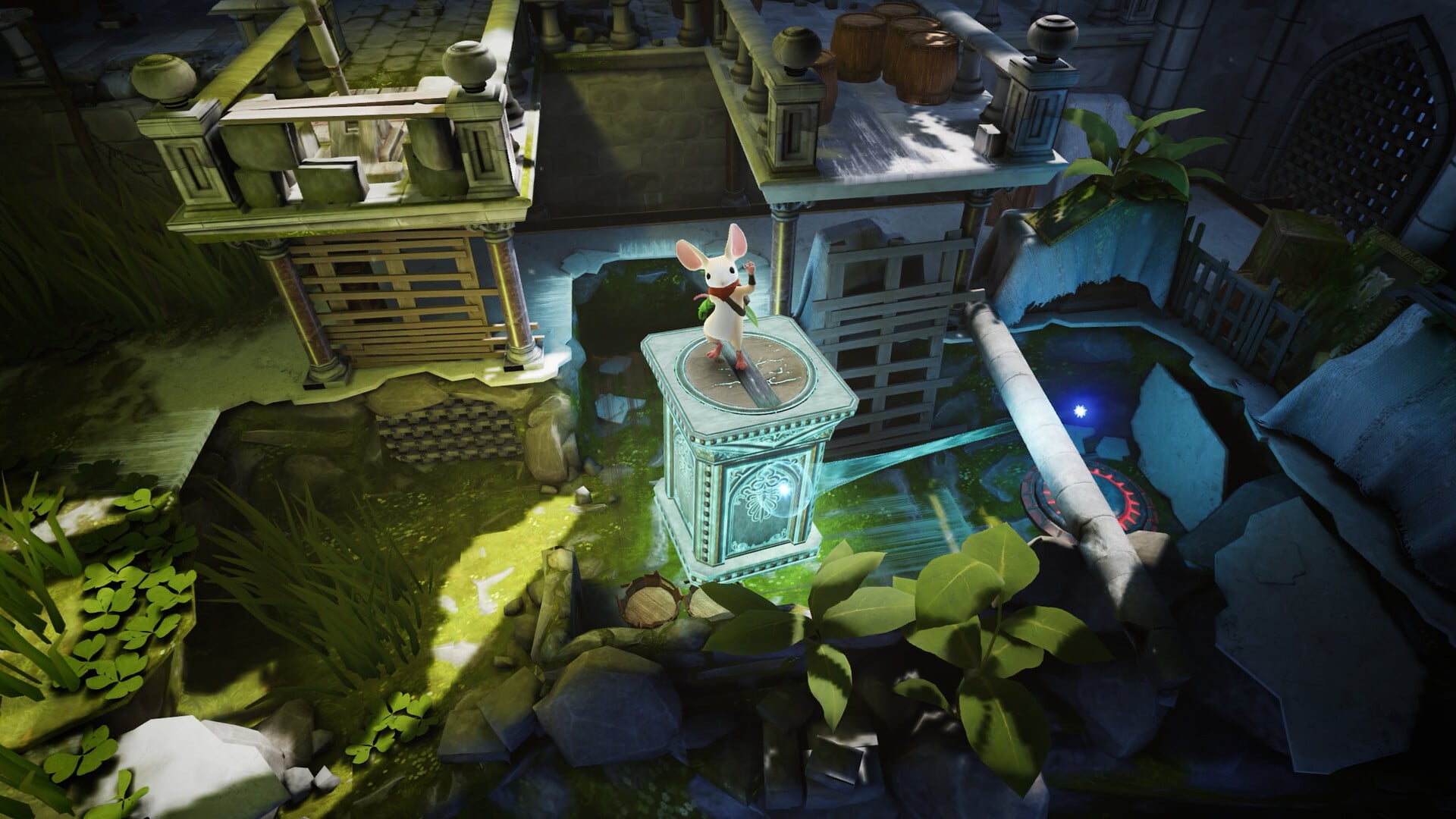
I loved Moss immediately, but I remember very clearly the exact moment that this game permanently seared itself into my memory. Early on, Quill stumbles and falls from a height. She cries out in pain and glows red in the traditional video game signifier of damage being taken. My little mouse was hurt. One of the devs assisting me through the demo explained how I could heal her. I reached out my hand and gently picked up Quill. I held her, and felt and heard her tiny heartbeat as my hands filled her with life and energy again. When I put her down, she looked up at me, smiled, and signed “Thank you,” in ASL.
It sounds cheesy to explain now, but this moment absolutely broke my heart. You really have to have experienced it to understand. I teared up and cried a little, all over that poor dev’s nice PSVR headset. I’d never experienced anything like this before! This feeling of connecting with a fictional character in such a direct, loving manner. I know the moment wasn’t “real,” but the way I felt was. It changed how I look at video games, at ludonarrative, and at player-character relationships.
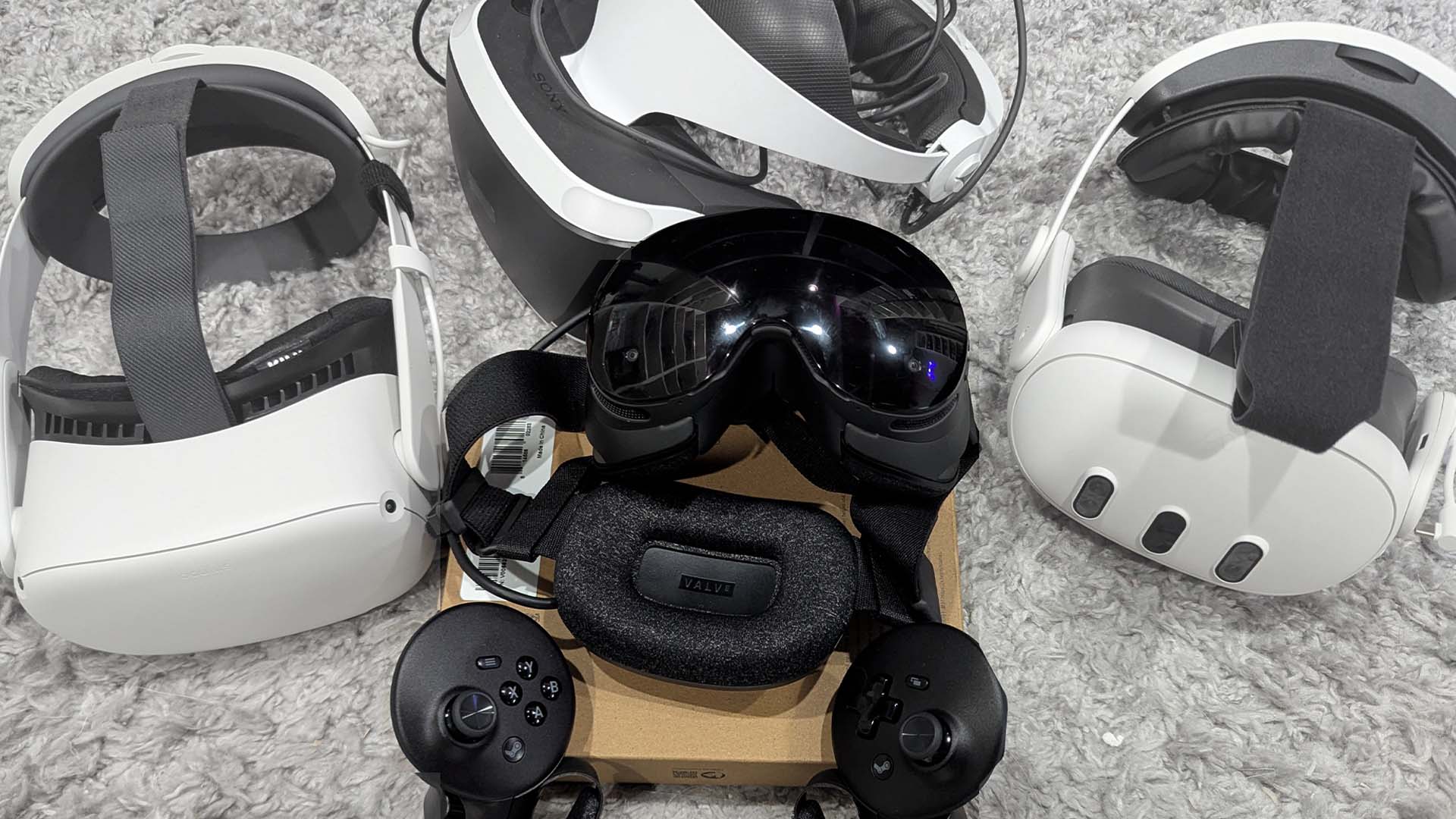
I eventually owned my own VR headset, and played all the way through Moss. It’s a fantastic game, with interesting puzzles and lovely music and a lovable protagonist. But it was the connection between Quill and myself that really made it memorable for me, and I chased that feeling in VR for years after. I never quite found it again, not in the same way. There are a lot of fantastic VR games out there, some of which do brilliant things with the medium (I’m a big fan of Job and Vacation Simulator, Half-Life: Alyx, and Beat Saber, and I think games like The Talos Principle, Superhot, and No Man’s Sky translated to VR very well). But as time went on, I increasingly felt like VR games were trying too hard to ape console games, just with a slightly different perspective. I wasn’t as compelled as I had once been. VR was annoying to set up (I had a Valve Index, for context). I quit using it, and never ended up playing Moss: Book II.
Today, Polyarc has launched Moss: The Forgotten Relic on PC and all three major consoles. It consists of Moss, Moss II, and the Twilight Garden expansion, and it critically does not require you to wear a big, heavy hat to play. It’s all on the TV. I booted up Moss on PS5 earlier this week, just to see if it was everything I remembered it being. And as far as mechanics, and story, and look, it certainly is. It’s the same little tale of an unlikely mouse hero caught up in something bigger than herself. You still move blocks around to help Quill proceed. You still look for hidden scrolls, and reach out with your hands to turn book pages.
But it’s also not the same, not at all. The world does not grow up around you and engulf you in forest. The hands that move the giant blocks do not feel like my hands. They just feel like controls. Without the closeness and the tactility of my movements in VR, I feel increasingly like I’m playing Quill, rather than some other entity helping her along, someone with whom she has a relationship. When Quill is hurt, I do not take her in my hands and hold her gently. I just push R2 and the stone in her backpack that connects her to me glows, and she’s all better in a second. She still thanks me, but what did I really even do? I just pushed a button so my character would live a little longer.
I think it is an unequivocally good thing that Moss is now available on more platforms for more people. VR is inherently inaccessible for so many reasons, be it physical limitations or price or the space required to use it or just being generally unjustifiable given increasingly limited game libraries, communities, and support. I would never want Moss to slowly fade away as fewer and fewer people had the ability to play it. I also want Polyarc to survive and thrive, and to keep making games that are deeply thoughtful about the relationship between player and game. But it’s also true that the version of Moss we have now is a far cry from the incredible work of art that I played in the hall at E3 2017, all because of something as simple as a perspective and controller shift. And I don’t know how we get that back. Nor do I know what to do with the notion that the kinds of experiences clever developers were designing that could only be had in VR are effectively dead in the water as funding for them is stripped, studios close, and support for headsets vanishes.
If you have never played Moss, I think you should play Moss, however it is available to you. But if you have a dusty old VR headset in your garage somewhere, it’s better if you brush it off, take the time to set it up, and play Moss that way. Quill will thank you, quite literally, and it might just break your heart.