“Shades on! Mario’s debut on Cube is a historic blinder. Better than Mario 64? You betcha!”
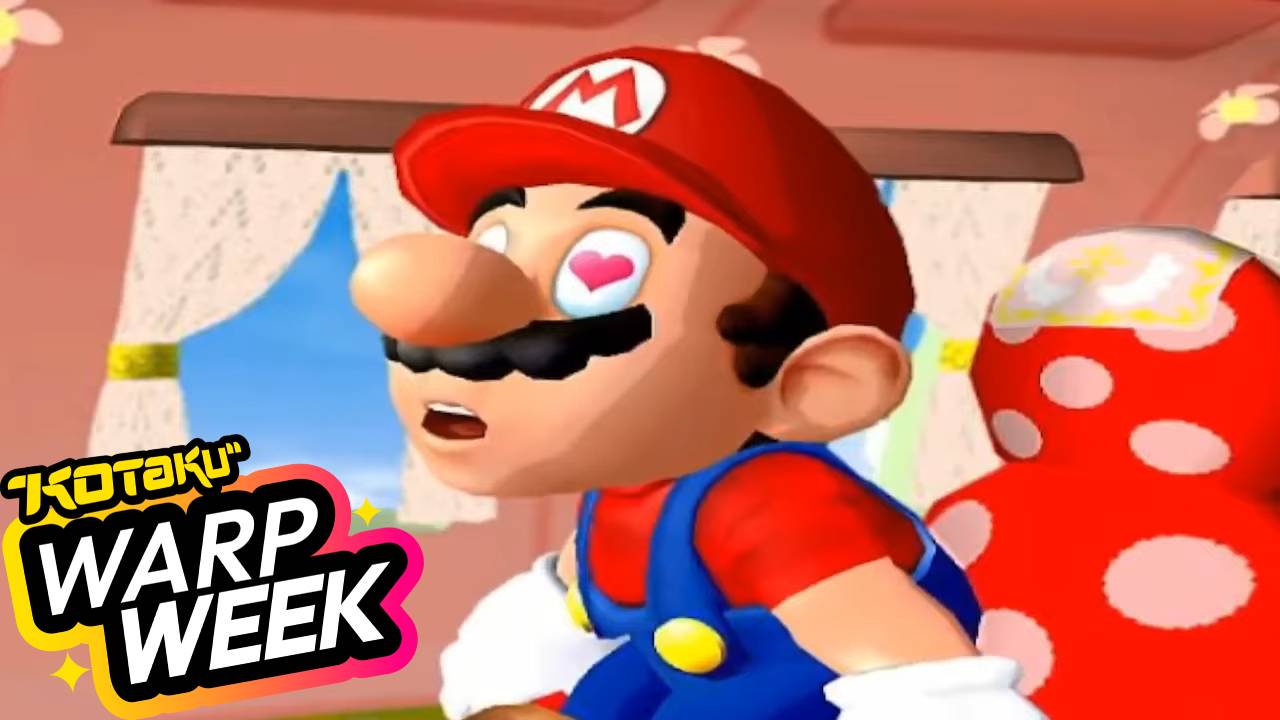
This was the opener to Michael Cooper’s effusive 10/10 review for Computer and Video Games of Super Mario Sunshine for the Nintendo GameCube, which launched July 19, 2002. Nintendo’s 3D follow-up to Super Mario 64, Super Mario Sunshine immediately stands out due to its tropical vacation themes, and the fact that Mario is now wearing a backpack named FLUDD that squirts water. Weird as that may sound, according to Cooper, we’re really going to love this one. Cooper continues:
“To describe this game as utterly sensational is like saying Shigeru Miyamoto is just a programmer. Your eyes will pulsate with pleasure and your heart will melt with joy as you explore Mario’s colossal universe. But beneath this happy glowing exterior lie rock-solid challenges and hardcore gameplay of the highest calibre.”
Judging by the flood of high scores it’s receiving, Super Mario Sunshine is indeed beloved by critics, though most were slightly more temperate in their praise than Cooper. Most critics agree that Super Mario Sunshine, despite its unique environment and aesthetic, is not an innovation. Rather, it’s a natural second step after Super Mario 64. Here’s Andrew Reiner for Game Informer, for instance, with his 9.75/10 review making that point:
“This is aged-in-oak proof that a game doesn’t need to be original to win over the hearts of gamers. When a new Mario game hits the market, there’s an underlying expectation that it’ll revolutionize gaming as we know it. Assuredly, this statement may seem like a stretch, but if you gauge the impact that each Mario release has made, it’s not so crazy after all. Think of this: If Nintendo never released Super Mario 64, what would the shape of 3D gaming be like? It’s a scary thought, especially when you take into account that almost every platformer on the market is in some way influenced by this legendary release. Of course, this was six years ago, and given the lengthy absence, everyone anticipated that Mario’s reemergence would bring about another mind-boggling gaming revolution.
“Rather than reinventing the wheel, Nintendo developed the long awaited GameCube follow-up under the philosophy ‘if it ain’t broke, don’t fix it.’ Super Mario Sunshine truly is 64-bit at heart. Just the look of the game should evoke a flashback of memories. Ironically, age is on Mario’s side. Rather than experimenting with jet set technologies, Nintendo took the knowledge and experience from the previous game and used it to fashion the perfect sequel.”
And here’s Tom Bramwell from Eurogamer, with a similar take in a 9/10 review:
“To say that there has been an air of expectancy surrounding Super Mario Sunshine is like saying that plumbers don’t wear ties. It seems almost pointless to draw attention to something so glaringly obvious. This is the sequel to Super Mario 64, the game which launched a platform and reminded the world that Shigeru Miyamoto makes the best platform games. Super Mario Sunshine couldn’t hope to shatter boundaries and reshape the genre for a second time, but it could and has managed to provide one of the biggest and most entertaining platform games since its illustrious predecessor. The best game ever? No, but you’d be a fool not to buy it.”
The most noticeable distinction between Super Mario Sunshine and its Mario predecessors is, as mentioned, its tropical island setting and vacation-y themes. Most reviewers loved these, with IGN’s Fran Mirabella III saying that “the Caribbean-themed locales, big and beautiful, are so well designed that an ear-to-ear smile is often produced” in a 9.4/10 review.
But as pretty as the vibes were, a lot of reviewers couldn’t help but notice some inconsistencies. A lot of Super Mario Sunshine’s visual elements, such as its water and use of color, garnered praise. But a lot of reviewers pointed out textures that looked flat-out ugly up close. Jeff Gerstmann, in his 8/10 review for GameSpot, summed it up pretty well:
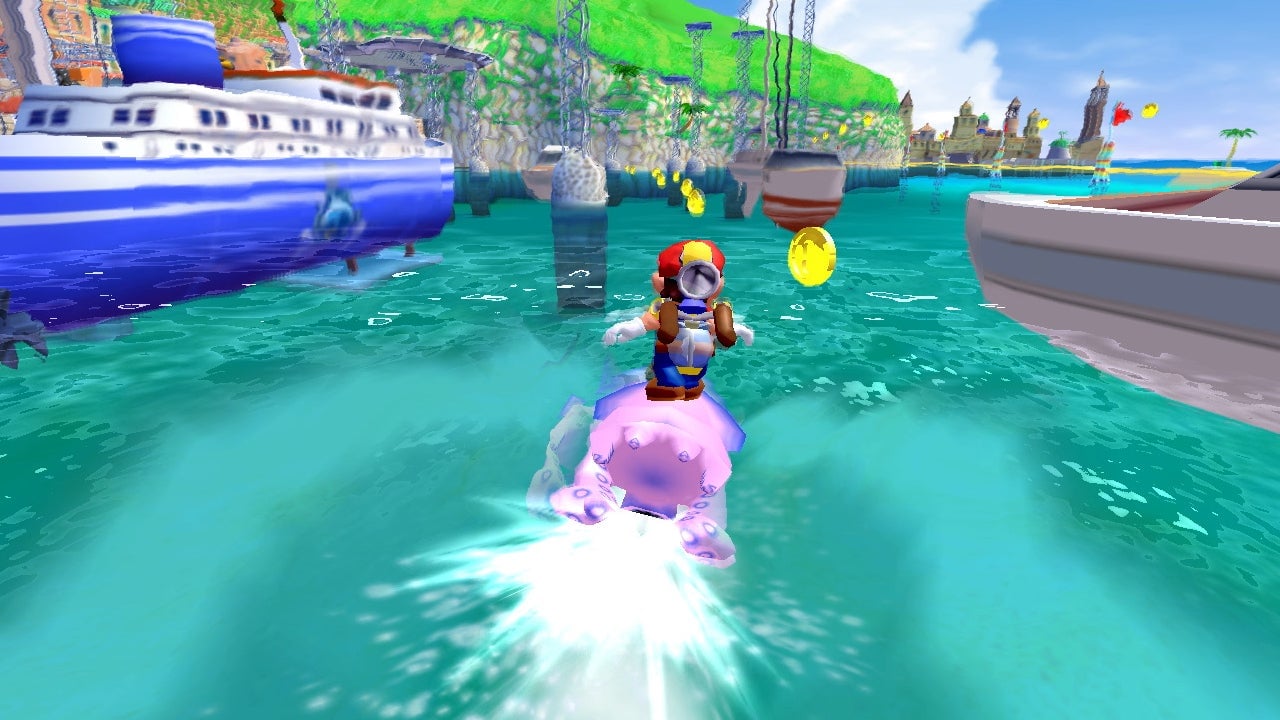
“Plenty of fuss has been brewing over Super Mario Sunshine’s graphics. It seems that some people think it looks awful and others think it’s gorgeous, and that schism probably isn’t going to change. I personally fit into the latter category; while there are a few nasty textures, most of the game is simply breathtaking. The character modeling for Mario and Yoshi is excellent, the draw distance is unrivaled, and the water is the best I’ve ever seen in any game. Simple but charming special effects are everywhere, from the little ribbons of light sucked into level entrances to the impressive motion blur applied sporadically. Then there’s the sludge. I don’t even want to know the technical mayhem behind applying these wonderful dynamic sludge textures. There’s something magical about spraying water at this colored goop and seeing it realistically be washed away. The effect is magnified when you meet enemies later in the game that actually leave trails of sludge behind them. I can’t see how anyone could not be impressed with the level of interactivity and life that these graphic achievements provide to the game.”
Basically everyone had great things to say about the actual platforming in Super Mario Sunshine, with and without FLUDD’s assistance. Hector Guzman wrote a five-star review for GameSpy in which he called Super Mario Sunshine “pure, ‘Video Game Crack.’ There just isn’t quite enough of it.” He also has a vivid description of what it feels like to run around Isle Delfino with Mario’s abilities:
“You haven’t played Super Mario Sunshine until you’ve run and sprayed water from your nozzle, slid stomach-first along the ground, leapt up onto a wall, bounced off it, and hovered onto the building’s roof. While second-rate developers are loading up their increasingly lame ‘animal avatars’ with 30-plus power-ups that haven’t been completely thought out or developed, Nintendo once again shows us how it’s done: Take one character, round him out with four different nozzles, and create dozens of moves around each similar device to create countless variations on hovering, Turboing, squirting, and rocketing. That’s the pinnacle of immersive gameplay in the year 2002 right there.“
For GamePro, Star Dingo puts the game in the larger context of Nintendo’s wildly creative GameCube releases, saying, “Link’s new cel-shaded PaRappa-paper appearance; Metroid reinvented as an FPS; Mario’s latest stint as an earth-cleansing Greenpeace spokesman; the mere fact that Pikmin even exists; many gamers have taken these as sure signs that Shigeru Miyamoto’s sanity meter has finally hit rock bottom. Here’s hoping the entire video game industry contracts a crippling case of mad cow disease.”
Dingo’s review, like others, also praised the controls, with some special love given to the GameCube controller:
“Rest assured, Mario’s new ability to squirt water isn’t merely a gimmick so Nintendo can say, ‘Look, it’s different’. Here, it’s as natural and integral a part of Mario’s move list as his wall jump, butt stomp, or just good ol’ fashioned ability to walk forward. There’s hardly a moment when you aren’t hovering or squirting or executing some sort of hover/squirt combo maneuver, be it to hose down an enemy, land a tricky jump, water a plant in the hopes of revealing some sort of pleasant surprise, or just giddily annoy the endlessly agreeable citizens of Delfino. The GameCube controller seems specifically designed for the task—double jumps, triple jumps, wall jumps, and backflips are executed with supernatural ease; narrow pathways are navigated effortlessly; and the analog shoulder button makes water cannon control a brainless affair. This is one of the tightest-controlling games you’ll ever play.”
And just one more, from Bramwell again. Everyone has such nice things to say about the controls and movement!
“Of course, the control system is about as perfect as we could have hoped. Mario’s adventures still involve performing otherworldly tasks in peculiar settings to collect stars (or ‘shines’ in this case), and control of him is very simple and easily picked up. Even the addition of the water backpack doesn’t cause any difficulties – you’ll quickly get the hang of switching between modes, hovering over gaps and using the jetpack mode to reach areas you didn’t think possible. You even develop clever little shortcut moves, like performing a backflip jump and then using the jetpack to climb a few extra feet onto a bit of netting in the harbour level, or performing a three-step jump to get maximum distance and then jetpacking the rest of the way across a ravine. It’s all very intuitive and you’ll fall in love with the changes as if they’d been there since the very first Mario titles.”
The biggest complaint mentioned by just about everyone is Super Mario Sunshine’s camera controls. Moving Mario around? Feels great. Moving the camera around Mario? Not so good.
“Nintendo has designed a few objectives where the camera is absolutely, frustratingly horrible,” writes Mirabella. “You almost feel as if no one playtested a few of these areas, as you’ll find the camera flipping out as it gets caught on and trapped behind walls. On the upside, the good far outweighs the bad. With practice, you’ll be able to set up more than enough intelligent camera angles to aid you through your adventure. Only rarely does the camera get so bad you can’t navigate yourself.”
-
Back-of-the-box quote:
"...this really is the only new Mario game out there." -Jeff Gerstmann, GameSpot, 2002
-
Type of game:
Wet
-
Time played since 2002:
Maybe a few hours here and there, mostly just when testing out emulators since it makes use of the GameCube's weird triggers and those are tricky to map to most modern controllers.
-
Liked:
Great use of the GameCube's weird, clicky analog trigger, the Japanese version says "SHINE GET" when you collect a Shine.
-
Disliked:
Awful and frustrating camera, the water pack gimmick wears out its welcome really quickly, the US version does not say "SHINE GET," which is a huge step down.
-
Does it hold up now?
It's about as flawed as it always was, but since it never got a direct follow-up it's perhaps a bit more interesting today due to just how different it is. It's easy to see this as the start of a phase where they were trying to figure out what to do with Mario after the success of Mario 64, and they'd eventually move onto the Galaxy games, which I only recently realized that I never really cared for. Is it because there's still some sort of little Sunshine DNA hiding in there?
-
Most memorable moment 24 years later:
I was asked to close my office door while reviewing Super Mario Sunshine due to all the cursing. Also, this review generated a great deal of reader feedback, due to it "only" getting an 8.0.
-
Final reflection:
This review is also memorable because it highlights an issue with GameSpot's formula-based scoring system. We gave component scores that were then run through a formula (gameplay and reviewer's tilt were the most heavily weighted) and the final score was, for the most part, out of our hands. While the component scores ended up working out to an 8.0 ("great" in GameSpot 2002 terminology) I do not think this game is great. I have never thought this game was great. Because it is not great. A few years after this I was able to significantly revamp the site's review system, putting control over the final score more directly into the hands of the reviewers.
This was also a sticking point for Gerstmann:
“Needless to say, you spend most of your time in Super Mario Sunshine controlling Mario. But you’ll also have to spend time controlling the game’s camera. Actually, much of the game’s difficulty comes from having to keep the camera in check while performing Mario’s otherwise simple tasks. The game is slow to auto-correct the camera angle when you change direction, and as a result, you really have to stay on top of the C stick to make sure you can see what you need to see. In addition to circling the perspective around Mario, you can also use the camera control to zoom in or out on the action. This can be helpful if your back is up against a wall, but sometimes even the camera controls can’t help you there, and you’ll be left looking at the back of a wall texture while a silhouette of Mario gives you a general idea of where he is on the screen.”
Another very common criticism was of the game’s voice acting (or lack thereof) and FMV sequences. “I am quite disappointed by the vacation theme and Nintendo’s stubborness to pay attention to presentation,” writes Mirabella. “The story and character design especially is poorly executed…If Nintendo truly didn’t care about the story, then it shouldn’t have even bothered to offer up the poorly done, compressed FMV sequences.”
There were a few other callouts I spotted in Super Mario Sunshine reviews that are worth mentioning. Allgame’s Scott Allen Marriott paid attention to the game’s manual, which he said was “in full color and features a number of attractive pictures to complement the well-organized layout” in a 3.5/5 review.
Nintendo World Report’s Jonathan Metts has apparently “been wearing these shorts for three days now. I used my last spoon this morning. Empty Dr. Pepper cans are everywhere. My apartment is in shambles. Mario has arrived.”
Given his review, it seems like Metts’ shut-in situation may have been brought about by Super Mario Sunshine being quite difficult, a factor which he uniquely honed in on:
“Sunshine’s level of difficulty is sure to become a hot topic as the game is released worldwide. To be blunt, it’s fricking hard. Hard like banging your fists on the floor. Hard like WaveBirds flying across the room. Hard like spending fifteen lives and over an hour just trying to beat one puzzle level. And yet, even when I’m cussing the game out, I can’t help but be thankful for the challenge. The frustrating parts are actually few and far between; for me, the difficulty is such that I can usually scrape by after two or three tries…just barely. It makes for an exciting game that you can’t just breeze through.”
And Metts really, really loves the music and sound design, too:
“The sound is practically flawless. Every song is beautiful, from the completely original tunes to the very innovative remixes of old favorites. If you haven’t heard the a cappella Super Mario Bros. theme that plays in puzzle levels, you haven’t lived. (We have it for download at our SMS game profile, by the way.) Billy and I both agree that the beat of that song helps our timing for the puzzle levels…how cool is that? The music is sometimes exciting, sometimes soothing, but always very well done and quite smile-inducing. Sound effects are also great, especially the many water sounds associated with your backpack.”
I’ll let Cooper’s enthusiasm have the final word on this one, as he concludes his review:
“This is an adventure so addictive that you’ll be forgiven for believing that Nintendo has built a mini tractor-beam into the disc. Prepare to have your sleep patterns disrupted, and stock up on provisions, because once Mario Sunshine is locked and loaded in your Cube, it’s not leaving, and neither are you. Simply put, this is the best platform game. Ever.
“Step into the ultimate playground. When you’re faced with a challenge or puzzle, you can be assured that the correct way to overcome it is also the most fun solution. And it’s this devotion to pure concentrated fun that makes Mario Sunshine‘s gameplay so astonishing and rewarding. It’s a mammoth sugar-coated slice of gaming genius that will provide you with some of the happiest hours you’ll ever spend in front of your telly.”
The story you just read is part of the 2002 edition of Warp Week, a Kotaku series that takes readers back to gaming’s past through a mix of time-dilated reviews, retrospectives, and on-the-ground reports.