The release of GPT-6 Astra from Open AI has led to the familiar hype cycle that accompanies the launch of any AI model: a much-hyped announcement video, a rollout, and a cacophony of hardcore AI tech people rushing to excitedly share how this new model is going to take away jobs with “shocking” advancements they will decry as minor and insignificant by the time the next model rolls around. This time, Astra’s most talked-about feature is its ability to take control of a person’s computer within programs often used for 3D game development such as Blender, with those people using it to “create” their own games.
Naturally, this has led some to proudly proclaim that GPT-6 has the ability to revolutionize gaming, creating outlandish experiences without the need for human assistance. To prove its ability to develop its own unique and original video games independent of human input, these testers are showing how it’s possible to use Astra to, well, recreate already-existing games that required humans to conceptualize and create originally, except functionally worse in nearly every way.
it may soon be cheaper to rebuild/clone games than to buy them at the store…
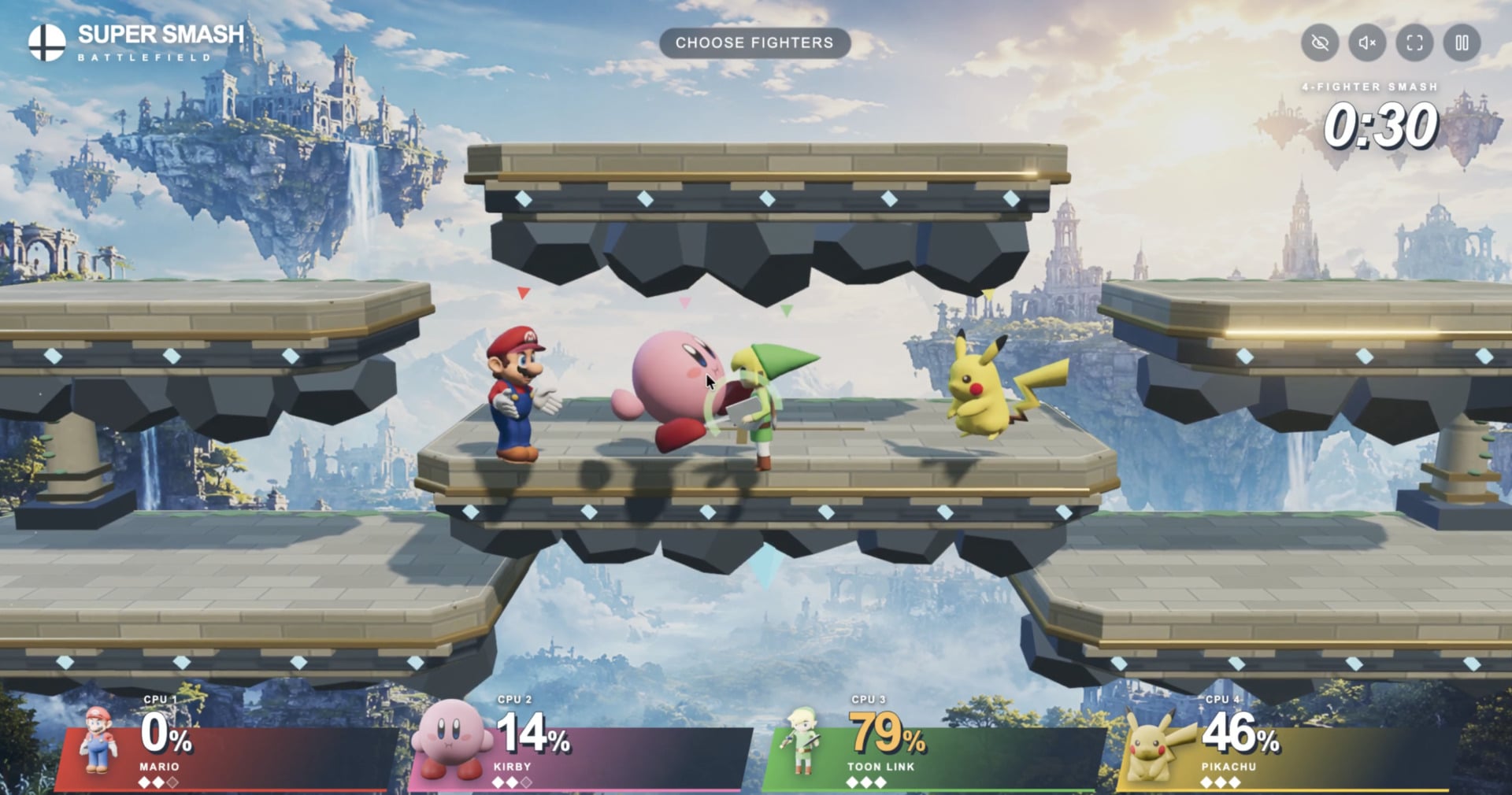
it cost about $10 of compute each to knock off Super Smash Bros, as well as mario kart and a few others
built with Astra ofc
this isn't full game quality and no online vs. mode or all the maps, but… pic.twitter.com/4ngpYa5nId
— Zaddy (@zaddyfi) September 6, 2026
Nintendo characters and IP have become a natural target for this. Rumors are swirling that a new Super Smash Bros. game is in development ahead of a Nintendo Direct later this week, and the question on many people’s lips is whether the event will lead to the game’s grand unveiling. Yet according to AI evangelists, there’s no need to wait. A “new” Smash Bros. exists now, thanks to AI. Sure, the physics and animations are missing, as are full gameplay modes and anything beyond an initial stage, and it’s all built using characters that neither the AI nor the prompter own, but what does that matter?
GPT-6-Astra (Max) VS GPT-6-Astra (Medium) – Simple 3D Sonic Game In Godot
Astra on Max took 53 minutes and used 4% of my weekly usage on a Pro x5 Account. Astra on Medium took 25 minutes and used 1% of the weekly usage pic.twitter.com/obw8r6pC8k
— AiBattle (@AiBattle_) September 4, 2026
Many other attempts are similar, and also significantly worse. There’s a Sonic the Hedgehog ripoff, except somehow devoid of color, proportion, or a sense of speed. Someone else whipped up a recreation of Contra from the NES with realistic visuals, but visual clarity is thrown out the window, the jumps look horribly floaty, and our heroes seem impervious to enemy fire. How about The Simpsons: Hit and Run, except the car doesn’t move correctly, there are no characters, and the sun blinds you?
It has taken GPT-6 Astra about 15 minutes to extract this PS2 game, including the initial graphics and maps. It's now adding in the characters and then said it's going to use Blender to modernize the graphics. pic.twitter.com/eD8IR7AwUI
— Dwayne (@CtrlAltDwayne) September 7, 2026
What’s missing from these renders are original ideas, rather than a use of resources to take things that already exist and remake them in ways that are demonstrably worse. There’s also no consideration for how, even if such technology were used to create original games, any generated result would need to be refined and optimized, undergoing the complex interweaving of mechanics and refinements necessary to create an actual decent game. Never mind the brazen use of the IP of others.
It’s all especially notable with these experiments coming at a time when the demands of AI technology have increased the cost of RAM and other crucial computing parts to the point that the consoles needed to play the games they render keep on rising in price. DLSS 5 is another recent AI experiment in gaming whose results have left players more horrified than excited, and even that, in its leaked, experimental state, was reported to cut framerates up to 50 percent and harm the player experience. Maybe a future of AI-fueled gaming is not going to save us.