
Hades is amazing. The latest from developer Supergiant Games (Transistor, Bastion, Pyre) is a roguelike set in the unforgiving underworld of ancient Greece. Playing this game means you’re going to die—a lot. These tips should help make sure those (many, many) deaths aren’t in vain.
[This post originally ran on 9/17/2020. We’ve since updated it with some additional advice, and are re-running it today for the game’s release PS4, PS5, Xbox One, and Xbox Series X/S]
Brush up on the Greek gods.
The characters in Hades are well-realized and compelling even if you know squat about Greek mythology, but a rudimentary understanding of the Greek mytheme makes this game that much more satisfying. The narrative unspools non-traditionally: With each run, you learn more about—and meet more—characters from legend. Seeing how Supergiant plays with millennia-old stories is endlessly fascinating.
A working knowledge—something you can glean from skimming Wikipedia entries—will serve as a fine foundation. It helps to know who the Olympians (Athena, Aphrodite, Dionysus, and the rest of that exalted pantheon) and major mythological figures (folks like Eurydice, Achilles, or Sisyphus) are. Chthonic figures (Charon, Cerberus, Nyx, and, of course, Hades) are good to know, too.
Talk to everyone.
Between runs, you’ll find yourself back in the court of Hades. Some characters will have an exclamation point over their head. Talk to all of them. There are practical reasons for doing this (sometimes, they’ll open up parts of the game that were previously locked, like the Mirror of Night), but the truth is that conversations are just delightful. As my colleague Nathan Grayson pointed out, chatting with the characters teases out backstories and personalities at an organic rate. You get to know them just as you would real-world people.
There are alternate skills.
As you play, you’ll earn Darkness, a form of in-game currency that’s used to level up your skills by gazing into the Mirror of Night. After a few escape attempts, if you take the time to speak to everyone, you’ll open up the option to shift how those skills work—and some alternate options are truly game-changing.
For instance, the Death Defiance ability will bring you back to life with half of your health restored when you die, but it has a limited number of uses, dependent on how high you rank it up. Its alternate, Stubborn Defiance, only restores you with 30 percent of your health, but you can use it once per chamber. Considering a complete run will take you through more than 50 chambers, Stubborn Defiance is an invaluable ability for newcomers.
Some alternate skills tweak your dash (maybe you’d prefer an extra use rather than a damage boost). Some dictate whether you start with more money or earn more money as you go. Some govern the variables necessary for a significant attack boost. Before you dump all of your Darkness into the skills initially available to you, wait until you’ve opened up the alternative options.
Prioritize finding Chthonic keys.
If you mess up how you want to allocate your skills, don’t worry: One Chthonic key will return all of your Darkness. But that’s not all these trinkets are used for. You can also use them to reveal more skills in the Mirror of Night—and you can use them to unlock more of the game’s weapons. Pretty good, right?
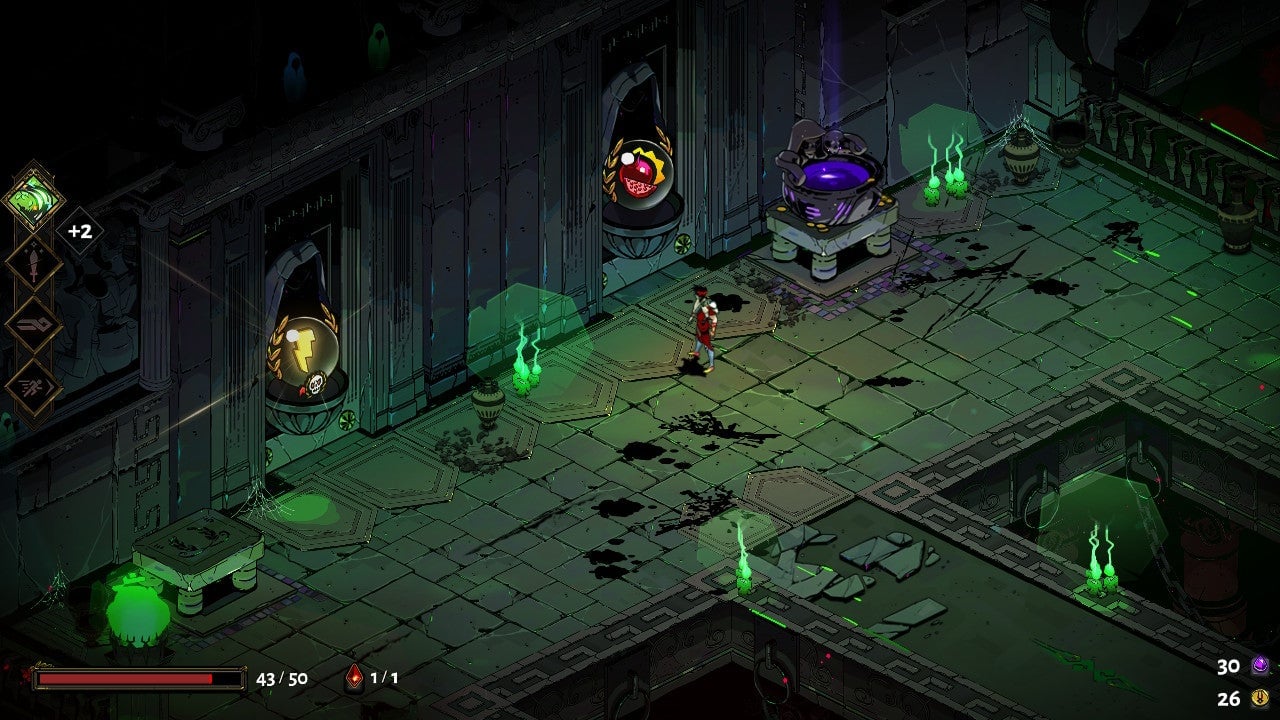
At the end of most chambers, you’ll face a crossroads. On the front of each door, in a clear bubble, you’ll see what reward awaits you in the next chamber. If it’s a coin, you’ll earn some gold for clearing the next room. If it’s a purple crystal, you’ll earn some Darkness. During your first few runs, go through the doors with key symbols on the front. In the early game, few items are more key than Chthonic keys. Opening up your whole suite of available weapons and abilities is roguelike 101. Do so as soon as you can.
Then focus on Daedalus hammers.
If Chthonic keys aren’t available, focus on various upgrades that buff Zagreus to pantheonic levels. The best of such are Daedalus hammers, which are indicated by a hammer-shaped icon. (Sorry to disappoint fans of Hephaestus, but the smithy god isn’t in this game, though his wife, Aphrodite, does make the occasional snide remark about his absence.)
When you find a Daedalus hammer, you’ll get a chance to tweak how your equipped weapon works, usually for the better. Each hammer offers up a choice of three potential upgrades. You might be able to expand the window for a critical shot with the bow, or extend the reach of the spear by 40 percent. Some change the weapon entirely. For instance, you could turn the Adamant Rail’s lob attack into a rocket-propelled missile. (Yes, Hades has “modern” firearms.)
Read More: How To Unlock All Six Hidden Weapon Aspects In Hades
A late-game skill can increase the rate in which hammers can show up, but for all intents and purposes, Daedalus hammers are extremely rare. I’ve found that one tends to show up in Tartarus, the first area, on most runs. I’ve also found that one usually pops up in the third area, too—a place whose name I’ll withhold because its reveal is something you should experience yourself. Beyond that, you probably won’t find any, so if you see one, go for it.
Then boons.
Next to Daedalus hammers, boons from the Olympian gods are the best thing you can go for. These are indicated by brightly colored unique symbols, and give you a significant buff from a specific deity. For instance, if you see a green arrow, you’ll get a boon from Artemis, the goddess of the hunt. Zeus, meanwhile, is marked by a yellow thunderbolt, while Poseidon, the luxuriously bearded god of the sea, shows up after you interact with a blue trident.
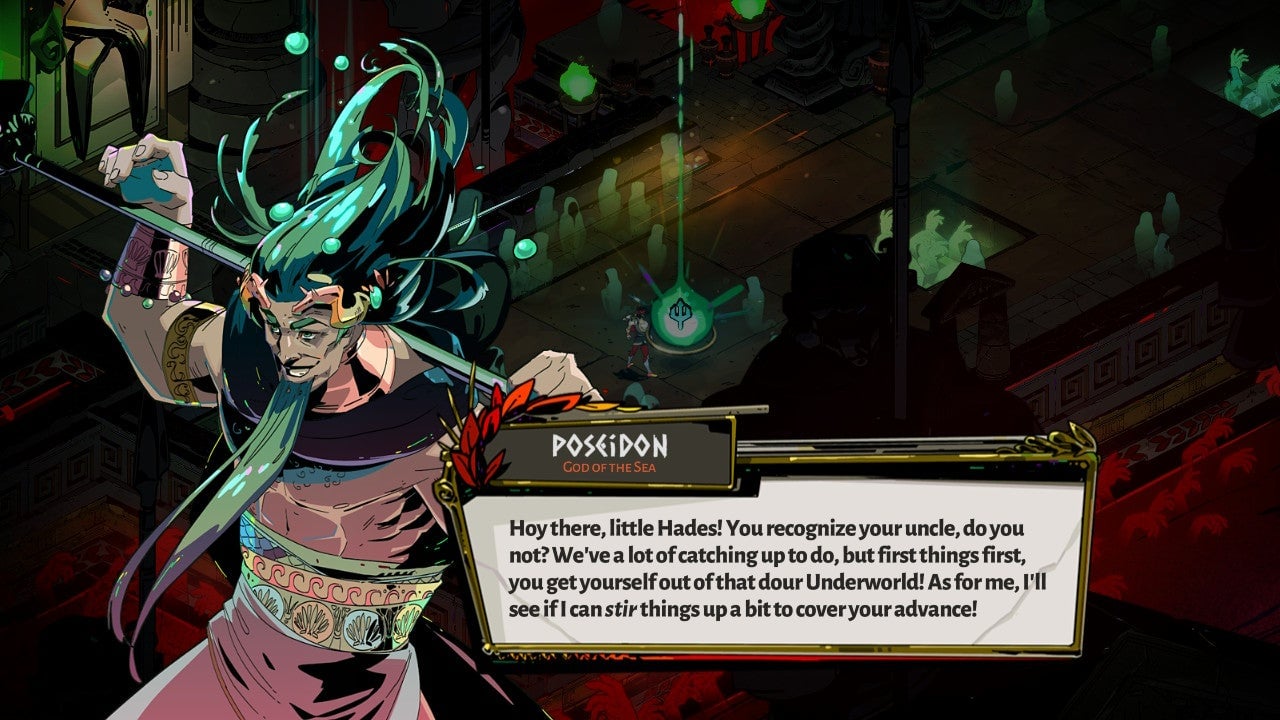
In general, the more boons you have, the stronger you’ll be. Each Olympian offers boons in a different category. Athena’s, for instance, tend to buff your defense and grant you deflection abilities. Ares—go figure, since he’s the god of war—offer attack boosts. Dionysus, the wine god, offers boons that inflict “hangover,” a status effect that deals damage over time.
It’s all a matter of playstyle, something that will slowly crystalize for you the more you play. But there are some that are always worth going for, no matter the player or the situation:
Cast boons: Zagreus starts out with the ability to “cast” a damage-dealing projectile. In its base start, it’s a relatively weak arrow, but augmenting it with a boon can transform the projectile into everything from an enemy-hopping ball of thunder (Zeus) to a potent bog of wine fumes (Dionysus). You can only have one at any given time. Finding one in the early game can make those first few chambers a breeze.
Duo boons: These are circumstantially contingent on already having a boon from a compatible Olympian. For instance, if you stumble upon a boon from Demeter, the goddess of the seasons, you might be able to supercharge Poseidon’s cast boon. Even if you don’t know how they’ll fit with your build, they’re worth trying out due to rarity alone. You never know when the Fates might align and give you another chance.
Trial of the Gods: If you see a door with two boon icons, go through it. You’ll be forced to choose one boon. Whomever you don’t choose will throw a small army of enemies at you. If you defeat them, you’ll get that second boon as well. In the underworld, a two-for-one deal is as good as you’ll get!
Don’t be afraid to sell boons.
After you clear each region of the Underworld, you’ll come across a shop that allows you to sell off some boons. (These storefronts sometimes pop up in normal chambers, but you can’t count on that.) If a loadout isn’t working for you—say, you’re optimizing a build for speed but are saddled with Dionysus’ slow-lob cast—make like the heroes of yore and wash yourself of your bad boons.
Each shop will make an offer for up to three of your boons. There’s no shame in selling off the ones you don’t like and curating your loadouts by region. Generally speaking, bosses and minibosses serve as a good metric for whether or not a build is working for you. If you can barely make it through one of those chambers, you should consider switching things up.
Give your nectar to Skelly.
Throughout Hades’ domain, you’ll find various bottles of nectar. You can give these bottles as gifts to most characters in the game. The first time you do so for each character, they’ll give you a keepsake in return, an equippable item that grants a small stat boost.
The Olympian gods offer you a variety on a keepsake that ensures the first boon you find in a given run will be one of theirs. The deities in Hades’ court, meanwhile, tend to give you keepsakes with more tangible effects, like an attack or health boost. Do what you will based on your own playstyle, but give your first bottle of nectar to Skelly, your talkative training dummy. His keepsake gives you an extra life. The more you level it up—you can level up keepsakes by clearing chambers when they’re equipped—the more health you’ll revive with. By the time you’re at a point where you can take on the final boss, you’ll want it maxed out.
Control the Fates.
Like most roguelikes, every run in Hades is generated randomly. But that doesn’t mean you can’t exert some control. At the start of every run, you’re granted an Olympian boon. By equipping a deity’s specific keepsake—if you have it, of course—you can determine who grants you the first one. Understanding which weapons match best with which boons is key to starting your loadouts off on the right foot.
I know, for instance, that the bow pairs well with shock abilities. If I’m planning an archery run, I’ll start things off with Zeus’ artifact equipped. The spear is best used for keeping enemies at a distance, so it’s good to match up with Poseidon’s boons, which tend to push enemies away. Mix and match until you find killer combos that work with your playstyle.
Reconstruct Hades.
To the left of Hades’ ostentatious desk, you’ll find the House Contractor. In exchange for resources, this silent fella can build various upgrades throughout the realm. Some are cosmetic; don’t bother with those. The important stuff will be designated as either an Underworld Renovation (“an enhancement to some part or artifact of the ever-shifting underworld”) or a Special Item (“an object that unlocks something you could not do without it”).
At first, the House Contractor only has a few jobs. As you unlock more, you’ll open up more jobs. The most crucial of these upgrades is the Fated List of Minor Prophecies. Unlocking this will, in turn, unlock a whole litany of various objectives. Completing those will earn you more resources, which you can use to get more upgrades.
If the going’s tough, turn on God Mode.
Let’s say you, unlike Zagreus, are sick of dying. In the settings, you can turn on God Mode, which will make you tougher. Better yet, that toughness will compound the more you die, so you quickly become an unstoppable machine. For those who can’t stand the roguelike grind and want to just soak up the game’s story, God Mode is an indispensable tool.
Or, just check out our (mildly spoilery) guide for making it to the end—well, for the first time.
Text too small? Zoom in (on Switch).
Pretty much all text in Hades—from the menus to the subtitles to the boon descriptions—could generously be described as “fine print.” It’s even worse if you’re playing on handheld. At the moment, the game doesn’t have a setting to increase the font size, but you can make use of the Switch’s built-in zoom feature
Go to the system’s settings. Scroll down to the “System” submenu and toggle the “Zoom” setting on. Once you do that, you’ll be able to double-tap the Home button to pull up a digital magnifying glass, of sorts: Press X to zoom in on a portion of your screen, or press Y to zoom back out. (Note that this feature doesn’t pause your game, so be sure no enemies are around before trying it!)
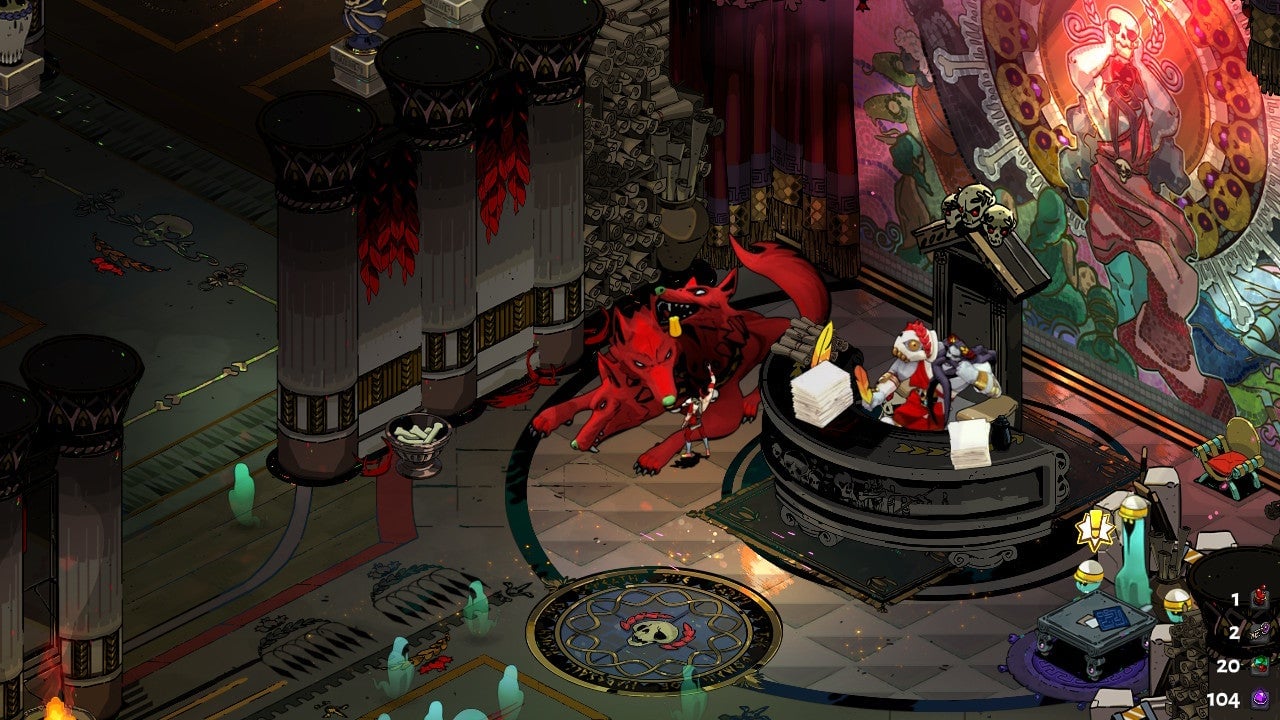
Yes, you can pet the dog.
Just play.
Hades might seem as straightforward as any other dungeon-crawling roguelike: Go into one room, kill all the enemies, go into the next. But that’s just the surface-level stuff. As you play and open up more of this wondrous game, you’ll slowly begin to realize that Hades is as deep as Hades itself.
A dozen hours in, you might meet a character who blows your mind to the peak of Mount Olympus. At 20 or 30 hours, you might open up a previously hidden gameplay system that completely changes how you play. Finishing a run is just the beginning. As the game so often likes to say, there is no escape. Might as well make the most of it.