Six years ago, the games industry said Black Lives Matter. During the protests nationwide (and beyond) over the police murders of George Floyd and Breonna Taylor, there was no ignoring people’s rage and the clear truths that fueled it. The games industry, as well as society, found a mirror held up to itself regarding racism.
This period reinforced that the North American games sector has always operated under and reflected the social, economic, and political systems of the nation in which it is based. We spoke with a cohort of Black game developers to assess the industry’s responses to 2020, to understand the realities of the industry today in all its contradictions and challenges, and to examine its ongoing relationship with Black professionals.
The empty gestures of 2020
In the midst of the wider racial justice movement of 2020, numerous game companies publicly announced donations to Black organizations, businesses, and efforts against racial injustice. Ubisoft, for instance, donated $100,000 to the NAACP and Black Lives Matter. Square Enix, meanwhile, said at the time that it would contribute $250,000 to the Black Lives Matter organization and other charities.
We stand in solidarity with Black team members, players, and the Black community. We are making a $100,000 contribution to the NAACP and Black Lives Matter and encourage those who are able to, to donate. #BlackLivesMatter pic.twitter.com/KpHZCF6VWx
— Ubisoft (@Ubisoft) June 2, 2020
#BlackLivesMatter (1/2) pic.twitter.com/luAbZQWmuQ
— Square Enix (@SquareEnix) June 2, 2020
While on the surface these gestures may seem like sincere efforts to help address the racial inequities that exist in the United States, they can more honestly be viewed as moves meant to generate good PR, and understandably received criticism as a result. In their book Laundering Black Rage, authors Too Black and Dr. Rasul A. Mowat offer a frank appraisal of the actions of many U.S. companies at this time.
“How was the contagious Black Rage provoked by the police officer’s knee on a poor Black man’s neck converted into a benign commodity that could be massively marketed by corporations?” they ask.
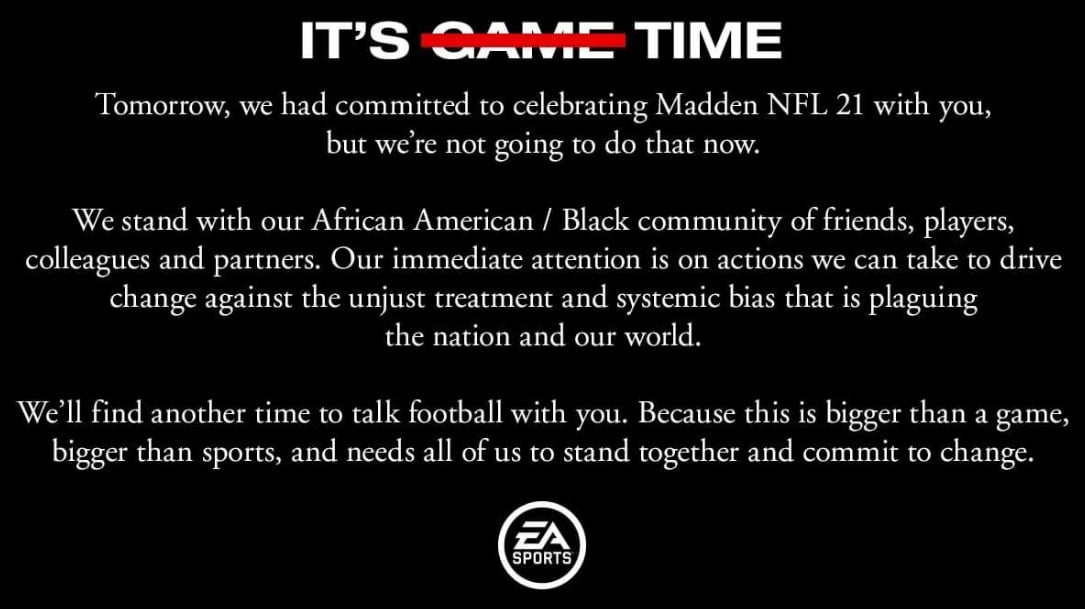
Among the companies making such pledges was also EA. The publisher, on a now-deleted page titled “actions-against-racial-injustice,” said it would contribute $1 million to organizations such as the Equal Justice Initiative and the NAACP Legal Defense and Educational Fund. It’s unknown why that landing page was removed.
Former EA and Respawn narrative designer Jarory De Jesus believes the decision to remove the post was likely political. The current presidential administration is fiercely anti-DEI, and has taken measures against some businesses that have DEI policies, while threatening to take measures against others.
“It has to do with the current political environment,” says De Jesus. “In 2024 and subsequent years, you saw a lot of a shift away from positive outlooks on diversity, towards a more ‘neutral’ stance. It’s not really a neutral stance; no stance is neutral,” he explains.
De Jesus juxtaposes EA’s decision to take down the page with the support he received while working at mobile game developer Scopely in 2020, during the height of the protests. The publisher told its staffers that it had allocated a million dollars to support any facing legal issues for engaging in protests. If employees wanted to attend protests, they would be supported. This support wasn’t something the narrative writer felt while at EA.
Still, the years weren’t all bad as the industry preached more diversity and equality. De Jesus also felt that supportive sentiment was present during his time at Respawn Entertainment. He helped with the efforts of the company’s DEI board while concurrently, the Apex Legends team was working on trans hero Catalyst.
Eventually, however, the industry-wide support that had started in 2020 stopped. Nearly everyone I spoke to noted that any serious efforts initiated during that period had mostly wound down or been shut down three years later.
Parallel with this, the Supreme Court effectively prohibited affirmative action in 2023. Additionally, in 2023, a wave of anti-trans laws was passed across the country. This effectively gave the current presidential administration a runway to go after firms and programs it believed were antithetical to American values.
De Jesus says, “It’s really unfortunate because we were making a lot of progress, you know, at least in terms of representation in games. It’s not [as if] we’re out here making technology that’s going to redefine someone’s livelihood. We are going to maybe help people identify and find the right way to express themselves.”
Meanwhile, among the changes that have taken place over the years, layoffs and studio closures have become as commonplace as game releases. It must be understood that the broader layoffs affecting millions in America are a response to a combination of factors including real-world market forces, AI adoption/implementation, U.S. geopolitical warfare, inflation, tariffs, and so forth.
De Jesus reflects on the years of widespread layoffs in the games industry and what they have meant for him. He says, “It pains me to see people who I know are clearly talented, clearly driven, hardworking, inspired individuals that just get laid off without any notice…I think the biggest [loss for those who remain] is the cultural stuff. When you lose pillars of your community within your company, that can be devastating. Because, especially at the AAA level, it allows you to reshape a culture into something more homogeneous, safe, and less organic.”
The game writer adds, “The other thing that I think is worth mentioning is…you’re going to see a lot more smaller indie and AA studios popping up from those same talented creative professionals that were let go.”
Navigating contradictions
The year of racial justice uprisings was also an interesting time for nonprofits to navigate as donations and contributions came in, according to Catt Small, executive director of Game Devs of Color, Inc (GDoC).
Small explains, “I think we were really grateful for being given the funding that we could then route to people who needed it. [It] was something that was really meaningful for us. But because of what it was tied to at the same time, I think we all felt internally that this was temporary. This was something that was tied to a moment, and it was possible that the moment was not going to result in longer-term consistent structural change. While we want that to happen and are working toward giving game developers of color the power to be able to create that long-term change where they can support themselves and tell the stories they want to tell…while we want that to happen and are working at that, we had a strong feeling that for primarily white institutions, this was a temporary optical presentation.”
But while Small is well aware that gaming companies may have their own motivations for these initiatives, she’s also frank about the fact that GDoC wants to achieve its mission, which is to amplify the creative power of people of color in video games. This effort requires receiving help from all interested parties, even if they are largely interested in a good one-off PR story.
Expanding on her point, the executive director says, “At large, especially primarily white institutions, they’re mostly thinking about things on a quarterly basis. That’s part of it; the way that capitalism is structured encourages people to think about things in terms of what will be perceived in that particular moment.”
The occasional donation, however, is far from sufficient to address the daily material conditions of local Black communities.
While she’s been a game maker for 14 years, the GDoC executive director says that especially now, she doesn’t fully trust the games sector to provide her with a livelihood.
She explains, “It is really challenging as an industry. Because the reality is that games are these interactive experiences that are very based on feelings. They touch people emotionally, which can require a lot of work and is very creative, which is what draws me to it. At the same time, we’re trying to [create these works within] capitalism, which is inherently about what is the quickest way that we can extract money from people. There’s a tension there.”
She acknowledges that marginalized people still need material help. This means having access to resources, mentorship, and opportunities for connection, which GDoC regularly offers.
Small explains, “Access to capital is what matters most, for most people; mentorship and relationships are also incredibly valuable, but the difference between somebody actually building that idea that becomes the next major hit and not doing that is money.”
There was a brief window of what could be called “we understand your problems, Black people.” However, that led to a larger, reactionary formation of racist, sexist, and homophobic antagonism toward games and developers from a vocal minority. Gamergate 2.0, while lacking the headline-grabbing scale of the original, nonetheless permeated online culture as an effective misinformation and disinformation campaign, much to Small’s chagrin.
She explains, “I think there’s a narrative that Black people have been in power this whole time and are forcing all of these game companies to put stories that they care about in place…It has been over a decade of just people, game devs of color, women, queer people, just being harassed constantly.
“I’ve had friends and great people that I know who had to lock down their social media, or they’ve been laid off from companies in part because of something that was taken out of context.”
Mixed messages and broken promises from the inside
Again, those making games and working in the business of games can’t escape or ignore reality, as EA alum and programmer Kat Barkwell highlights in her account of beginning work in the sector. Before working in Edmonton, Alberta, her father cautioned her about the city’s deep issues of systemic racism. But it also happens to be a game development hub.
Starting out at BioWare developing Anthem, the programmer first joined a women’s employee resource group (ERG). However, she left the group, citing its nearly-all-white composition, which didn’t align with her values. She eventually found a better fit in the BEAT (Black EA Team) ERG.
Eventually, Covid-19-era remote work led to a positive turn in her career, as she had her first Black manager.
“[The] advice I got from well-meaning managers before just wouldn’t apply to me because I’m a programmer, I’m quiet, I’m introverted. [They’d tell me to] keep my head down, do good work, ‘people are going to see that.’ And then my [first Black] manager [said], ‘They think you’re lazy. If you don’t talk about what you’re doing all the time, they’re going to think you’re lazy…You gotta show it to them.’ And that made a big difference in my career,” the programmer explains.
Also, following the industry’s broader acknowledgment of racial issues, EA leadership became receptive to suggestions of support for causes such as GDoC and local organizations that assist marginalized game creators and future developers. Barkwell dedicated time to those efforts to make the industry more inclusive.
But when the expiration date for so-called racial solidarity came, emails requesting contributions were eventually ignored. The BioWare alum says the shift revealed that the attention paid to these issues by EA and other corporations had been shallow from the beginning.
Working through this and seeing layoffs hit EA led Barkwell to become increasingly frustrated with the industry. These frustrations, along with her experiences, served as the basis for an analytical presentation she gave for GDoC last year.
“How do you not be pissed all the time working in this industry? I’m filled with rage all the time, and I don’t have anywhere to put it, cause I’m mad and it sucks, and I tell people ‘hey, that’s super,’” the programmer explains.
Barkwell continues, presenting a socio-political analysis that gets to the heart of the matter by examining society’s overall reaction to 2020.
She says, “You’re here, and you want more people here…I’m trying to do everything I can to make sure it’s hospitable. They’re happy to spend you as a token and currency. When it’s the right time for it, and you know, a token is there to be spent. Then once it’s spent, that’s it. So you can kick and scream about it. I guess that’s how I felt about it, bad, yeah, but not surprised at the same time too. Of course, that’s what they always do, right?”
After working on 2025’s Skate., the programmer made the choice to leave AAA game development for a better work environment, a better culture, and peace of mind.
Black people are talent, not a resource
2020 can also be understood as a time when the issues that Black people in games had been observing and speaking about for years became, however briefly, impossible for others to ignore. Analyzing these observations and conditions has been a part of the career of some game developers, such as Tanya DePass. The conversations echoed the work she began when establishing the non-profit I Need Diverse Games in 2016.
“[The 2020 support for Black folks] felt basically [like] taking the guilt, the anger about what was going on in the industry and what was driving many of us out—a lot of femmes out, a lot of queer folks out, a lot of trans folks out, the forces that were trying to get rid of us, compounding that with, hey, you know what, you could do something about this,” she says.
Looking back, she recognizes 2020 and the few years afterwards as a golden era. She was able to get work contracts, share contracts with others, and offer referrals for projects.
However, the industry has since contracted due to economic shifts and waves of job cuts. DePass cites the closure of Cliffhanger Games, the cancellation of its Black Panther project, the shuttering of Monolith Productions, and the sunsetting of its Wonder Woman game as particularly damning.
Additionally, she says that this targeting of games featuring Black and female heroes for cancellation lends a false legitimacy to the online hate mob against diversity, allowing them to feel correct in their belief that “true gamers” aren’t interested in games that prominently feature such characters. However, the writer emphasizes that paying attention to this hateful minority is not important to the business of game-making.
“These are the people who claim they love games, but don’t want everyone to access them…We saw Gamergate try to rise up again a couple of years ago. Y’all don’t have anything better to do? Wait, you don’t,” she says.
Returning to the subject of job loss, DePass notes that the industry has become a rat race for employment. She adds that requiring employees to move to expensive cities for roles doesn’t make sense, either, when the possibility of layoffs hangs over people’s heads like the Sword of Damocles. Making matters worse, recent reports reveal that Black applicants must also navigate biased technology when job hunting.
What’s also top of mind, she explains, is that these waves of layoffs are resulting in a brain drain for the games industry. In totality, DePass says, “the state of the industry is fucked up.”
She refers to the GDC State of the Industry report, which surveys game developers in the U.S. to get a sense of the industry’s racial and ethnic composition.
DePass notes that 30 percent of those surveyed identified as queer. Getting more granular with the data, the industry is 64-percent men and 67-percent white. A majority of people working in the industry fall between the ages of 25 and 44. DePass draws particular attention to the stat line for Black game developers, who make up 5 percent of the reported total.
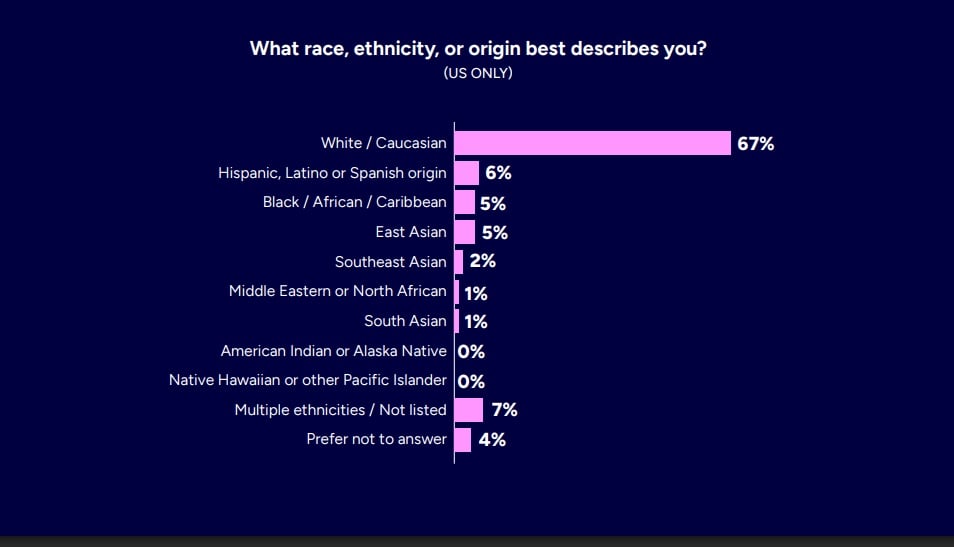
“In the 12 years since I’ve been doing this work, still the majority is 67-percent white dudes, and we are only 5 percent. That has only gone up 2 percent since I started doing this work. The first year I looked at one of these, we were only 3 percent of the developers that were self-reported in the developer satisfaction survey, which is the industry-standard [source of data],” she explains.
Still, DePass acknowledges that there are more Black folks in gaming now than there were in the past. She highlights the Black in Gaming Awards, for example. However, she cautions that the industry is still functionally exclusionary. For example, GDC is recognized as a good networking event. However, it comes with a high price tag, prohibitively high for many working-class people. And even if people are able to get tickets to the show, they’ll still need to obtain air travel and a hotel stay in, in one of the most economically antagonistic cities in the US.
Capitalism really isn’t working for workers
Senior character artist Del Walker has done a series of YouTube videos in which he discusses his experiences in game development and the multifaceted economic precarities that game makers face.
In one episode, Walker says, “My issue is that the cost of living is now untenable for most people…Capitalism is now at its threshold moment where I need to figure out how to survive the tidal wave. Simply put, the growing costs of development and the standard cost of living, particularly in California where the majority of the U.S. games industry operates, result in a reality where it’s not possible to make anything without insane risk.
“You have people on payroll at a studio, you need to pay them the cost of what it is to be in a city. That’s where all the talent is, and no one’s really addressing why it costs so much and is so high-risk… because no one has solved the problem that houses shouldn’t cost millions. I’m looking at it more from the point of view that this is not getting better; in fact, it’s accelerating, it’s getting worse,” he adds.
When asked specifically whether relocating the industry to lower-cost areas in the U.S. would be a solution, he replies, “You’re not really changing the source of the sickness if you keep saying, well, everyone just needs to just not be in California.”
“OK, cool. So do we just play the same game in Atlanta? Is this what we do? We find a hub, and then we just burn it out and make it untenable to live there, and then say, hey, everyone, we’re moving to South Carolina, what’s the game?… It’s seeing the plague is spreading, and you just move north? And that’s your answer every 15 years?”
Walker cites Matthew Ball’s State of the Industry Report to illustrate how the industry got to where it is today. Six years ago, with covid-19 keeping people indoors, the gaming industry received a revenue boost it hasn’t seen since. This resulted in companies becoming ambitious (some would say misguided) as they expanded their employee numbers, investments, and merger and acquisition activity—arguably beyond their scope.
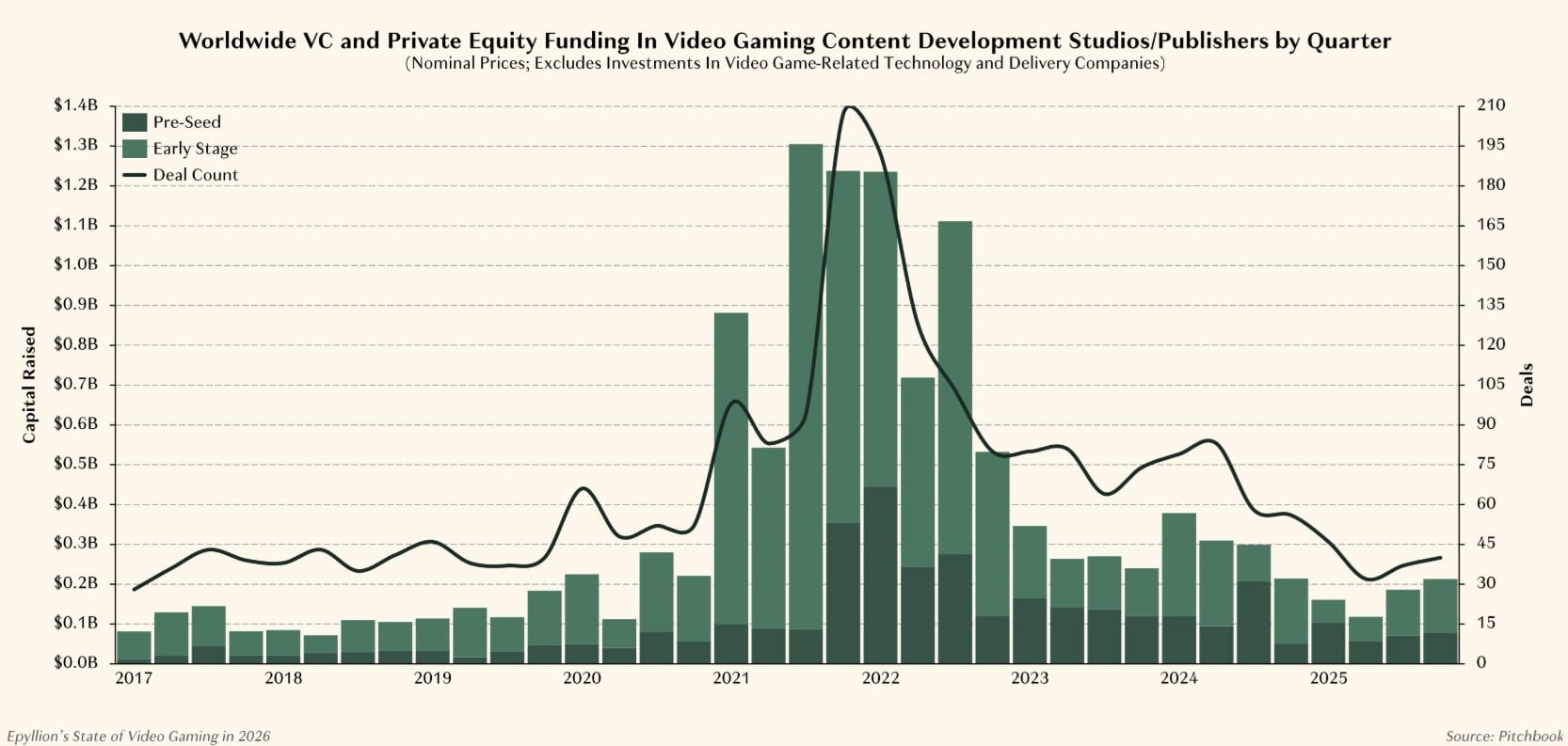
Walker explains, “The largest problem is definitely still a greed problem, because you had in 2020, when everyone got locked into COVID, and everyone was trying to figure out their shareholder value…You have a harder fall when you realize that the numbers you were hiring on were predicated on temporary situations or kind of finessed.”
He continues, “But where it fell down is larger than it was pre-pandemic, so the games industry is growing, it just should have never grown that fast. And there was a lot of hurt and pain caused by exploding that quickly. There are a few other things that are happening there as well, because you also have companies that went from small to medium, and you had medium companies that went from medium to enormous.”
To his point, the chase for 2020’s revenue, the changing economy, fewer investments in games, and other such factors have largely led to job losses and studio closures.
Where do these economic shifts leave the Black proletariat? Historically and presently, data supports the fact that when the economy is facing a bad time, Black workers across industries are often the first to be laid off.
Walker also said that the current state of the industry calls for more game professionals who are generalists rather than specialists. He argues that most current job listings in the games industry are effectively “asking for Jesus to apply.”
Manufacturing a boogeyman
The summer of 2020 also created conditions in which firms could gain unique institutional insights. Sweet Baby Inc. co-founder and CEO Kim Belair explains that the narrative and consultancy firm was, in part, able to observe how corporations were approaching the “racial reckoning” matter while working on game projects.
“[Corporations] did not want to get left behind, and I think a lot of money was put [into appearing to support] a lot of folks’ current games industry careers. Money started to show up behind some of these promises. I think it was misleading for some, an opportunity for others, and a kind of true deception for more people.”
The Sweet Baby CEO recalls an observation she made while working on portfolio reviews for Black and marginalized writers, offering feedback in an effort to help them improve their chances of finding work. Belair explains, “These portfolio reviews, while very kind and very important to the betterment of our craft…[were] not in any way addressing the actual problem. Because if we’re going to be honest, our industry is racist, sexist, and homophobic. What we’re essentially dealing with is that the marginalized people aren’t good enough.”
The period also provided firsthand insight into how game studios can overcome hurdles as they build out their casts. She uses the example of working with Sony Santa Monica on God of War Ragnarok. Following the reveal of Angrboda, who is a young Black girl, racists online were rather vocal about her inclusion.
“We got two different emails from Santa Monica going, hey, could you guys come in and talk to us, and how can we learn more?…It was because there were very few people discussing the intersection of art and politics for the use of this conversation.”
Belair continues, “Often, the most important expression of both art and politics is at their confluence. That is the discourse we’ve primarily lost in the past few years. It’s not just about wanting to see a Black person in this video game, but we want them written by whoever and we want it told by whoever.”
The CEO notes that not only did the so-called support for Black people expire by 2023, but companies became unwilling to openly defend their creative choices in their more diverse and inclusive games. This created a façade in which businesses sought to increase revenue by appearing progressive to a wider consumer base in their gaming projects, while simultaneously betraying those principles by staying silent when more racist and reactionary members of the gaming community criticized them.
Of note, Sweet Baby has drawn immense amounts of harassment and hostility from reactionary gamers who object to what they see as the “forcing” of diverse characters and identities into games. Belair herself, a Black woman, was made the face of a massive hate campaign targeting her narrative and consultancy firm. This happened shortly after the games industry said that it cared about the racial injustice that Black people face.
Still, despite all the hostility directed right at her and her firm, she says, “The most harmful part of what happened to us is not just about us. It expands to everybody. We allowed studios to get away with saying nothing about the things they make. I think that doesn’t negatively affect Sweet Baby; that negatively affects any marginalized person, and frankly, non-marginalized people who want to say something within these spaces.”
And despite the hate campaign, Sweet Baby continues to get jobs because the industry recognizes the quality of its work. This has allowed Belair to make some interesting revelations regarding game development. When it comes to storytelling and characterization, the games industry, she says, is particularly protective of depictions of cops.
Belair explains, “I’ve been in 1,000 rooms talking about criticism, sensitivity, risks, all these ideas, and I can tell you that the most protected group in video games is cops by a wide margin. You cannot say anything about them. You cannot allude to the idea that the institution may be corrupt…If we show a bad one, make sure you show a good one.”
Yes, the police, the same institution responsible for the murders of Breonna Taylor, George Floyd, and countless others. The same institution that has slave-catcher origins. The same institution that received more funding post-2020. The same institution that has a very low rate of nationwide crime prevention. The same institution that has a city built for it in Atlanta so it may surveil its Black population.
Where are the Black auteurs?
Kotaku alum and narrative designer Evan Narcisse notes that there’s a real dichotomy between working in games and dealing with real life.
He expresses concern that the Supreme Court is doing away with the last vestiges of the Voting Rights Act.
Back in 2020 and now, his focus remains on material conditions. “I think one of the things that happened in 2020 was that we saw a huge uptick in terms of lip service and vocal support in terms of inclusivity in video games,” he says. “There were initiatives to hire more people, to mentor more people, that kind of thing. But I’ll say that even then, I was dubious. The Black squares, what does that do for us, as Black people? The signs, painting streets with Black Lives Matter, and these are all surface-level demonstrations. You know, akin to Nancy Pelosi and them kneeling in kente cloth scarves in DC. It’s a gesture. It’s not something that materially changes circumstances for the people that they say they want to support.”
To his point, in a Pew Research report, five years after the murder of George Floyd, most respondents say that “the increased focus on race and racial inequality after Floyd’s killing” didn’t lead to an improvement in the lives of Black people. The social, economic, and political systems that keep Black people and many others oppressed are still alive and well.
Now, while some games may look more diverse and inclusive, Narcisse still has questions about who’s on the development staff. “This has always been super important to me…who’s behind the scenes working on these projects, who’s making these games, especially the ones that want to traffic in any kind of Black cultural representation?”
Questioning companies’ recruitment and retention pipelines, the game writer asks why there aren’t Black game developers who are recognizable industry figures. “We can debate auteurism all we want, but there hasn’t been a Black auteur in video games…There’s no Spike Lee in video games. There’s no Ryan Coogler. There are no equivalents to those kinds of names in this industry. It’s because what it takes to sustain a career in video games has always been a matter of socio-cultural alignment that seemingly is not inviting to us.”
Narcisse believes that the industry has barely scratched the surface of what a Black video game is, something he wrote about years ago. He emphasizes that titles can not only reflect stereotypes but also express cultural values unique to the community. He points to the release of Nyamakop’s Relooted as a good recent example.
He notes that throughout his career, he’s often been the only Black narrative designer on projects. Most recently, he’s been working at Brass Lion Entertainment, which is currently developing the game Wu-Tang: Rise of the Deceiver. “This is a team whose stated purpose is to expand the ranks of Black, Brown, and marginalized game developers,” he says, noting that his tenure there marks the first time in his career that he’s held the title of senior writer on a project.
His assessment of the games industry is heavily influenced by current economic conditions, and the longevity of his career and that of other Black game professionals remains a constant question. “The New York Times had an article on Black filmmakers such as Julie Dash (Daughters of the Dust) and Kasi Lemmons (The Caveman’s Valentine). These were all movies I saw in college. [I thought] we might be out here doing this thing in real numbers, and all those careers disappear within five, seven, 10 years. That’s always been the boogeyman over my shoulder. Whatever shot I have as a creative professional, there’s a clock on that shit. I don’t know when it’s going to be time’s up for me.”
The mission remains the same
While things have changed quite a bit in six years, Black Voices in Gaming (BViG) director and career developer Justin Woodward says that the mission statement of the organization, which was founded in response to racial inequity in the gaming space, remains the same.
Woodward explains, “The number one thing is to create opportunities for developers to get funds. Either through our grant process or through various partners, publishers, investors…that’s been the staple from the beginning. Black Voices in Gaming helps to represent underserved developers, especially in the entrepreneurial space.”
That’s easier said than done, though, and he says that due to a combination of factors including the current presidential administration, widespread industry layoffs, and a pullback in gaming investments, the organization’s mission has only become harder to maintain.
BViG adds that the U.S., unlike other countries, doesn’t have programs or provide government assistance to fund games despite the industry’s size. He highlights that venture capital is now focused on tech, AI, and whatever the latest hype is, and notes that venture capital investment is something of an old boys’ club as well.
Still, Woodward says that he and the team had faith that their efforts were proving fruitful after the positive reception of its first showcase. It has now become a regular entry in the assortment of gaming showcases that occur each year. Among the actions Woodward has taken, he served as the head of the Black Game Developer Fund at Humble Bundle, which distributed $1 million a year to Black game makers.
Woodward adds that BViG’s work has also helped support the launch of newer efforts, such as Destinee Cleveland’s Dames 4 Games. Dames 4 Games focuses on elevating the visibility of the games, careers, and networking opportunities of women and femmes.
And when support for and investment in initiatives intended to make the games industry more equitable began to dry up, Woodward wasn’t surprised. “I’m not surprised by any of it,” he says, “some of it is just unfortunate. It’s a little disappointing sometimes. It just looked good to front as if you’re helping different causes. Everyone was searching for how [to project] that [they were] helping. So, when that happens, they put a lot of money into it because it’s also additional PR and positive marketing for corporations…Obviously, when the tides turn, you see that faucet of capital gets turned off for those programs.”
In his analysis, people get let go and programs get shut down because equity is not core to the business of these studios and publishers. It’s purely transactional, “so you have to roll with the punches.”
He also feels that with everything happening, it’s easy to have a myopic view. Certainly, the games industry is undergoing many changes, and so is society as a whole. However, he wants to focus on the possibilities that lie ahead.
“I have a lot of friends who got laid off. What I would say is, every time this happens, it creates a new renaissance of amazing teams. Although it’s heart-wrenching to see people out of jobs and struggling right now, there’s going to be so much creativity; you’ve heard the adage ‘necessity breeds innovation.’ People are going to be innovative…I hope that culturally, they’re able to expand upon their creativity and not just do things that are generic, and push the bar,” he says.
When does Black talent get recognized?
To get a more thorough analytical assessment of the present, we spoke with Adanna Nedd, game developer and author of the Black Game Dev Survey.
While the survey had a relatively small pool of participants, it did provide some further insight into the nature of the field. One of the report’s major topics was industry-wide layoffs, now a normal part of working in the games sector. Nedd’s data says that in the past 5 years, “66.1% of Black developers were either directly or knew someone directly impacted by layoffs.”
This is a far cry from how things were six years ago. Explaining how things felt to them in the industry circa 2020, one Black game dev says, “It felt like a world of possibility was a little bit more on the horizon, people were getting opportunities to talk and work on things. I think we all kind of knew the bubble probably wouldn’t last. But it was nice to think about.”
At their own studio, they felt supported internally by coworkers and peers, and they note that their contributions to a particular title were internally recognized upon the game’s release. However, acknowledgment of them and other underrepresented team members ceased in the years that followed.
Again, a fleeting appearance of dedication to progressive values, quickly cast aside once the moment passes. But this is hardly the greatest frustration the anonymous game dev has experienced. Now, they and so many others in the industry are facing the reality of job precarity, which makes for an uneasy working experience.
“It’s fraught,” they say, “and I feel that you never want to lose your job, especially right now, because there are just so few jobs out there. I can’t speak up on things I may have in the past; I have to cater more to how [management thinks] I should act.
“You always have to kind of do that in a corporate structure. But it’s been more noticeable to me lately, being perceived as aggressive when you’re just trying to do your job…Oftentimes at the end of day, I’m just exhausted, trying to keep up the proper happy attitude that they want. Sometimes, I just want to put on my headphones and do my job.” Hardly conditions conducive to creative employees doing their best work.
The game maker is also worried about the ballooning costs and production times of developing games, particularly at the mainstream blockbuster level.
They note that the average career in the games industry is roughly five years, and that it’s possible for someone to work in the industry for all that time and not ship a single game.
For an industry that emphasizes shipped projects for career longevity and importance, game credits are elusive. The dev notes that a peer has worked in gaming for close to a decade with multiple canceled projects—as a result, they have little to show for all that time and effort.
They believe this is another reason the industry needs a central union to support professionals and their careers. Unionization efforts have been a boon over the years, but people are still struggling to protect themselves and their peers from fickle CEOs whose fix for their own mismanagement is often mass layoffs.
Relationship status?
Still, the question of what the games industry’s relationship is with Black game developers remains.
Barkwell’s assessment is straightforward: The industry’s relationship with Black game devs is bad. She says that the institution is not interested in change. However, the programmer remains hopeful nonetheless, saying “What gives me hope again…with the way the industry is going right now, [is that] no one is better suited to adapt to this sort of stuff than us. If we want to do something, we’ll make it happen. We are the people who set trends. I hope more people go off and do their own thing.”
DePass says she often feels that Black people are treated as a resource rather than as talent. “I wish we could stop having to preface with ‘I’m a Black game developer,’ ‘I’m a queer game developer,’ ‘I’m a femme developer,’ or all three of those. Why can’t I just be a developer? Why can’t I just be a narrative designer?”
However, she emphasizes that Black game professionals need to be in their FUBU era, citing Surgent Studios’ Tales of Kenzera: Zau and the studio’s founder, Abubakar Salim, as examples.
Sweet Baby’s Belair is very honest and says that the connection between the sector as a whole and Black game makers is “a contentious and cautious relationship right now, and I think that the smartest thing for all parties to do is to again, just be very real about what the deal is.”
Narcisse says that navigating the games industry with his peers is a one-step-at-a-time process. He explains, “It’s daily, it’s weekly, it’s monthly. I have calls with friends on a recurring basis just so we can get each other’s back and talk about the things that we’re dealing with and experiencing.
“Every Black creative professional I know in this field is doing it because they’re a dreamer in the medium and give back, offering their own unique perspectives…and hopefully produce work that ignites other people.”
When Walker is asked what the games industry’s relationship is with professionals like himself, he’s analytical. “Oh man, I’d say there is low trust everywhere now. Very low trust. There are some people who are just full-on jaded. But I’d say the…low trust [is ubiquitous], and that is low trust from professionals and from companies.
“I’ve seen people flown from one country to another to join a company and laid off within a week. You know, you are not in my best interest, or you’re telling me I’m doing great on my performance review, and then you lay off all my friends and me suddenly.”
He adds that the way many companies handle hiring has changed, and not for the better. “A studio hires someone based on a reference, and that person ends up being the wrong person, and they have to lay that person off,” the artist says. “Now they double down on low trust, wasted time, and now there’s a level of urgency because no one has cash like they used to.”
Additionally, all the developers I spoke to expressed a concern for creative output. With the current circumstances of the industry, how can they or their peers create work that features new ideas or challenge established norms without fear of losing their jobs?
Still, despite the systemic problems, the games industry isn’t without altruism and hope. De Jesus notes that being in community with organizations that are dedicated to overlooked populations, such as Black Voices in Gaming, makes the industry feel more supportive and affirming.
There are organizations and people whose work takes a critical look at the American game industry’s capitalist, patriarchal, heteronormative, and white foundations. There are developers who are working on labor movements (and being held accountable). Some game makers, in public solidarity with Palestinians, have supported the BDS movement. When Roe vs. Wade was overruled, some studios and game creators offered support for abortion access.
However, the contradictions that run through the industry can’t be dismissed as mere missteps here and there. The game industry is still one that has been plagued by years of reported and alleged labor issues. There is also a history of game studios having long relationships with the military and defense contractors. EA has just sold itself in a deal involving the current president’s son-in-law and Saudi Arabia. And some platform holders have a history of using conflict materials in their product manufacturing.
The games industry is not unique in its anti-Black and multifaceted contradictions. It’s an industry where, in a showcase for new games, a studio reveals that its cast includes the digital zombie of a rapper who was violently murdered 30 years ago, and the crowd just claps and cheers in response. You could also have a Peabody Award–winning studio such as Compulsion Games release a title like South of Midnight and still nearly be shuttered a year later.
How many times can we hear executives say they’re making the “difficult decision” to lay off thousands as if it’s just normal business practice? We live in a society where shareholder value demands constant growth, and the worker be damned.
The game industry can pretend that it’s very forward-thinking. However, we must be clear-eyed and push back on institutional mythmaking. Only through real-world analysis, consistent investigation, and understanding the experiences of game developers themselves can we properly assess the industry for what it is across race, gender, and class.
We can organize to challenge the industry’s ills, enjoy the hard work of creative individuals, and reject the social, political, and economic structures it operates under. Games are made by people, and the conditions in which they’re made are not separate from the reality we all share. Reality demands we not be passive. To invoke the Black authors that everyone supposedly read years ago, we must be collectively dedicated to doing away with these oppressive systems and rebuilding something better to improve our conditions. The starting point in that process was yesterday, the work continues today, and tomorrow we can create that kind of change with the help of our neighbors—especially the Black ones.