VR is not the Future of Gaming™. Rather, it’s an active, thriving, wonderful part of its present with many great experiences to enjoy. PS VR2 joins in on that fun with one of the best headsets you can presently buy. But at a cost of $550 dollars for the unit and its controllers (in addition to needing to own a PlayStation 5), determining whether or not it’s worth that cost is about more than just the quality of this specific headset. Between its current lineup and coming releases, PS VR2 has a solid present and a bright immediate future. Even so, keep that wallet closed until you’ve had a think about all the pros and cons, as well as alternative VR platforms competing for your attention.
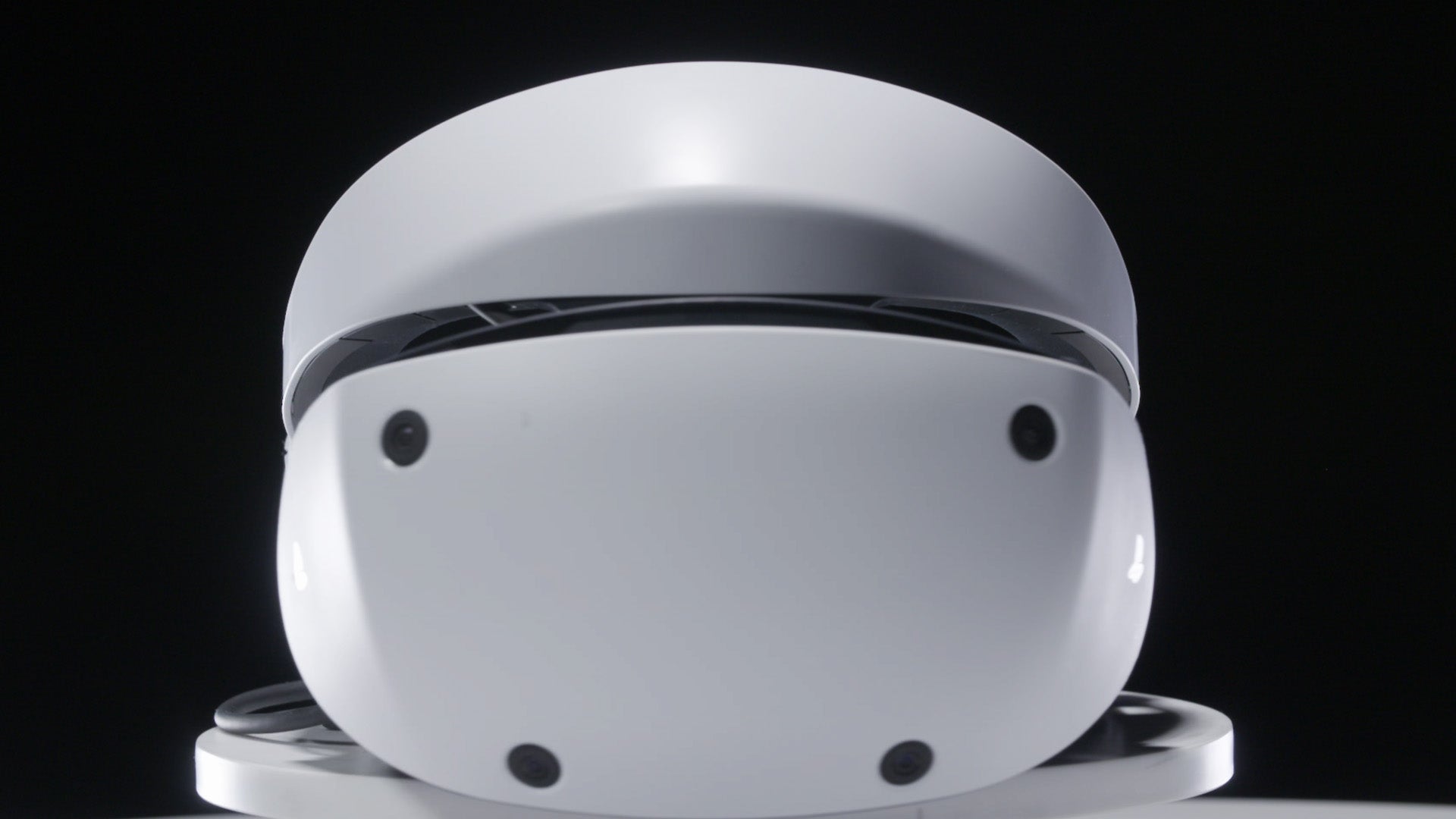
PS VR2 is Sony’s latest attempt at bringing cutting-edge virtual reality to consoles, and it’s launching on February 22. The headset features two 2000 x 2040 OLED panels for you to stare at with your eyeballs. A refresh rate of 90 to 120Hz aims to help mitigate motion sickness (I experienced basically none in my playtime so far), and the adjustable interpupillary distance (IPD) for the lenses means most people should be able to enjoy clear visuals.
The motion-sensing controllers work with fancy “inside-out” tracking—no base stations or the like required—but require a well-lit room. The headset also features eye-tracking and even has some cool haptic feedback built into the visor itself. The impressive specs best the latest Meta Quest Pro ($1500 new) and Valve Index ($1000) in several areas, such as resolution. And those headsets require a powerful PC to enjoy PS VR2-equivalent gaming performance.
The PS VR2 even has some good launch games to check out. But $600 isn’t chump change, so let’s see what’s on offer and put it through its paces.
Buy the PS VR2: Amazon | Best Buy
Is PS VR2 comfortable to wear?
The PS VR2 comes with the VR headset itself, two controllers, custom earbuds that plug into the back of the headset, and a USB A to C charging cable. The USB cable connects the headset to the front USB C port on the PS5, acting as the accessory’s single, elegant tether. This is one of the greatest strengths of the PS VR2: how simple it is to just plug in and use.
Quest 2 PCVR players have the advantage of going wireless (at the cost of streaming video to the headset, which does reduce quality), but unlike the first PlayStation headset, PS VR2 has no external processing device. And unlike some other wired VR headsets, like my Oculus Rift S, the tether is a mere half-a-centimeter thick, and only ties up a single port. One of VR’s biggest hurdles is ease of access and fortunately, the PS VR2 makes getting plugged in and set up a breeze.
When it comes to putting the headset on…well, that’s where my enthusiasm started to fade. For the week that I’ve had the device in my possession—sent to Kotaku pre-launch courtesy of Sony—I’ve struggled to find a comfortable way to position the visor on my head. But I’m not going to just write off PS VR2 as being uncomfortable. It’s a bit more nuanced than that.
VR headsets are far more personal devices than something like a simple controller. A device that sits on your head for long periods of time can take a while to get used to. You might have to find the right head placement, the right balance, the right level of tightness for the headband, how to position the lenses inside the device, etc. My first few months with my Oculus Rift S required a teething period during which I got used to what was comfortable for me. Because of longstanding issues I’ve had with its software-based IPD adjustment, I took to strapping the headset pretty tightly to my face. I also just prefer when a VR headset is on tight enough to feel like it’s a part of my head.
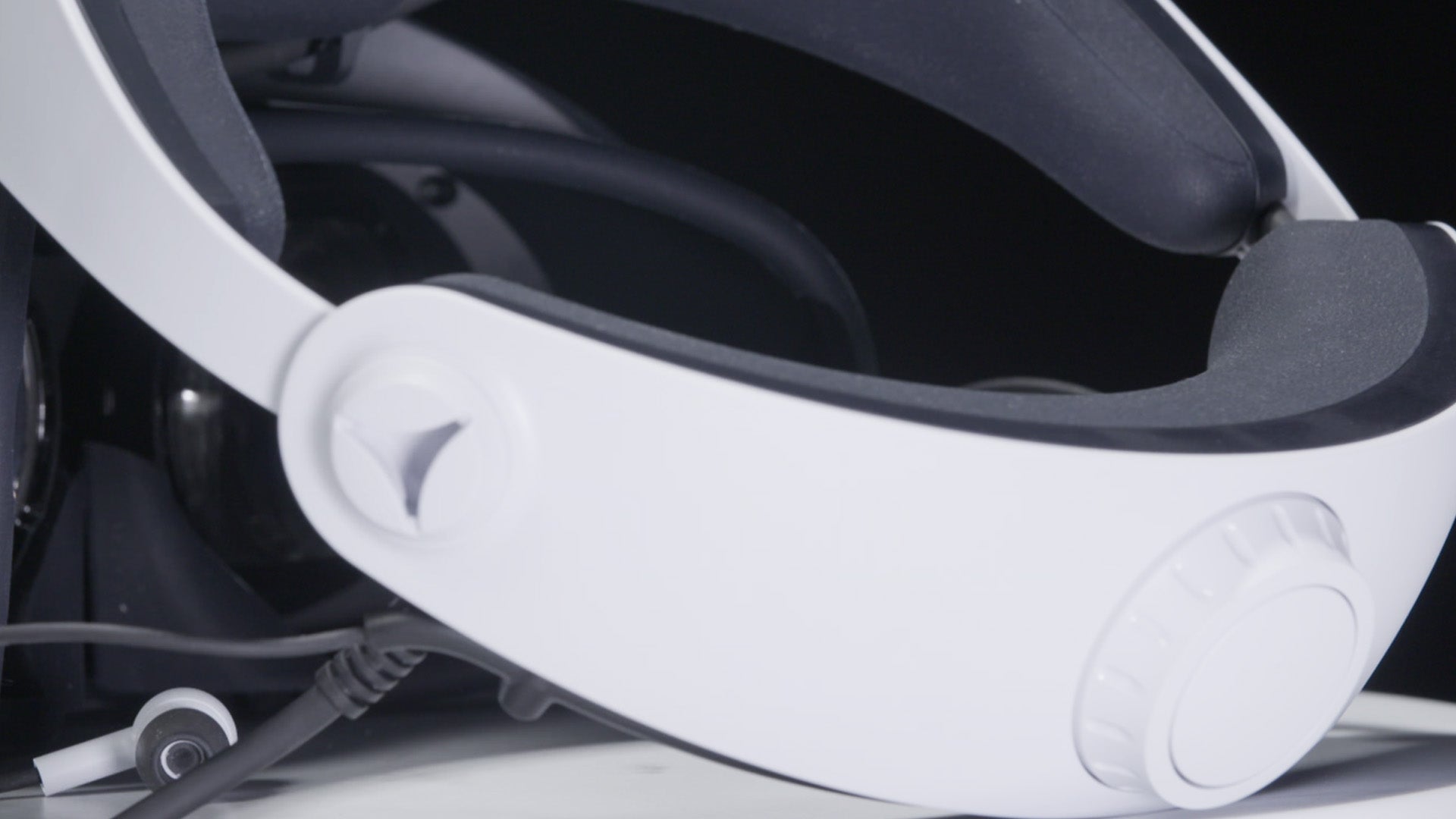
You place the PS VR2 on your noggin by pressing the big button at the back of the headset, pulling it open and over your head. Once on in a reasonably comfortable position, you tighten the fit with a clockwise turn of the dial that surrounds the button. You adjust the IPD via another dial on the top-right of the device, and can pull the visor itself closer or further away from your face with another button on the top-left.
I instinctively went for a tight fit on the PS VR2, and wasn’t too happy with how it felt. So I tried to loosen it, letting the front of the device sort of float in front of my eyes rather than be virtually glued to them. Still, the fit wasn’t totally right, and it kinda hurt. Here at the Kotaku offices, others reported similar experiences: The headset can very easily feel uncomfortable, specifically around the nose area where it feels like, I think, the sides of the lenses can sort of pinch or squeeze. Every session I’ve had with the PS VR2 has ended with red marks on my nose (similar things happen with my Rift S, for the record, but they’re usually not as painful).
Some sessions I’ve been able to finesse it into a reasonably comfortable position. The headset is very light, so it’s not a weight issue. I’ve taken it on and off dozens of times at this point and even the best fit I’ve had isn’t as comfortable as the Rift S—which, again, might be due to the fact that the Rift S is just the headset I’ve gotten to know over the last few years. Come back to me in six months and it’s totally possible I’ll have found the right fit for PS VR2. But you might find an initial discomfort period isn’t a great feeling when you just spent nearly $600.
Even when the fit was acceptable, other elements of the device bugged me. For example, when playing Horizon Call of the Mountain, you spend a lot of time climbing and looking up. The second I’d look up, I’d feel the weight of the PS VR2 pressing against my face, again specifically that upper region of my nose where I’d almost always have marks afterwards. This ruined a fair few sessions I had initially thought would go more smoothly. I’d be genuinely into a game, look up, and just, ugh, the headset felt like shit again. The illusion of the game world broke and I’d think, “there’s a thing on my head that hurts and it costs half a grand.”
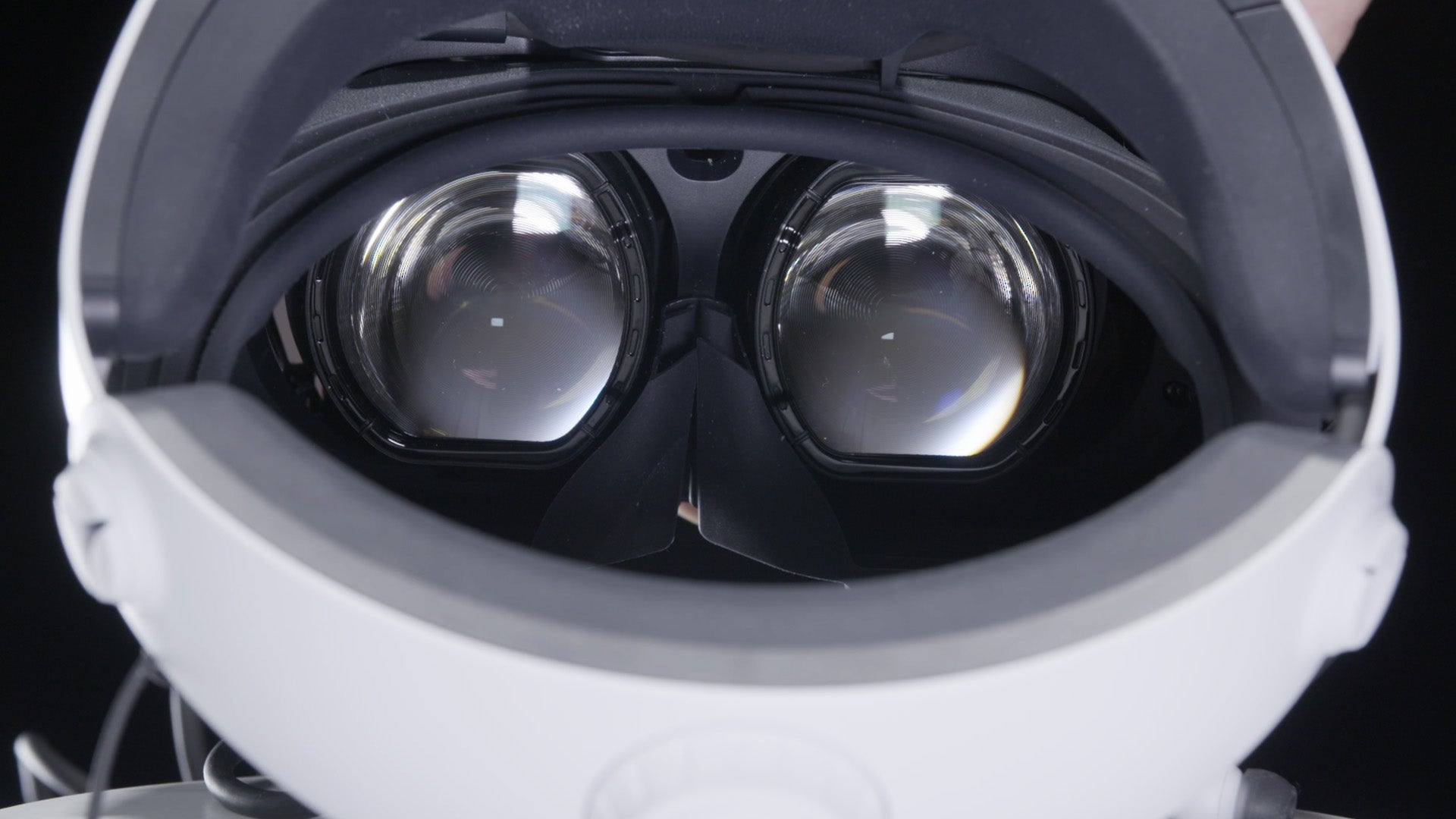
One curious PS VR2 design choice is that, unlike most other VR headsets, it has no built-in speakers. Instead it comes with 3.5mm stereo earbuds. While the U-shaped harness that plugs into the back of the headset is a neat little feat of engineering, two things about that stuck out to me. Sharing this device with someone will really suck (I hope you both have good ear hygiene) and using earbuds that block out all external sound leads to a level of isolation that prospective players, especially those new to VR, should be aware of. r/VRtoER is a real thing, and you should try to maintain an awareness of your surroundings while playing. The sound-isolating earbuds will make it that much harder when your roommate or significant other comes into the room (perhaps dodging your flailing limbs) to say, “hey, King Arthur, your sword swinging actually gave the dog a concussion just now.”
And, I’m hoping this is a freak accident, but on one occasion, one of the PS VR2’s silicon eartips (like the kind that comes with most earbuds) came off and was stuck in my ear canal. I initially thought I dropped it and almost put on a different set to jam the buds back in. Glad I didn’t do that! When I talk about VR headsets being more personal devices, these are the kinds of things you ought to be thinking about. It is after all a pair of fancy screens strapped to your friggin’ face.
I reached out to Sony to ask whether or not it plans to sell replacement headphone harnesses or eartips, but did not hear back prior to publication.
Tired of the complaining? We’re not done yet, but I promise the end’s in sight. During my testing, it became clear to me that no one should use PS VR2 without the optional charging station. The neat little sci-fi lookin’ controllers each take up a USB-A port on your PS5. You only get one USB C to A charging cable with the PS VR2, so you’ll need to pair it with the one that came with your PS5 and tie up two USB ports on your console.
This is why the $50 charging bay isn’t just a fancy accessory, but arguably should have been included with the headset. It comes with two little, destined-to-be-lost snap-on magnetic connectors (one for each controller) and requires being plugged into the wall, but at least it can charge both controllers at once.

Once charged, the controllers are comfortable to hold and far more responsive and accurate than the original PS VR’s PlayStation Move wands ever were. But while Sony states their DualSense-style adaptive triggers should provide resistance, during my playtime thus far they haven’t seemed to do so in the games I’ve tried.
How much room does PS VR2 require?
If you’ve set up a VR headset before, PS VR2 will be very familiar territory. You’ll have to follow some on-screen instructions for pairing the controllers and putting the headset on. The software will guide you through the fit and setting your IPD, which I believe it measures via the eye tracking. You’ll also define your play area.
The PS VR2 has three play styles: Sitting, Standing, and Roomscale. Roomscale is the largest and requires an area of at least 6 feet 7 inches square (2m x 2m), as per the setup menu. Sitting and Standing modes have a minimum play area requirement of about 3.5 feet square (1m x 1m). If you’re really strapped for space you can also choose to set up a “Temporary Play Area,” which I did when I traced a circle around my chair. This was enough to play Horizon Call of the Mountain, if I was careful not to move much.
Buy the PS VR2: Amazon | Best Buy

PS VR2
-
Back of the box quote
THE FUTURE™
-
Type of Device
Virtual Reality Headset and Controllers
-
Liked
Excellent tech specs, great lineup of games and ease of use
-
Disliked
Physical discomfort with the headset, locked into Sony’s ecosystem
-
Manufacturer
Sony
-
Platform
PS5
-
Release Date
February 22
-
Played
About 10 hours between various PS VR2 games
However, games requiring Roomscale won’t work this way. I know more than a few people who might struggle to meet Roomscale’s 4-square-meter space requirement. If you’re in a similar situation, checking the requirements on a PS VR2 game should let you know what modes it supports. Call of the Mountain’s purchase page, for example, shows that it supports all three play styles.
During gameplay, you’ll be notified if you’ve gone outside of a safe area by means of a red circle that will form over your hand and the appearance of a gridded, virtual wall fading in as you approach a boundary.
The room I tested in wasn’t officially big enough for the Roomscale mode. And in Standing mode, I felt the warnings about being too close to the edge of my play area would come up more often than with the Rift S, which I play in the same space. While the PS VR2’s setup and room safety features—which scan your room via the cameras mounted on the outside of the device—insist on checking the space every time you start a game, I found the software didn’t care if I lied and forcibly outlined a larger space than I actually had. No more invisible wall notices! Now I could just as easily trip over the stack of Pathfinder books I had on the floor, slam into the dresser, or, as I did on one occasion, whack my computer’s mic stand while climbing in Horizon Call of the Mountain
But if you’re not a rebel like me (and don’t want to go to the hospital), you should stick to the outlined safety areas the device will determine for you. It’s good that you can tweak the boundaries, though, since the PS VR2 is aggressive in trying to keep you away from walls and debris.
After you finish the setup, you get a rendering of your home screen in an endless void of enveloping, yet welcoming, darkness. I think this was a missed opportunity to feature a more interesting Matrix-esque construct loading environment like exists on the Oculus, but that’s hardly a big deal. Select your desired game from the home screen with the controller and it’s VR time. Which brings us to the big question: Does it have anything worth playing?
How are the PS VR2’s games?
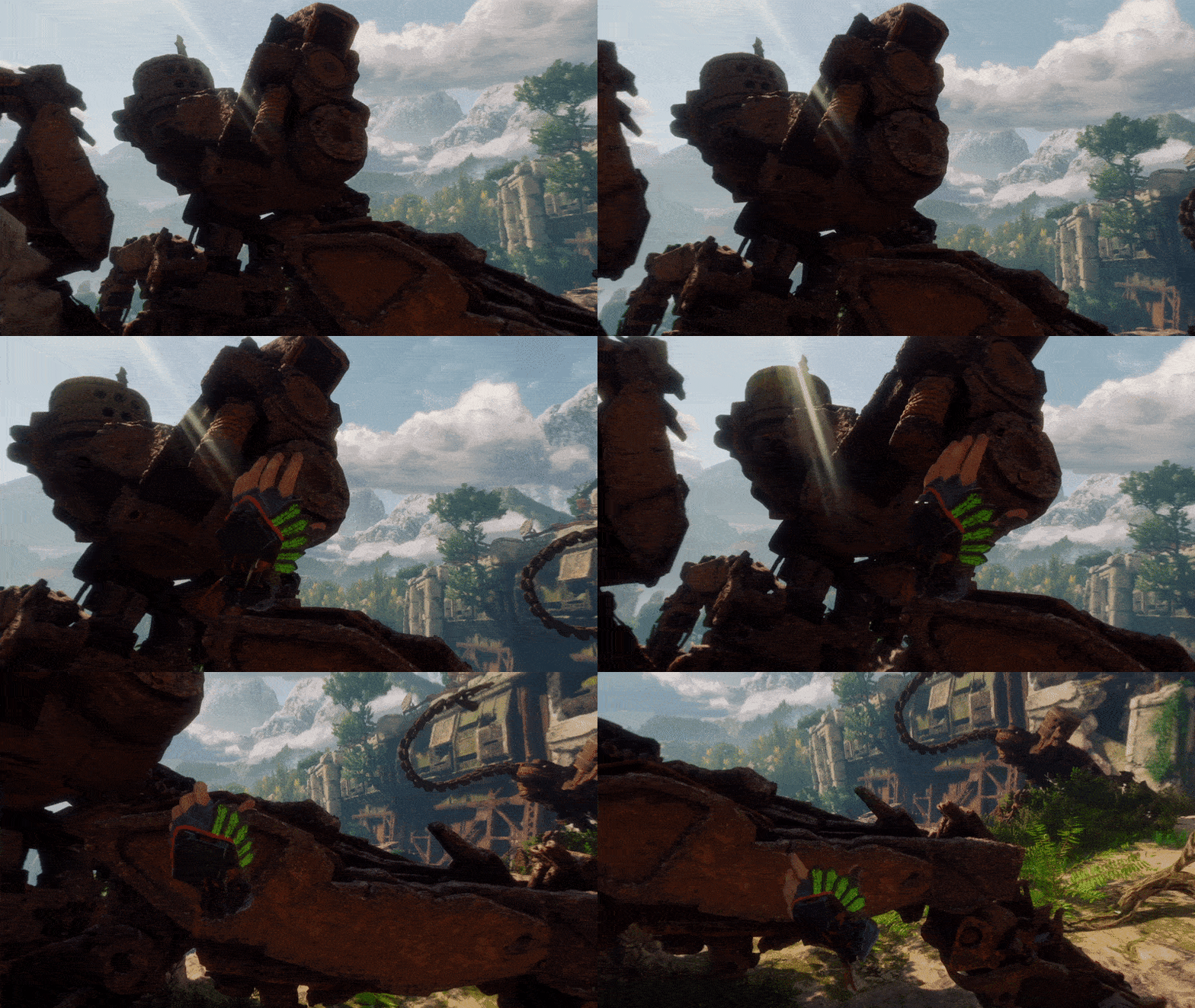
So what’s it like to play a PS VR2 game? My initial discomfort with the headset’s fit aside, it’s a killer piece of tech. I experienced basically no motion sickness (there was a single whoaaa moment in Horizon Call of the Mountain as I scaled a mess of debris and ancient machines). The clarity of the lenses is excellent, though I can still see a very, very faint screen door effect. The headset tracks perfectly well, and the controllers feel great and never seem to lose tracking. Unless you count it being tethered against it, this is a perfectly modern VR experience of the kind I’d expect on a high-end VR-ready PC.
Any gaming device is only as good as the games you can play on it. The PS VR2 is no exception, and some might argue that due to its high price, it has an even greater need for kick-ass games. So what’ll be available on launch?
I spent a lot of time checking out Horizon Call of the Mountain, which if you’re a VR newbie is worth a look, but is also limiting in some key ways. You can read more in my full impressions.
Here’s the full list of PS VR2 launch games:
After the Fall
Altair Breaker
Cities VR – Enhanced Edition
Cosmonious High
Dyschronia: Chronos Alternate
Demeo
Fantavision 202X
Gran Turismo 7
Hello Neighbor: Search and Rescue
Horizon Call of the Mountain
Jurassic World Aftermath Collection
Kayak VR: Mirage
The Last Clockwinder
The Light Brigade
Moss & Moss: Book II
Pavlov
Pistol Whip VR
Resident Evil Village
Star Wars: Tales from the Galaxy’s Edge
The Tale of Onogoro
Zenith: The Last City
That’s a pretty sweet list of games. Demeo in particular is a game I’ve enjoyed on PC. A card-based pseudo D&D experience, it’s good fun with friends. Down the road, PS VR2 is expected to get a VR-ready No Man’s Sky update (which, yes, is as immersive as you think it is), as well as Resident Evil 4, Beat Saber (the VR standby), an Among Us VR game, and Job Simulator, among others.
Read More: Horizon Call Of The Mountain Wears Out Its Wonders Much Too Quickly
Buy the PS VR2: Amazon | Best Buy
One thing you can’t play, however, is your older VR games that came out for the original PlayStation 4 PS VR headset. Many observers thought it would be a no-brainer for Sony to support its well-established previous-generation VR library on PS VR2, but in fact, there is no backward compatibility. If you want to play original PS VR games you need a PlayStation 4 and an original PS VR. That’s a truly unfortunate turn of events, especially considering how great many of those older games would’ve looked with PS VR2’s improved resolution and optics.
That disappointment aside, PS VR2 has a pretty stacked list of launch titles, though none of them feel like a Super Mario 64 moment. While the ultra-popular rhythm game Beat Saber is happily on the way, you won’t find any of the medium-pushing PCVR heavy hitters like Half-Life: Alyx or Boneworks. Which, finally, brings us to another elephant in the room: Why not just get VR on PC?
Is The PS5’s New VR better than PC VR?
It pains me that I can’t just plug the PS VR2 into my PC, tethered only by that elegant, solitary USB cable. My first thought after trying out PS VR2 was, “I need to upgrade my PC headset.” It genuinely sucks, as a PC VR gamer, that such a cool, powerful, and relatively affordable (compared to similar PC headsets) VR experience is locked to the closed environment of a console.
Even so, there are some good reasons to consider VR on a console like PlayStation 5 instead of on a PC.
If you’re a console-forever player, well, your answer’s cut out for you: This is the best and basically only VR experience on console worth giving a damn about. It has awesome tech, a good launch line-up, and more promising-sounding experiences on the way.
Consoles are also much easier in general to deal with than a Windows PC. You don’t have to manage graphics drivers. You don’t have to deal with annoying PC VR hiccups like your default mic input always changing. And the experience on the whole should be less buggy. Despite my (hopefully temporary) physical discomforts with the PS VR2 headset, it’s dramatically simpler to plug in, set up, and get going than anything on PC.
Sure, Quest 2 can be just as easy to enjoy in its standalone mode, but Quest (like any other PCVR headset) requires connecting to a PC to access PS5-equivalent processing power. And any PC worth powering a VR experience is going to cost you at least $1,000, give or take a few hundred dollars When you add in the cost of the PC headset, PS VR2 starts to feel on par or even a bargain by comparison.
But the available software isn’t the same: There’s not as much, nor as much variety. It’s also worth considering the fraught relationship console manufacturers have with the longevity of online storefronts as their associated platforms age. It feels like there’s a level of risk in plunking down $550 to $1000 bucks for the PS VR2 experience. We’re kind of counting that Sony’s going to support this ecosystem for a while to come. I will note that the original PS VR got over 600 games worldwide, which is pretty solid for an optional, expensive accessory. (Not to harp on it, but that also makes the PS VR2’s lack of backward compatibility sting yet again.)

In any case, the fact remains: You won’t be playing Half-Life: Alyx on PS VR2. You’re not even playing cool amateur creations like the incredible Half-Life 2 VR Mod or Metal Gear Solid’s first two levels recreated in Boneworks. Having full featured, premiere VR titles like Alyx alongside random indie games and niche mod experiences is one of the coolest things about PCVR. And while other AAA titles might eventually land on the PS VR2, we can all but guarantee that more experimental content, mods, or hell, just VRChat won’t be coming to Sony’s platform any time soon.
Read More: Half-Life 2’s Excellent VR Mod Is Almost Too Good To Be True
Buy the PS VR2: Amazon | Best Buy
Maybe you only want to check out the curated indies and occasional AAA VR experiences Sony will allow on its platform. For that, PS VR2 is a phenomenally powerful headset that has good games now and will receive more in the future. But if you really want to dive into VR at the enthusiast level the PCVR experience is still unparalleled, even by something as genuinely cool as PS VR2.
So, is PS VR2 worth buying?
It’s a bit complicated. Let’s walk through it.
At $550 for the unit itself, the PS VR2 headset is more expensive than a PS5, which is what you’ll need to use the headset. If you don’t yet have a PS5, you’re looking at over $1,000 to get started. Splashing out for PS VR2 isn’t equivalent to getting a new game, or a new controller (even a fancy one like the DualSense Edge); no, you’re looking at making a substantial investment into the hobby of video games itself.
Read More: The PS5’s Luxe New Controller Might Be A Game Changer (If You Can Afford It)
If you haven’t played VR before and are skeptical or unsure, I think it’s worth asking yourself whether something like a TV upgrade, sound system, or even a different console with a library of games you’ve never played might be more worthy of your $550. Honestly, when I think of upgrading my PS5 experience, something like an OLED TV with a better HDR implementation would go a long way toward improving my experience with the games I already have. That’s a key question: Would you rather spend this kind of money on improving your existing game experience, or on a bold new experience that might have a few learning curves for you to get over before it really clicks?
Hell, you might even want to ask yourself whether or not that $550 would be better spent on four and a half years of PlayStation Plus Premium. And I’ll make it worse for you, I don’t think anyone should buy a PS VR2 without the controller charging station, which costs an extra 50 bucks!
The PS VR2 is expensive for a console accessory but reasonably priced for a VR headset, with hardware that compares favorably to pricier PC-only goggles. The lack of PS VR backward compatibility is unfortunate, but PS VR2 has genuinely good software currently available, and more is on the way. And if you’re committed to having a console VR experience, it’s really the only game in town.
PS VR2 is a premium experience for the committed PS5 enthusiast who has no need or interest in other consoles, a VR-capable PC, or more general upgrades to their current setup. But the future of VR is likely to be experienced on PC first, where the ecosystem is more diverse, performance grows over time, and games tend to be less locked into specific platforms or storefronts. Where do your interests fall? Answering that will go a long way toward determining if Sony’s new VR wonder is a comfy fit for you.
Well, comfy might not be the right word.
PS VR2 will go on sale February 22, and we’ll be doing more coverage of it and its games in the weeks to come.