As we stare vacantly at our smartphones and watch global atrocities unfold over “X,” it’s easy to forget that the internet once offered a vision for hope. In the early ‘90s, the infinite possibilities of an interconnected web felt exhilarating. Knowledge and data could be seamlessly shared across the globe. “Snail mail” would soon be replaced by instantaneous e-mail. Yet for Rich Vogel and his colleagues at Archetype Interactive, the world wide web had a much more exciting application—it represented the future of play.
Working alongside Google Earth and Pokémon Go creator John Hanke, Vogel and Archetype Interactive created the first proper MMO, Meridian 59, wowing players as it hit CRT screens in 1996. “John [Hanke] changed the way people navigate the world,” Vogel says of the current Niantic CEO. “To me, that’s like meeting Thomas Edison.”
Yet if Hanke’s cartographic innovations make him the App Store Edison, then Vogel is the MMO’s Leonardo Da Vinci. If you’ve ever played an online game, you’ve felt Vogel’s influence. Fascinated with the idea of connecting people through games, Vogel worked on beloved creations like Star Wars Galaxies, Ultima Online and Star Wars: The Old Republic, defining the core rules that govern the massively multiplayer experiences that have transformed both the games industry and popular culture as a whole.
“Meridian 59 was the very first game outside private networks like AOL, where you actually went on the internet to play the game,” Vogel explains. “You downloaded the client from a browser and it installed—that was simply never done before. With Ultima Online, we had a seamless world holding thousands of players, which also had never been done before. We had a crafting system, a PVP room…we helped really define what PvP was.”
A Wild West in the Outer Rim
While many of his colleagues who built Ultima Online went on to work on World of Warcraft, Vogel abandoned swords and sorcery in favor of a trip to a galaxy far, far away. The result? The equally influential, if far less commercially successful, Star Wars Galaxies
Released in 2003, this unwieldy and highly ambitious MMO saw players roleplay as whoever they wanted in the Star Wars universe, offering a bold departure from your traditional, quest-based fantasy fare.
“With Star Wars Galaxies, we basically did No Man’s Sky in 2003,” Vogel says. “It was all procedurally generated terrain, all the Star Wars settings and historic places were layered on top of the procedural world. We even had procedural ways of developing points of interest. It was well, well beyond what other people were doing at the time.”

While its servers were shuttered in 2011, Galaxies influenced everything from EVE Online to Fallout 76 For many mourning fans, it’s an online experience that still hasn’t been replicated. “We gave people the ability to play in the Star Wars universe as anything they wanted to be,” Vogel says. “We had an amazing crafting system that no one’s ever been able to duplicate, and a character creation system people are still doing everything to duplicate today.”
Greenlit in 2000, Galaxies was conceived in a pre Jar-Jar age, when excitement around Star Wars was at an all-time high. Developed by San Diego-based Sony Online Entertainment while Lucasfilm was shooting the prequel trilogy, Galaxies’ story prompted an unusual level of involvement from George Lucas himself. “When Galaxies showed the player places that they’d never seen in Star Wars before, George would review them, to make sure that we didn’t conflict with [the prequels],” Vogel tells Kotaku
Set in between A New Hope and The Empire Strikes Back, Galaxies leaned into locations that would be revealed in the prequels. Working alongside long-term Star Wars writer Haden Blackman, who penned multiple Star Wars comics and went on to write The Force Unleashed series, Blackman ensured that everything in Galaxies felt sufficiently authentic. Yet despite the forensic attention paid to fact-checking Galaxies’ lore, gameplay-wise, these young developers were given free reign. “That was incredibly rare, having that freedom…” says Vogel, “It’s how we built something so far beyond what had been done [with MMOs] before.”
Still, the team weren’t entirely without a guiding hand—they received invaluable critiques from an unlikely junior tester. “George Lucas’ son would come and play the game and give us feedback,” Vogel reflects with a smile. Not much of a gamer himself, Lucas instead sent his video game-loving son to give the nervous team his verdict. “He was just a teenager, but we listened to all of his feedback. He’s a pretty good gamer, actually. We got to know each other really well.”
Nothing’s ever really gone
Despite Vogel’s obvious pride for Galaxies and the rabid fanbase it’s since garnered, when it first hit shelves in 2003, this pioneering MMO flopped like a womp rat. “It’s amazing how people talk about it now, because when we were building and releasing it, we didn’t feel that way,” reflects Vogel. “The community really turned [Galaxies] around, and somehow it’s still going,” he adds, referring to the emulated servers thatare still lovingly maintained by fans. “I think it just shows you how powerful that game was.”
After a rocky start, Galaxies’ legend slowly spread, players flocking to its malleable take on the MMO genre. From in-character role playing servers to surprisingly horny after-dark shenanigans, Galaxies felt almost as unpredictable as the shadiest corners of the Outer Rim. “It was a real hive of scum and villainy,” Vogel says, referring to the seedy nighttime play in Mos Eisley. “And no, I will not expand on the kinds of scum and villainy,” he says with a laugh.
For all the sexting in a galaxy far, far away, in a pre-social-media landscape, Galaxies was also somewhere thousands could form real connections.“It was pre-Facebook, right? There were people in the military, a woman who played with her husband together at night, just so they could talk to each other. I thought that was really special.”
For all the respect it receives in game dev circles, Vogel feels Galaxies still doesn’t get enough credit for what it achieved. “Star Wars Galaxies was absolutely a metaverse.” Vogel continues, “What Fortnite is saying they did first? We did that in 2005. We hired people and volunteers to come in and do events, we had a whole event system layered on top. We had bands come and play, It was amazing!”
Yet there is one thing that even the self-assured Vogel regrets about Galaxies: its canon storyline. “One of the things I think BioWare did really well with KOTOR is they pulled it away from the movies. We didn’t with SWG, and we had a lot of restrictions on the story, like that the Jedi were rare. Why do you want to play Star Wars if you can’t be a jedi? That’s the fantasy! I wish we pulled out of that timeline and did our own thing.”
Always in motion is the future
Now, however, Vogel is aiming to create a new type of online experience. Forming T Minus Zero Entertainment with veterans behind Dragon Age Inquisition, The Elder Scrolls Online, and Fallout 76, he says the Austin-based studio’s debut will offer up a different kind of online play.
“It’s an action game,” Vogel explains of the as-yet-unannounced title. “It’s based on a public domain IP that no one has built a game around yet. A session-based game”—like Destiny’s 30-40 minutes strikes, he explains—“based on a licence that has a very global appeal.”
Why not make another traditional MMO? Vogel explains that he sees the World of Warcraft era as one firmly rooted in the past. “This generation of players don’t want to go through the grind—they like to get to the fun fast,” he reflects. “Look at all the popular games in the multiplayer space now; the top five games don’t require a huge amount of your time.”
“There will always be room for people to play MMOS, of course,” Vogel continues. “But they’re for the grinders, aged 35 and above. It’s a nostalgia play, not a huge space for this generation of gamers.”
Yet no matter what form the mystery game takes, Galaxies taught Vogel what will ultimately decide its fate. “It’s all about listening to the community,” Vogel says. “Because frankly, it’s their game. Where you see a lot of developers go wrong is that they think [an online game] is their game.”
“You need to watch what [players] do. Watch what they navigate to, what they like and what they don’t.” He continues, “Look at analytic data, have heat maps where players are, how long it takes to kill, so you have an objective and a subjective point of view. A lot of players don’t know what they really like or want and it’s too easy to pander to the vocal minority. But if you don’t listen to players at all, you’re not gonna win. Especially in the connected world we live in today.”

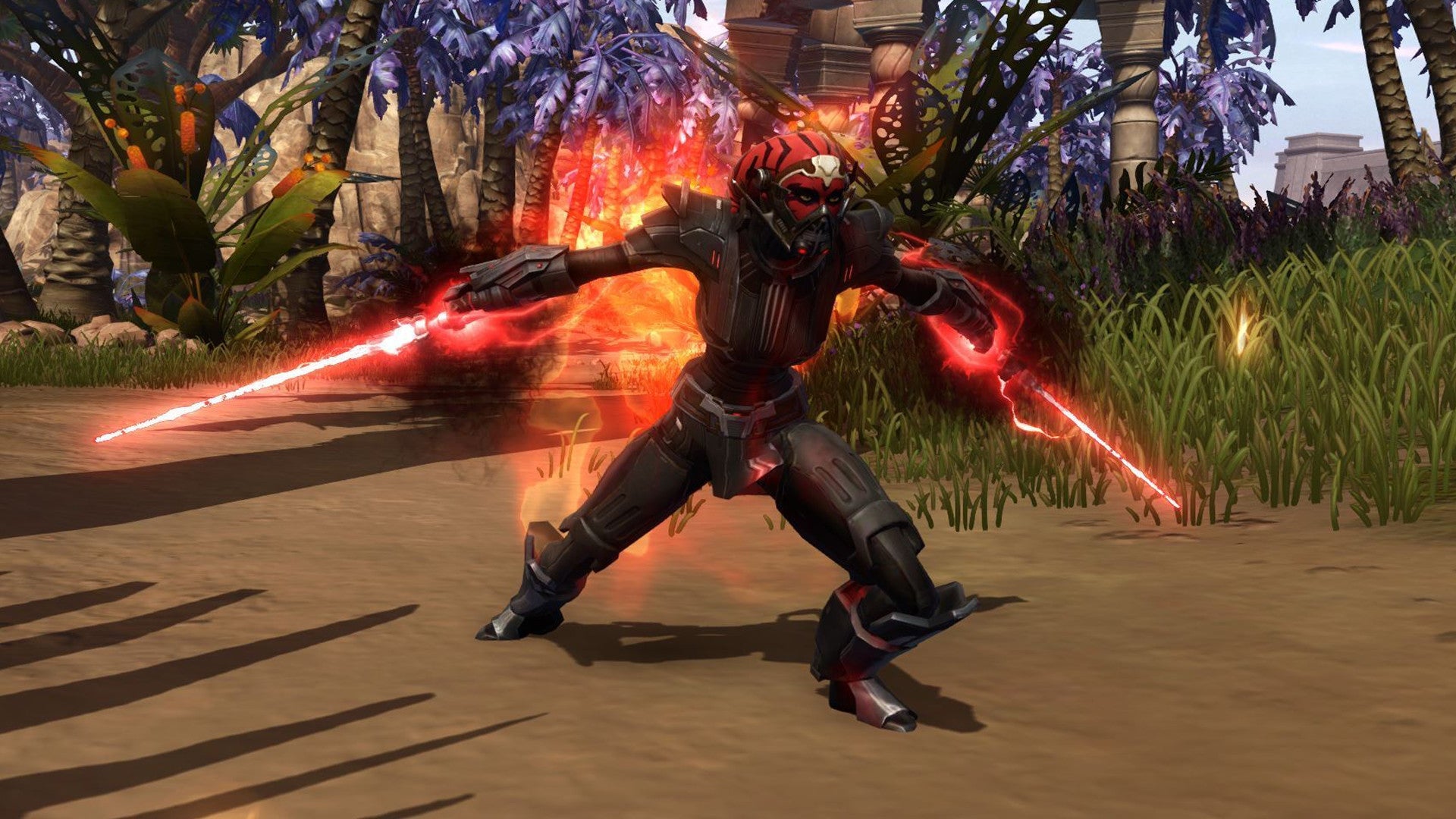
While Vogel continued playing in the Star Wars toy box with 2011’s The Old Republic—a story-led approach to the MMO that Vogel is quick to point out “no one had done before”—it is the free-form role-playing of Galaxies that is remembered most fondly. The question is, can he bring that same sense of innovation to the increasingly well-worn online shooter?
“What we’re building now is something very ambitious,” says Vogel. “You look at my track record and it has been going to places that people haven’t before. I want something that is ideal for you to come in and have fun for a while with your friends—and I believe that small parties are where relationships are really formed.”
While the decades have long removed most people’s romanticism of the internet, Vogel is just as excited about its socialising potential today as he was in the ‘90s.
“I think this is the MMO’s future,” Vogel reflects, referring to short-session multiplayer. “Epic, immersive worlds where people form vibrant communities. I really want to build a game that people talk about for a long time, where it becomes their hobby. People have gotten married in these kinds of games, people have made friends forever. It’s why I love creating online games, they let you form relationships with people that you simply can’t in single player.”