

Mars First Logistics, released last week into Early Access on Steam, is a game with a very simple setup. You are driving little robot vehicles around the surface of Mars, doing jobs for people, and those jobs involve you having to build your own cars (or whatever else!) in a way that gets the job done.
Let’s say you get a contract where you need to take a steel beam from one little Martian base to another. You open up a lovely little building screen—one that is very reminiscent of LEGO instruction manuals—and, from a limited selection of parts, get building. You’ll need something to hold the steel, that ideally can also carry it across the surface of Mars, and you’ll also need something to reposition the steel when you get there for delivery.
So you do that—or at least something you think will do that—and get driving. And within 20 seconds, you know you have messed it up. This little car isn’t going to be hauling anything anywhere, it’s a disaster, your wheels are spinning all over the place, the steel has fallen out and not for the first time in this game you will be back to, and spending a lot of time at, the drawing board.
Mars First Logistics is, at its heart, a physics puzzler. If you’ve ever blown up a rocket on the launchpad in Kerbal Space Program or driven a misshapen buggy off a cliff in Tears of the Kingdom, you’ll be right at home here. It’s not the challenge itself you’re really out to master, but the way that challenge is represented in a world that has a ruthless awareness of its own gravity:
All that jiggling around and broken cars and repeated failures could have been a recipe for frustration, but as the video above shows, Mars First Logistics is anything but. Thanks to a combination of its floaty gravity, cheery visuals and—I cannot quantify this, so just trust me—cute handling, to play it for stretches of time is to be at the helm of an adorable little blooper reel, each stuck payload or spinning set of tyres eliciting more of a “haha, we’ll get ‘em next time” than a “fuck this, I hate it”.
Please note I don’t want to somehow demean or dismiss Mars First Logistics’ puzzling credentials by focusing solely on the fact it’s funny (even though, compared to gaming’s own deeply unfunny norms, this is a comedic masterpiece). It’s funny because it’s so hard, and that humour does a fantastic job of defusing the trial-and-error that could so easily have frustrated in a game like this. Even Tears of the Kingdom’s toughest nuts are child’s play compared to some of the challenges here, which don’t just ask a lot of you in terms of carrying them out—delicately balancing an ever-toppling payload as you drive it over bumpy hills—but in preparing for them in the first place.
See, Mars First Logistics isn’t an immediately open sandbox game, it makes you earn it. You don’t start it with every tool at your fingertips, each part available in limitless quantities. You get money for completing courier jobs, and you can then spend that money unlocking more parts. So there’s an economy at play, allowing you to focus on the type of vehicles you want to build, and how fancy you want to make them.
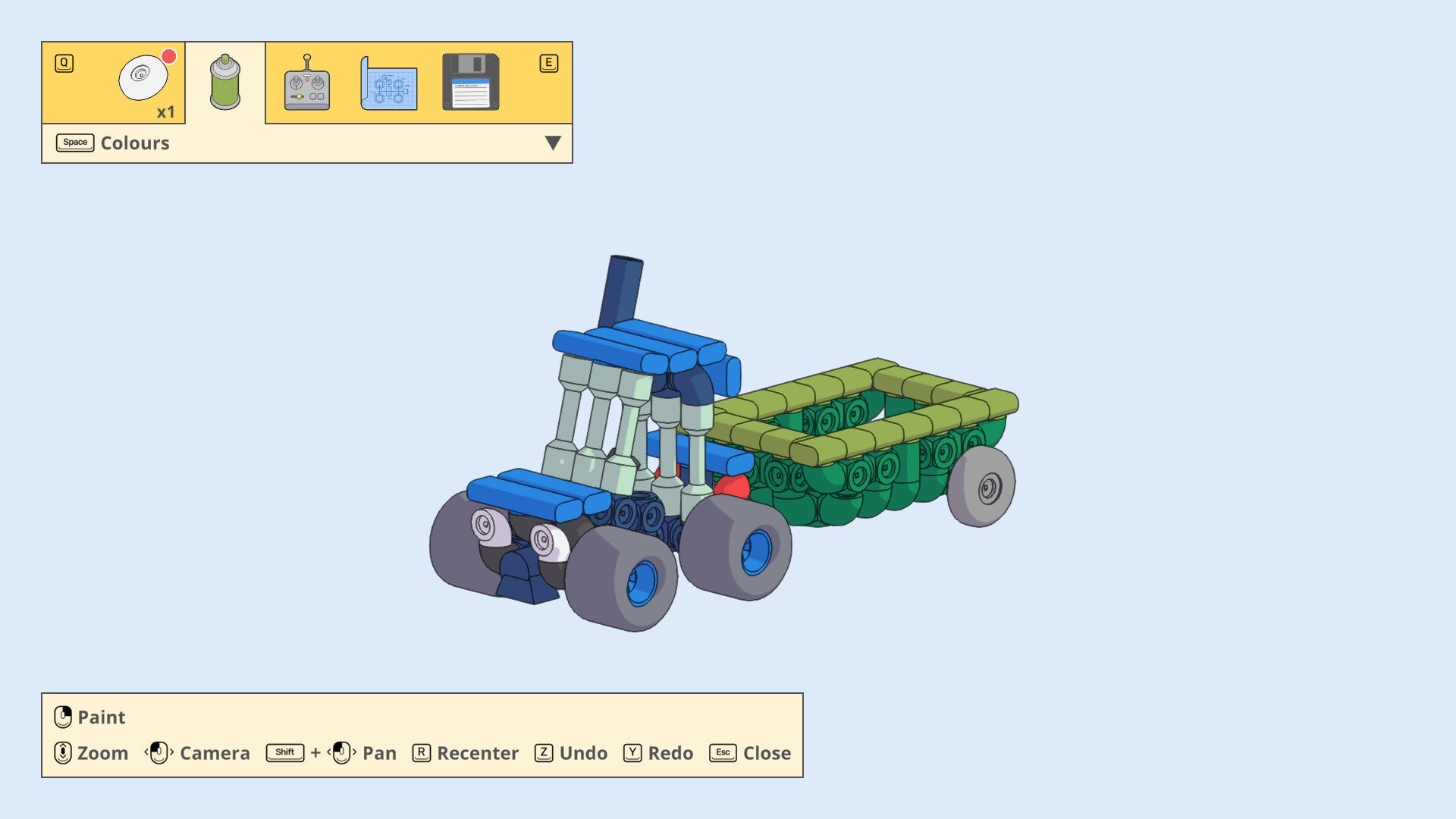
I found myself spending most of my time not on the game’s open world but in its LEGO-like building screen, endlessly tinkering with wheels and control arms and servos that can be arrayed however you like them, or at least however you think they’ll be able to get a job done.
It’s fun to mess around with, and can allow for creations of immense precision, but I think the real joy of Mars First Logistics is that it doesn’t need you to be perfect. You can shoot for it, sure, but at the end of the day you’re here to do a job, and so long as you get it done, the game is happy.
Take the steel beam job I mentioned above. I could have spent an age agonising over the most economical and functional vehicle possible, which is something the game definitely allows for and a path which some players might feel compelled to force themselves down. What I ended up doing after a few hilariously inept failures, though, was creating a buggy that could just drag the beam precariously across the countryside, which worked so long as I drove really carefully.
A good video game would have forced me to make the economical and functional one. A very good one would let me make whatever the hell I want. A great video game lets me do whatever I want and makes it funny while I’m screwing it up.