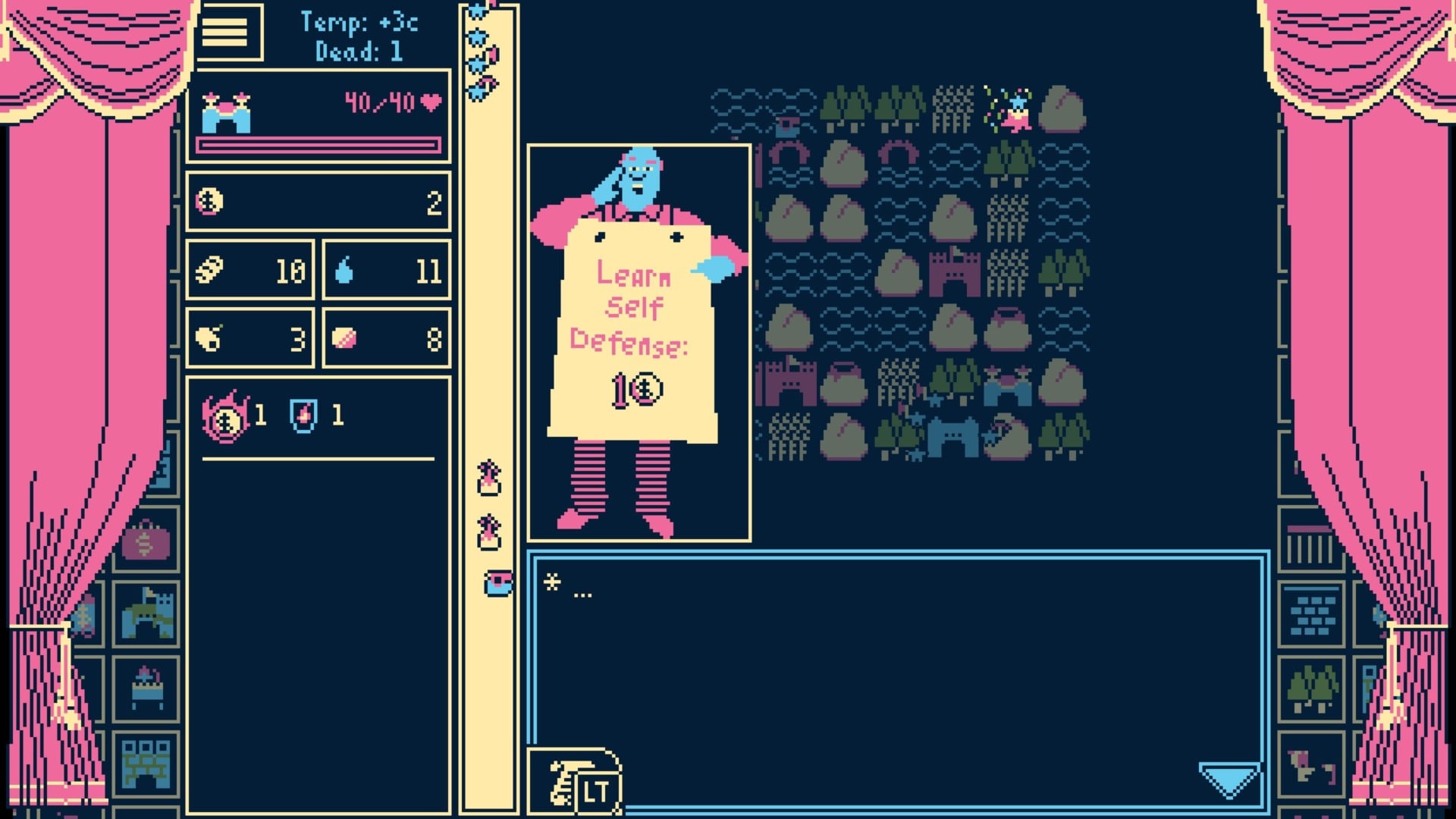
Last week, I finished playing Titanium Court. I wiped away a couple of tears, stared at the final screen for a few moments, and then shut it down. I will never, ever open this program again. I will not buy it on any other platforms. I will recommend it to almost everyone, while personally never touching it again. And I will do all this because I deeply, deeply loved Titanium Court.
I am going to talk about the ending now:

You can leave Titanium Court and end the game at almost any time, as long as you’ve collected four keys. The actual act of collecting those keys can be trivially easy, depending on how you play and whose help you enlist. You can do it in just a few hours. But most players, I imagine, will collect those keys and immediately begin to stall. Trying to walk out prompts a “point of no return” style message that feels ominous—surely you can’t leave without having finished all your business in the court? What about all the achievements, all the side quests? No, you have no reason to end Titanium Court the moment you are able to do so. Until, suddenly, you do.
Around about the halfway mark of Titanium Court, faeries in your court will begin to go “stale,” an irreversible condition that occurs when they, as NPCs, fully run out of unique dialogue. It’s a condition that every single faerie in the court is destined to inherit if you, the queen and the player, stick around and keep talking to them until everything they could possibly say has been said. This gradual reveal isn’t just a cool meta device, it’s also genuinely moving, and not just because you face down the prospect of seeing NPCs you’ve come to love turn into shells of themselves. It also explains why your steward, Puck, has been begging you to leave the court this whole time, and why he’s so afraid to talk to you. It’s not because he hates you. It’s because he’s desperate not to become stale himself.
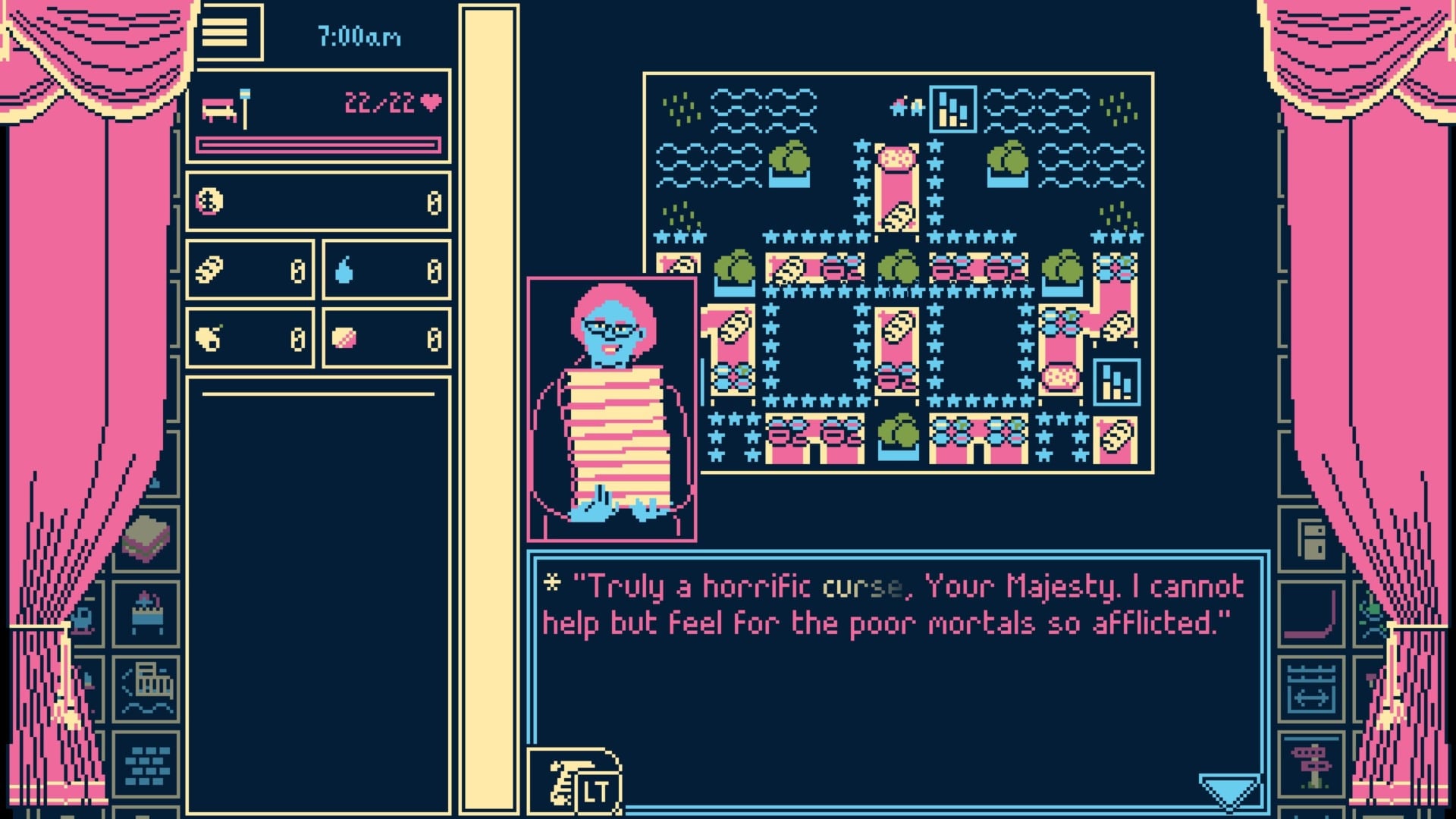
So you have your four keys, and so many tasks left unaccomplished, and a court of faeries withering away due to your very presence. Do you choose to leave? Or do you stay, betray your steward, see all there is to see, and force all your faerie friends to go stale one by one as you fulfill each achievement?
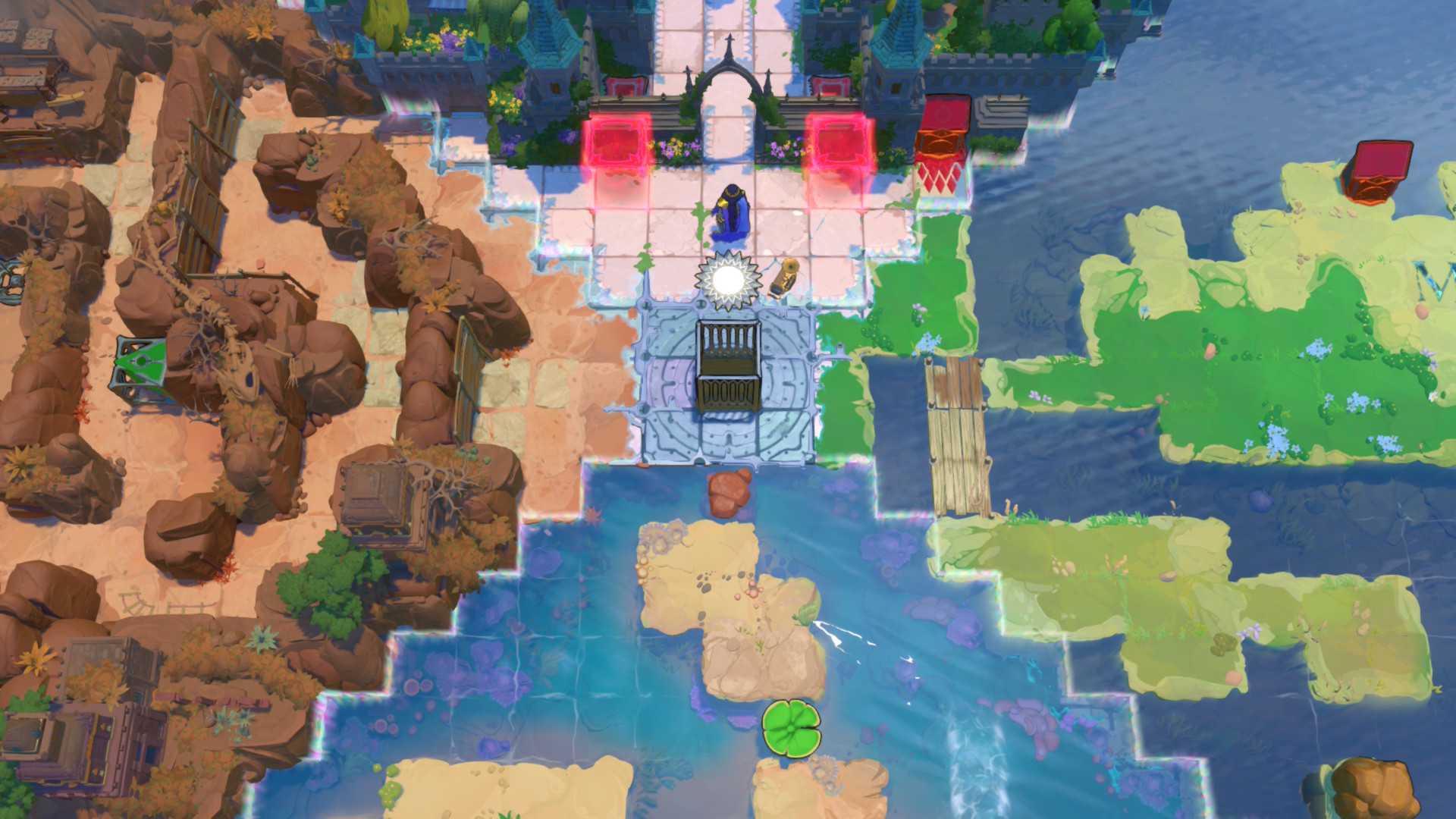
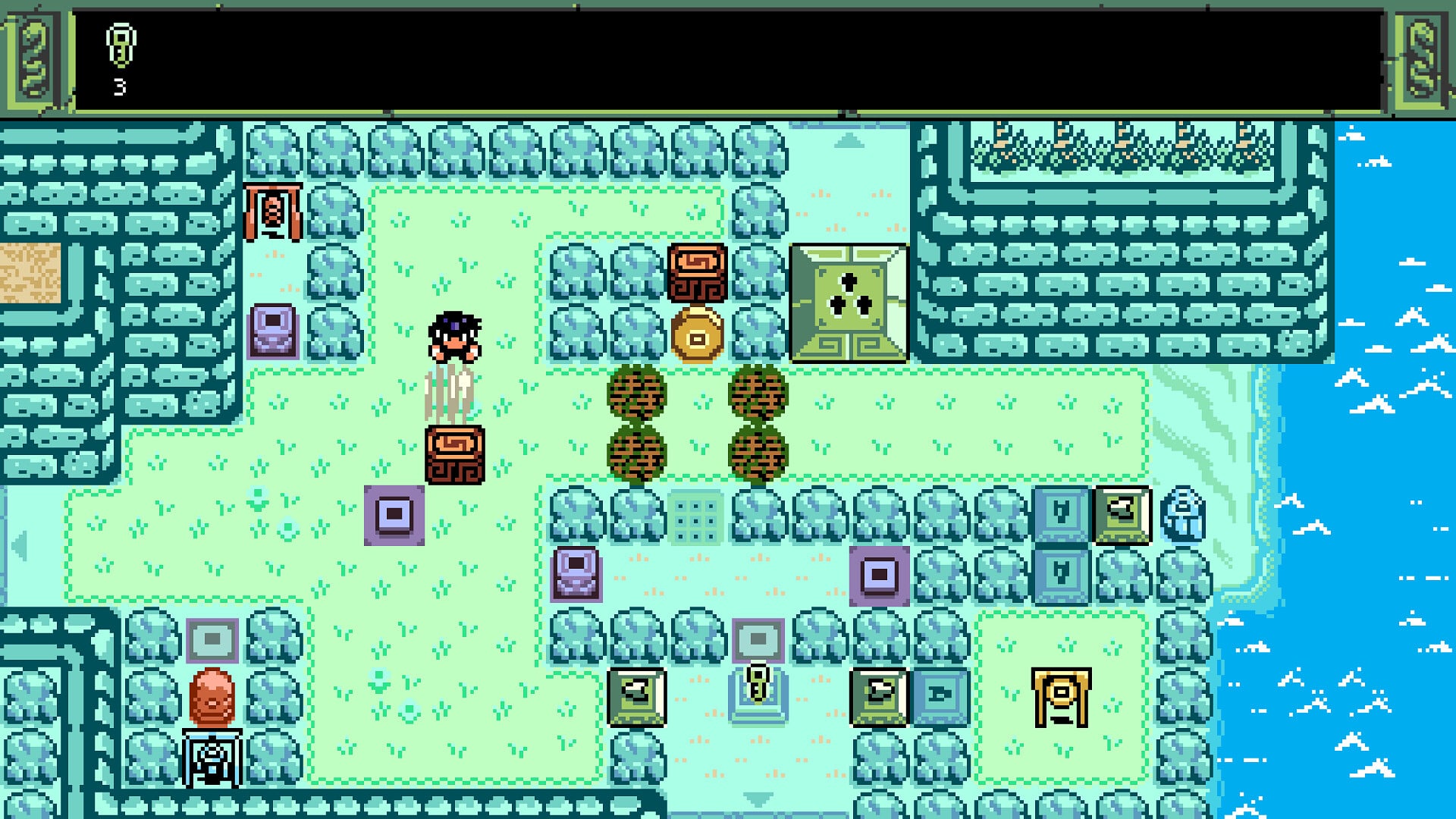
It’s tempting to stay. There are 13 curses on the court. By the time I had all the keys, I had only lifted about four of them. A cat still wanted help reaching the top of the pantry. I hadn’t reunited the diregoats, nor had I fulfilled all the fire-related prophecies delivered by the drunk guy in the bar. I had managed to face myself in the mirror, but I hadn’t yet offered a worthy sacrifice to the kraken, nor discovered what was at the end of a winding labyrinth in my castle, nor completely devoted myself to either comfort or strife. I still had so many unanswered questions, so many unexplored passageways! What if I stayed just a bit longer?
I couldn’t.
For some reason, I could not bring myself to let this story, this fictional story that exists only in a video game and in my head, be that I betrayed Puck and the entire Titanium Court, consigning them to oblivion. I could not make the choice to face Puck’s hurt and sorrow. I could not handle the thought of sending Robin, or Hop, or the cat, or even obnoxious Leland to the Stale Feast, forever parroting their last words to and for no one.
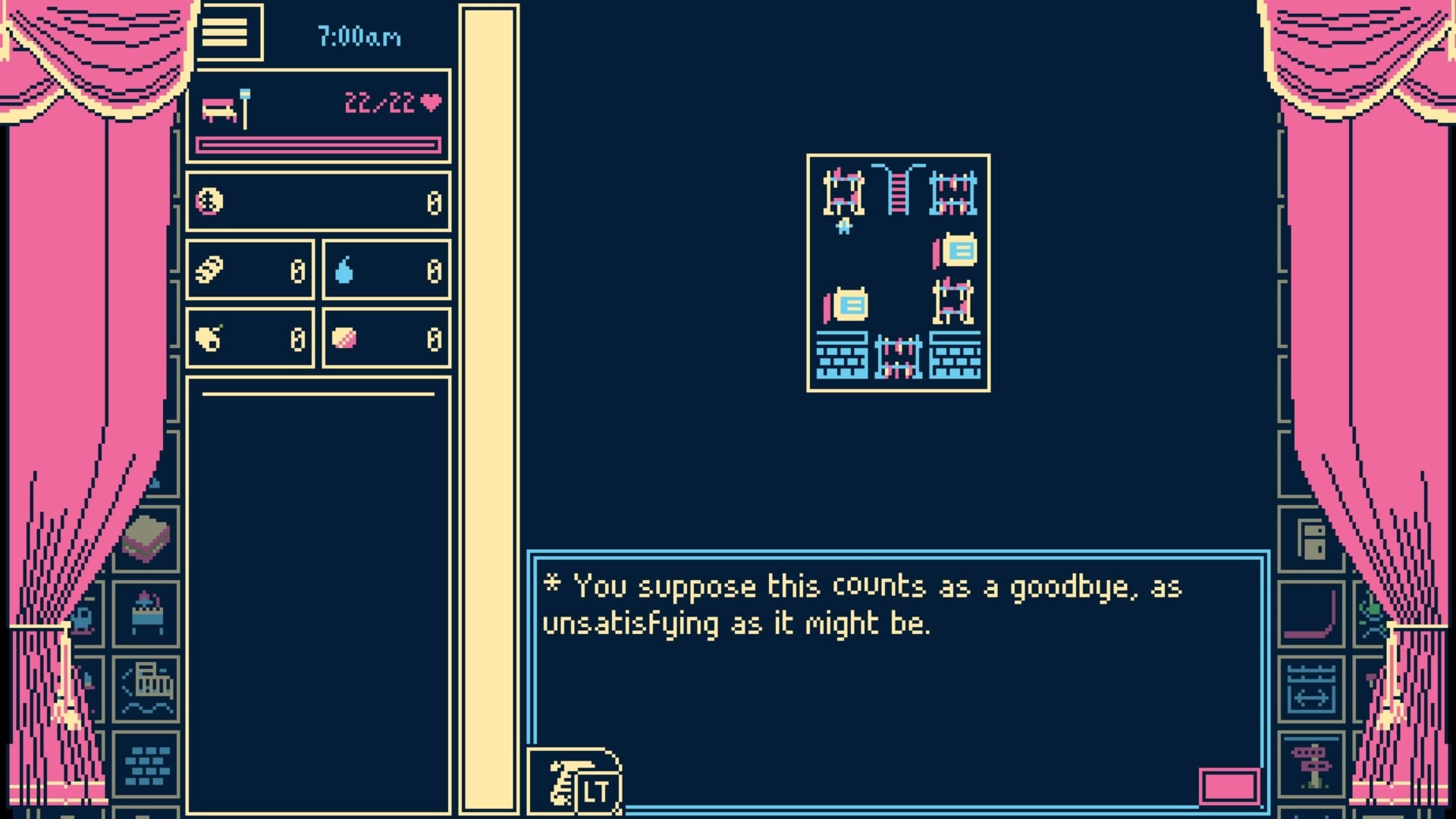
I took one last walk around the court. I spoke to the faeries that remained, that weren’t yet stale, and said my goodbyes. I went to the gates. I unlocked them. My Enemy appeared again to stop me, but I distracted him easily by setting him up with another faerie who’d been looking for a hot date this whole time. It was a silly, anticlimactic ending. The sort of thing I’d normally reset a game over to try and get something better. No epic confrontation. No boss battle. Just me, walking out of the court alone.
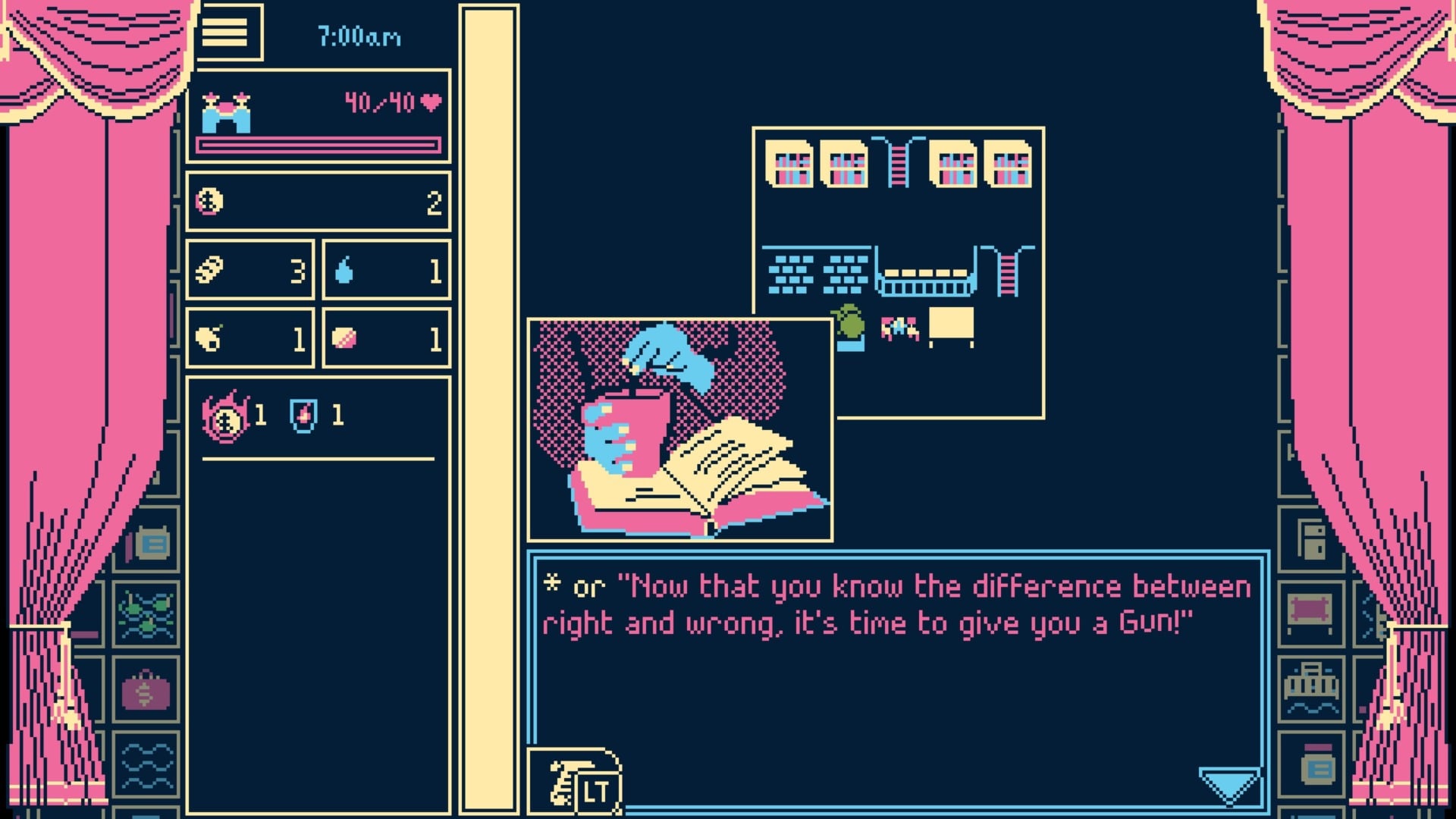
A prompt briefly asked me if I wanted to look back at the court one last time. I said no. The court washed away with the tide, and the game ended. The credits rolled. I was left at a bus stop, able to review my journal of past cutscenes and play a little alternative version of the match-3 whenever I wanted, but with no meaningful plot progress or ability to continue gathering achievements. That was it. That was Titanium Court.
I’m not a completionist by any stretch. I don’t care about Platinum trophies or 100-percenting things or whatever. But for games I like, I do tend to determine in my head roughly how much of it I feel I need to play in order to be satisfied with it. Maybe I’ll try to collect all of one thing, but not another. Maybe I’ll try to unlock all the characters, but skip the minigames. Titanium Court is so enjoyable that, under different circumstances I would have chosen to lift all the curses and finish most or all of the side quests. I could have easily spent 10, 15 more hours in its world, happily playing a match-3 and trying to puzzle out cryptic hints that, if solved, could end an endless war or enlist a swarm of bees to help a kraken give birth. As it stands, I left Titanium Court deeply unsatisfied. I felt sad. I still feel sad days later. Like I’ve stopped reading a book I really, really loved two-thirds of the way through, and just can’t bring myself to pick it back up again even though it’s sitting, wide open, on my bed. Like I went on a vacation to a beautiful country, only to leave a week early for no reason.
As recommended in the game’s closing credits, I have joined the Fellow Traveler Discord and read up on the “What ifs” of what can happen if you do this and that, and it’s given me confidence that I made the right decision for me. I won’t spoil them all here for those who wish to continue unraveling Titanium Court for themselves, but I’m satisfied that there is no “better ending” if you stick around and do 100 percent of everything. It is, in fact, a significantly worse ending. What you think happens to the court based on what you know of staleness does in fact happen just as you were told. The only remedy is to leave, leaving as much of the game unseen as you possibly can.
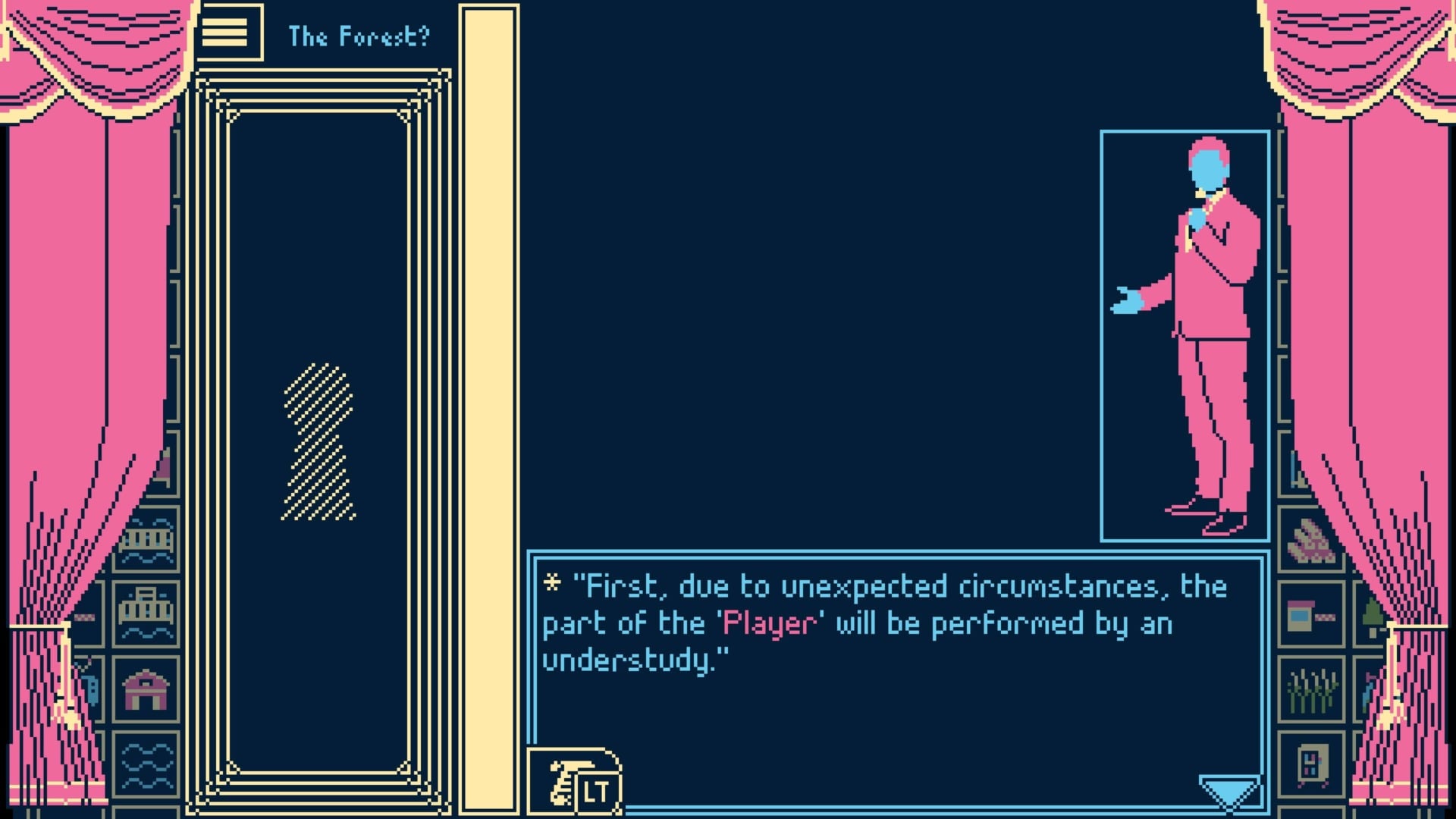
I could go back. I could start a new game on a new file, choose different paths, try different things. But the game would remember. Even if I did everything I could—spoke to as few faeries as possible, looked for ways to stave off the staleness long enough to see more of the game—returning would remain a betrayal of Puck, and Puck would remember. We signed an agreement to help one another, and he would consider it broken if I returned.
Video games are fictional. The characters in them are not real. They cannot feel pain nor sorrow nor anger. They cannot be disappointed in me. And yet I can’t seem to make the choice to face a fictional character’s disappointment. Maybe that’s just my own anxiety, too pervasive to be confined to actual, real situations alone. Maybe it’s the good ol’ Catholic guilt I can’t seem to shake. Maybe it’s because I know the “reward” wouldn’t be a reward at all: it would just be a series of increasingly depressing scenes ending in inevitable solitude, all for a few Steam achievements.
Or, you know, maybe I am being forced to admit to myself that I get attached, sometimes, to fictional characters. Or that video games and fiction and art more broadly do get under my skin and into my heart, and my reaction to that is to want to treat the ideas created by those stories with tenderness. It’s fine if other people don’t. I’m benefitting, even, from people who chose to 100-percent complete Titanium Court, because I can read their accounts and still know the story that I can’t bring myself to complete. As recommended by the game itself, I’m trying to use that to be okay, even at peace, with leaving the wonderful Titanium Court undisturbed in a file on my PC forever. Heck, I won’t even buy it and play it on another platform. Puck wouldn’t know, but I would.
When I spoke to creator AP Thomson about Titanium Court, he told me that the way I’m feeling right now was very much deliberate on his part. It’s, like, the game’s whole deal, as the faeries would say. “I think that there is a mode in which a lot of players play video games that involves basically slurping the whole thing up,” Thomson told me. “Seeing everything they’re able to see, unlocking every single achievement, the 100-percent playthrough and everything. It’s a valid way to play games. But on the other hand, I do want to push back against it, because I think that some of my best experiences with games as a player have been when I have left them, not necessarily unfinished, but leaving large aspects of them unexplored. I think that by doing that, the game can occupy your imagination in a far greater capacity than if you explore every single nook and cranny, you see exactly everything the game had to offer. I think that one of the things that games are great at is living large in our imaginations.”
He ends that answer by saying that Titanium Court is essentially trying to “change the player.” He calls it a spell, “cast in their direction.” Thomson takes that idea very literally in the game itself. The last bit of magic in Titanium Court involves the protagonist casting a spell on the player. The spell itself is what officially brings the game to a close, with a big shiny “The End” on-screen. What the spell actually does is left up to player interpretation, and will differ from person to person. I’m not yet sure what my own spell (maybe curse!) is just yet. I don’t feel magically more okay with unsatisfying endings. Nor do I feel like I want to go play other games and end them before I’m ready. I’m not suddenly extremely interested in baseball. I just feel incredibly happy that I played Titanium Court, and incredibly sad that it’s over and that I will not play it again. I might always feel this way about it.
I suppose, if Titanium Court’s spell is ultimately effective on me, it will have been a spell of acceptance: acceptance of contradiction and inconclusiveness. A spell to help me be okay with leaving things I have loved behind.