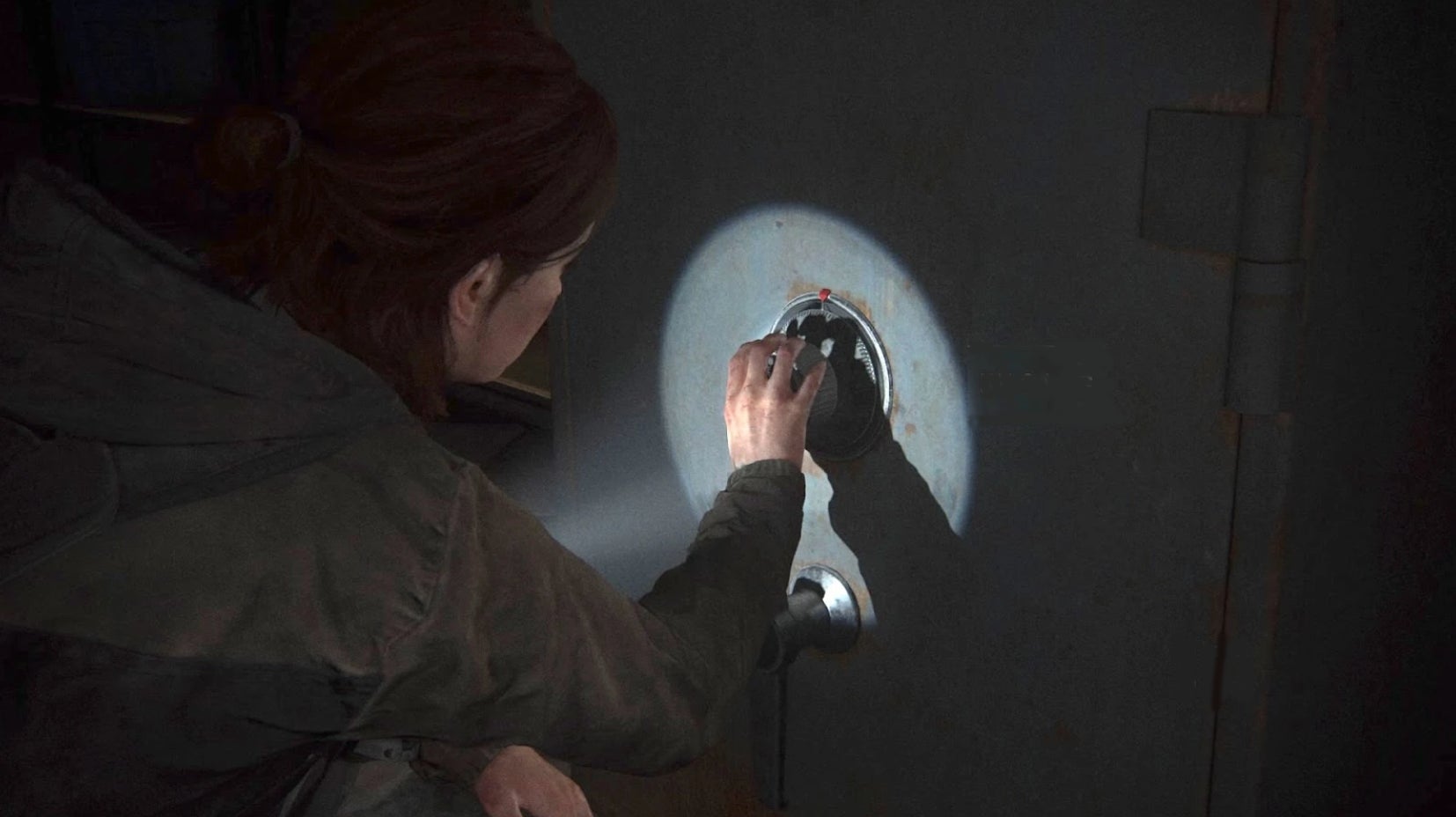
The Last of Us Part 2 has 14 locked safes scattered throughout its world. In contrast to the rest of the game, where resources are limited and ammo is scarce, these safes are loaded with supplies. In a game where visceral fun isin short supply, cracking these safes is a pleasurable experience that forces you to slow down and pay attention.
This might sound like an odd observation in a game where you habitually make loops around every room to make sure you collected everything. But when you scavenge for supplies like this, you’re not really observing or appreciating your environment. Instead, you’re zeroed in on your character as you wait for the Triangle prompt to open a drawer or pick up a bottle of alcohol. The safes, on the other hand, make you look at the granular detail and layout of the world itself.

Spoilers follow.
It starts with their placement. In stores, the safes are typically in the employee section—in the supply room of a pharmacy, or adjacent to the break room of an office.
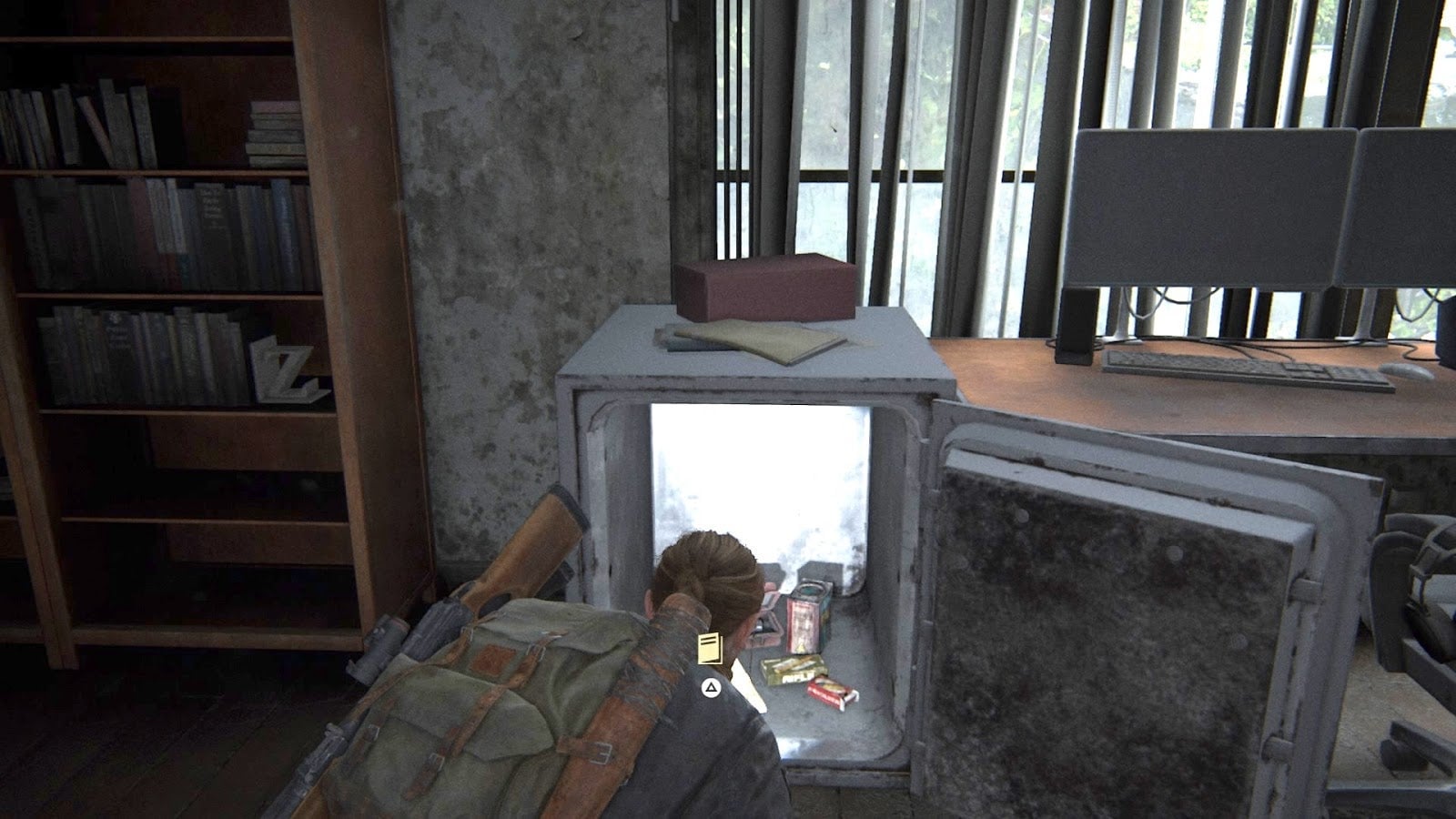
The Last of Us Part 2 encouraged me to think of its environments as real places in order to determine where a safe might be. If I walked into a store, and I didn’t find anything I could scavenge on the display shelves, I’d wonder, “What practical rooms would be in a store like this? Is there a stockroom in the back? Is there a bathroom for the employees? Maybe I’ll have better luck there.” In less detailed games, I wouldn’t expect a department store to be much more than the surface appearance of a department store. But in The Last of Part 2, the developers placed great care in functionality as well as appearance. It reminded me of when I was 16, and I worked at a local fast food restaurant—I had gone there many times as a customer, but working there, it was jarring to see the “other half” of the restaurant that the customers never got to see.
After you find a safe, you have to crack it. The clue to doing so is usually in the direct vicinity of the safe. While this formula—find safe, look for a clue nearby—is usually the same, the developers did an excellent job of varying the methods by which you arrive at a solution.
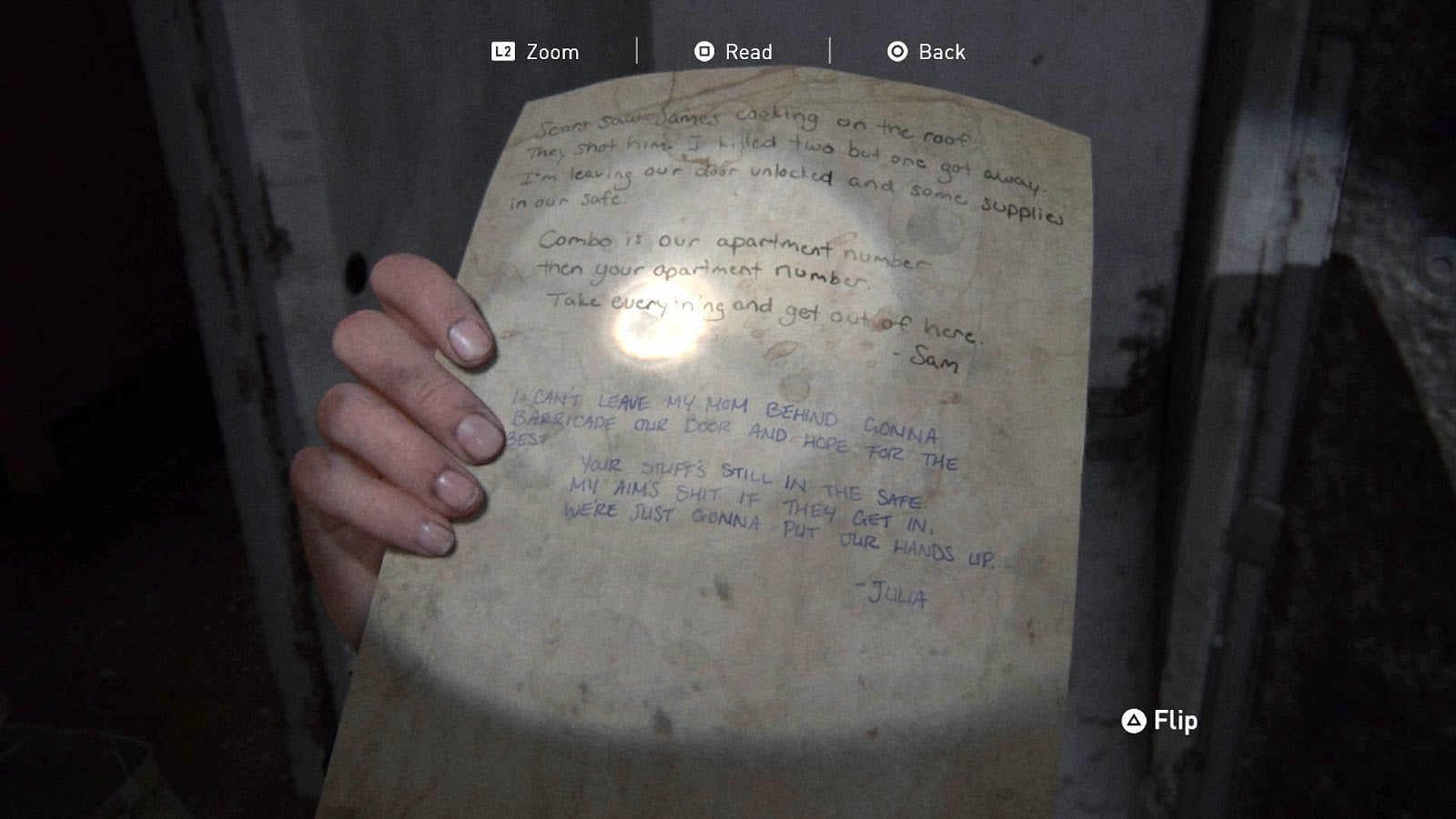
For instance, there’s a safe in an apartment complex. I found a piece of paper on the table, where I learned that two sets of survivors—Sam and James, and Julia—lived next to each other and had been exchanging notes. One of their last correspondences was, “Combo is our apartment number then your apartment number.” Since you’re in Room 302 ( it says so in the note, and you can go out in the hallway and see for yourself), and apartment numbers typically count up by evens or odds on one side of a hall, I concluded that the combination was either 30-23-00 or 30-23-04. I tried both, and sure enough, one of them worked.
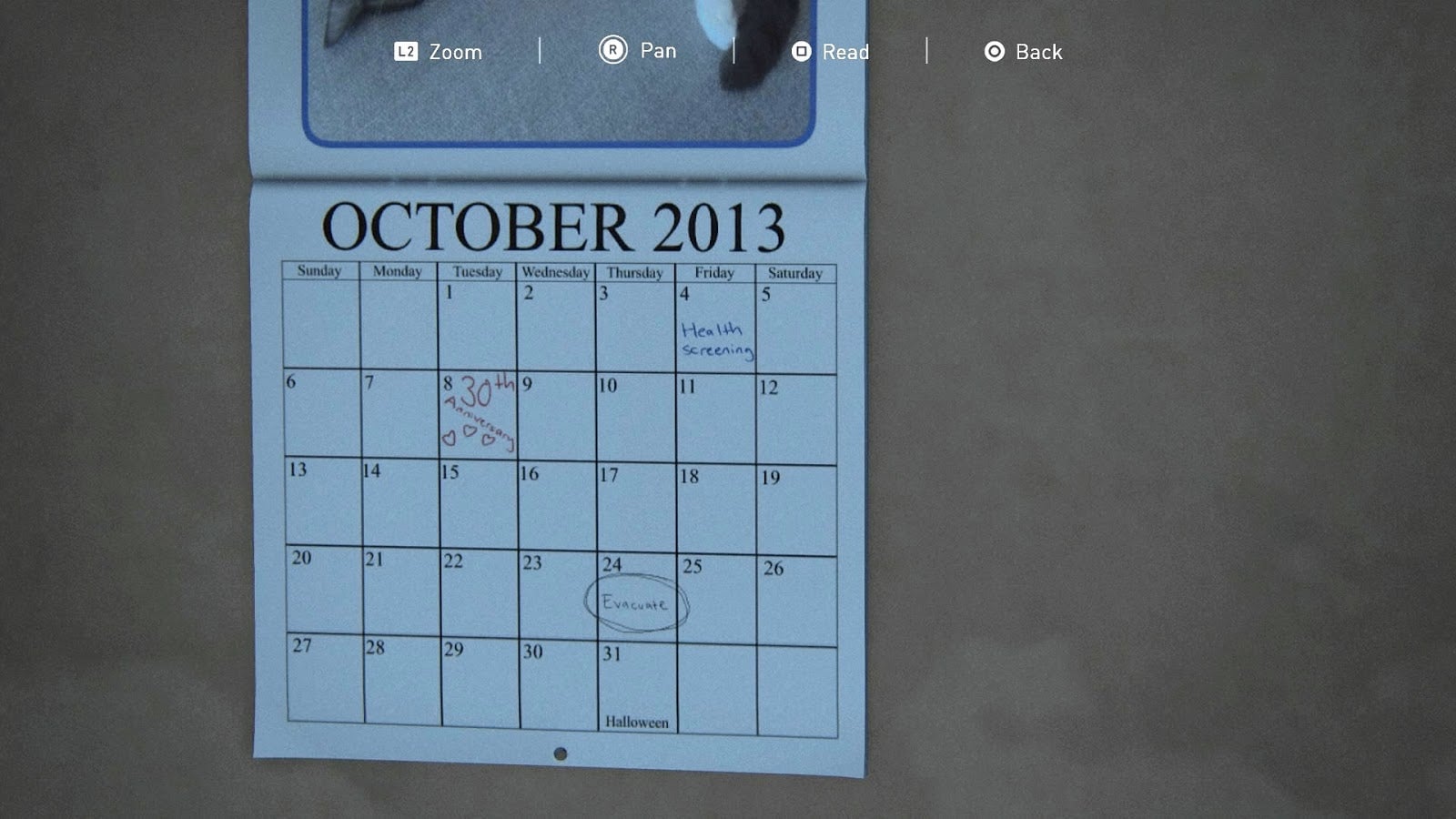
Another safe, which gave me the most trouble, made me do some math. One half of a married couple left a note for the other, which said that the safe combination was “Set to our wedding date – I mean it’s been thirty years, but I assume you remember when that was, right?”
So, the first thing I looked for was a calendar. I found one hanging up in the bedroom, where the couple marked their wedding anniversary on October 8, 2013. I entered 10-08-13 into the safe, but it didn’t work. I reread the note and realized that it was the wedding date. So: 2013 minus 30 equals 1983. I entered 10-08-83, and this time, the safe opened. I was proud of myself, and I helped out a fellow player on Twitter who ran into the same problem.
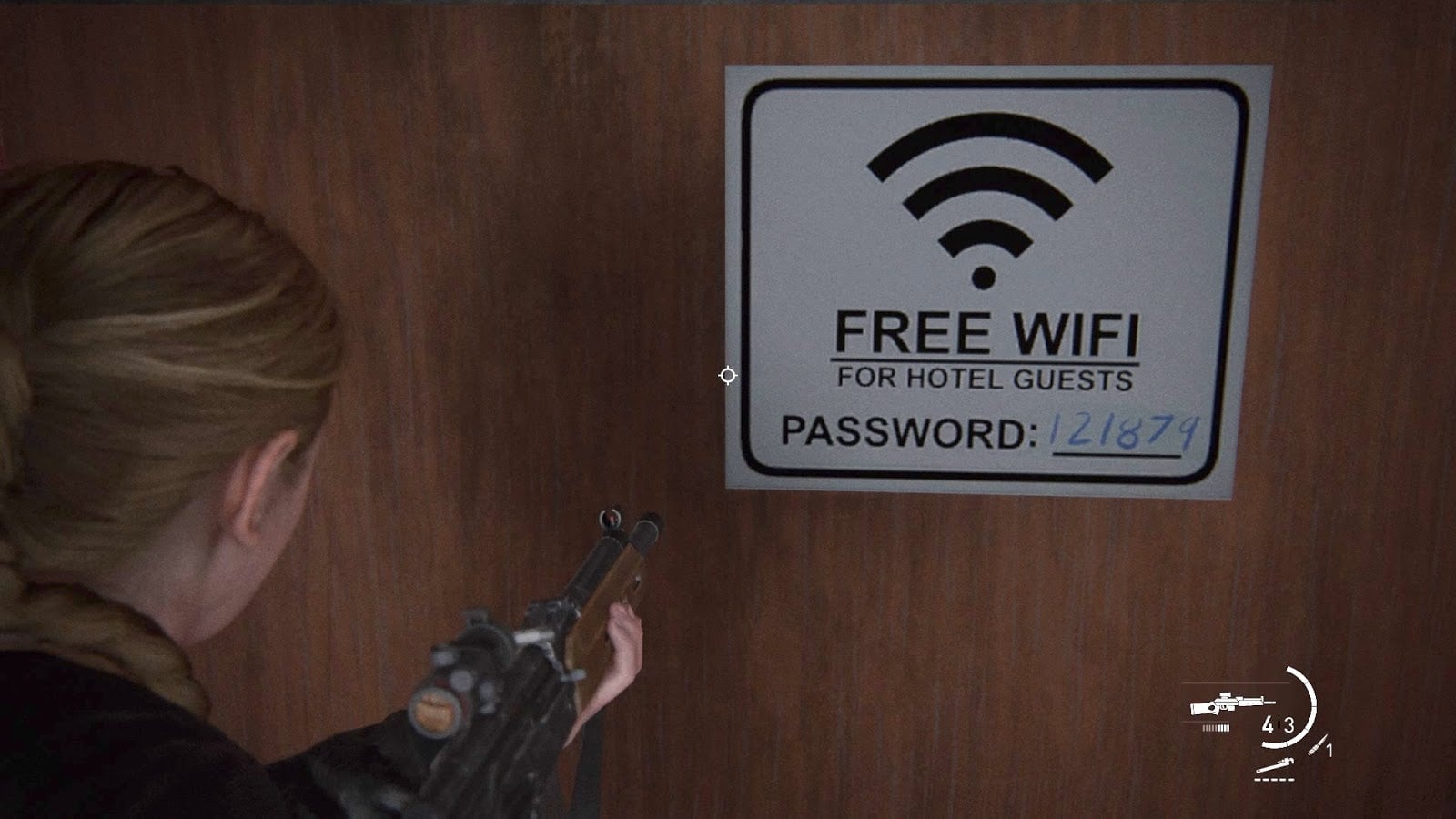
For another safe in a hotel, I went into the downstairs coffee shop and learned from an employer memo that the safe combination was the same as the Wi-Fi code. This was both dumb and relatable, in the same way that people use “Password” or “123456″ as their passwords. Since I was in a hotel, I thought, “Where would the hotel put the Wi-Fi password? They would probably display it in a central location, where everyone could see it.” I started looking at the front and reception desks of every area I went into. And sure enough, there was a Wi-Fi code posted behind the reception desk in the gym.
Once you find the safe and its code, you have to manually open it. In the first The Last of Us, finding the right note for the right safe was an auto-crack; the developers never made you manually input the combination. It felt more like an electronic passkey than a traditional combination safe. The manual input is so much more involved, in a good way. You have to actually read the notes you found, and sometimes follow a trail of additional contextual clues to arrive at the solution yourself.
You input the combination by adjusting individual counters for each number. Each time you go up or down by a single digit, your digital avatar turns the safe’s dial in corresponding fashion. By slowing down the moment of cracking the safe, the game builds suspense for what’s inside. The feeling of manually inputting the combination emphasizes how specific the numbers are; it would be incredibly difficult to crack the safe with a brute-force attack (although some players report being able to crack the safe by listening to the clicks).
Inside each safe are whole units of essential supplies: an entire bag of explosive materials or an entire set of blades, which you could use to craft arrows and shivs. You find lots of ammo. But most importantly, you find large caches of mechanical parts, which you use to upgrade your weapons, as well as bottles of pills, which you use to upgrade your personal abilities. These finds highlight the sense of the game’s post-apocalyptic world, where everyone has so little that a bit of rag, an empty pop bottle, or a scrap of metal is a literal treasure.
The Last of Us Part 2′s developers excelled at creating livable spaces that once contained living people. Correspondingly, the player needed to explore the environment’s details and treat the settings as livable spaces to get the most out of them.