
Dragon Age is an immensely popular fantasy roleplaying series that has spawned several main entries, spin-off games, novels, comics books, a tabletop game, an animated film, and a web series. Yet the first entry in the series was relatively modest: Origins is a single-player game with a main story campaign that apparently takes most people somewhere in the range of 40 hours. Sure, there are different races and classes to choose, different narrative pathways to go down, all of which might incentivize those truly taken with BioWare’s fantasy RPG to play through it several times, perhaps racking up 200 hours or so of playtime before they feel like they’ve experienced everything the realm of Thedas has to offer. And yet, I managed to accumulate 1,167 hours in the game. This is my story.
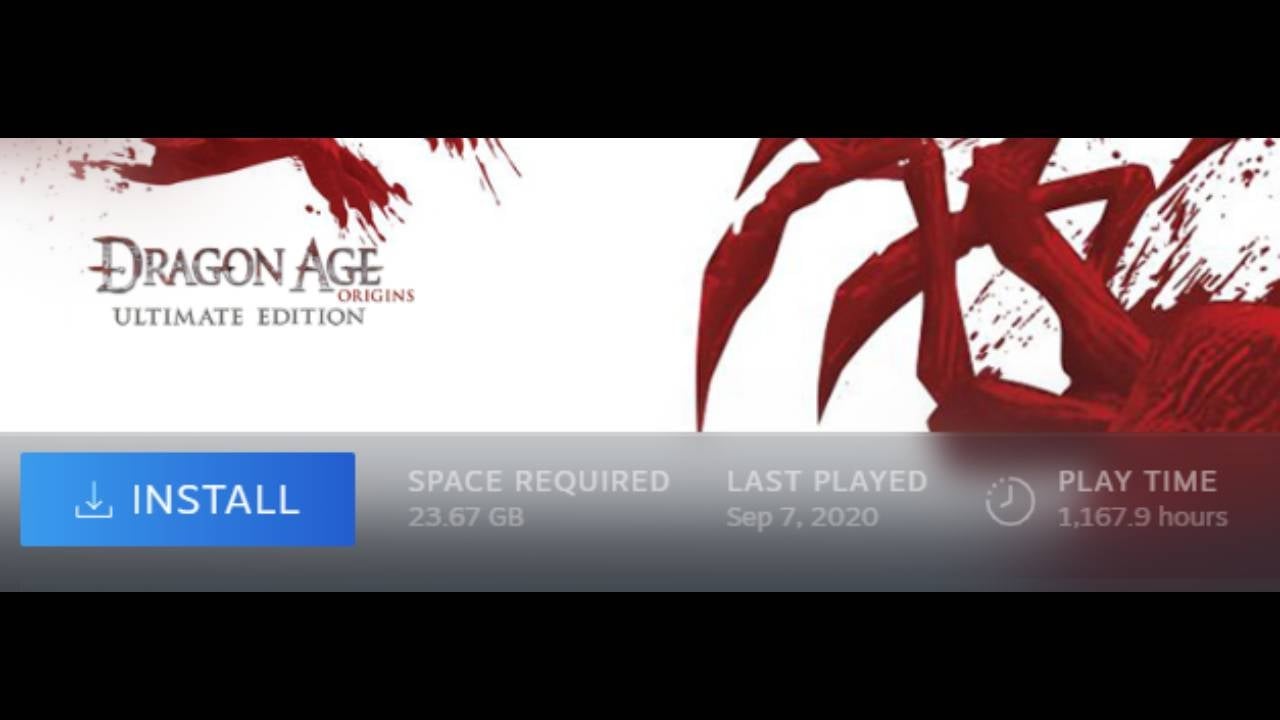
In all honesty, it had never previously occurred to me that spending over 1,000 hours with Dragon Age: Origins might be unusual. But then, Kotaku EIC Patricia Hernandez asked writers to interview people “who have played at least x hours of a game.” She wrote in Slack, “theoretically it could be 5,000, 1,000. Something no average person would have, but some definitely do.”
I put my face in my hands and groaned. Me. She was indirectly talking about me, the writer who has accumulated 1,167 hours in Dragon Age: Origins on Steam. When I confessed my gamer crimes to my boss, she was astonished. “How?” she asked.
“Listen,” I sputtered. “I have a lot of characters. Sometimes they make different choices.”
Surely I wasn’t the only person who had logged over a thousand hours on PC, not to mention the considerable amount of time I’d spent with the Xbox 360 edition? I started asking around.
Ash Parrish, former Dragon Age blogger at Kotaku, had accumulated an estimated 120 hours. “Friend, I am in awe of you. Those are live service game hours. How on earth?”
Meanwhile, current Kotaku writer Claire Jackson tried to be kind. Tried. “That’s like 48 days of Dragon Age without stopping?” she wrote in Slack. “I think that’s quite an accomplishment, actually.”
My fellow staffer Zack Zweizen had to put his foot down when I insisted that I played Dragon Age: Origins a normal amount. “I….will not say that.”
The question remained. How on Earth did I play the game for 1,167 hours when, according to HowLongToBeat, an entire completionist run only takes 87 hours? To write this blog, I opened up my Dragon Age game and started digging through my various save files. Except there was one problem. I’d mostly played the game on my old laptop (RIP 2015-2020), and I was a Luddite who hadn’t yet discovered Steam cloud backups. So I don’t have any in-game screenshots from my adventures to show you.
HOWEVER, one does not play over a thousand hours of Dragon Age: Origins without developing a morbidly good memory about the game. Here’s how I became trapped in Thedas for a thousand hours. The secret is that Dragon Age: Origins can be and should be played like Skyrim: with a boatload of mods that completely change your experience of the game. Your quest to kill the corrupted dragon doesn’t have to be a railroaded single-player campaign. It can be whatever you want it to be, within reason.
The secret to replaying BioWare’s critically acclaimed RPG is to be utterly dissatisfied with it. In truth, I had fallen off the game for a few years before I came back and decided to give it a second chance. The combat system was too opaque, and I had much better looking JRPGs in my games backlog. Perhaps more frustrating was that I couldn’t see myself in the game. If you’re white and cisgender, then Dragon Age will always have a place for you. Otherwise, tough luck. Inquisition, the most recent Dragon Age game, didn’t feel inclusive enough for me upon its release in 2014, but good representation was even more lacking in the series’ 2009 progenitor. There wasn’t any way that I could make the main character look Asian, like me. Want to play as a nonbinary character? Forget about it. You couldn’t kiss Morrigan while playing as a woman either, which is an oversight that makes about as much sense as heterosexual Miranda Lawson
I loaded my game with some of the most popular mods. I didn’t like the boringly European hair choices, so I downloaded some longer styles for men. Playing as a non-rogue (or a low-level rogue), I felt frustrated at being locked out of higher-level treasure chests. So I installed a “lockbash” mod that would allow me to bust open any lock. If I wanted a full party of four, then I had to leave my loyal dog companion at home. “Extra Dog Slot” allowed me to bring him along on adventures as a summon. If I hadn’t been able to do that, I would have abandoned him at camp for more talkative characters. By the end of my campaign, he did actually feel like family.
Now, this isn’t to say that the vanilla version of Origins is…vanilla. The only reason that I cared to mod Dragon Age for dozens of hours was because the first game was so evocative. The storytelling always made me feel like there was more to Thedas than what I was seeing onscreen. I hungrily pursued additional lore through art books, the official novels, developer interviews, and additional sequels. These bits of worldbuilding only made me more determined to expand my version of Thedas.
For me, the most game-changing mods weren’t ones that had a far-reaching impact on the story or the mechanics, but rather ones that simply allowed me to replace the generically bland armor textures with lore-appropriate ones. This minor change totally altered how I saw my characters, and the ties that bound them together. See, I like to roleplay as a lot of evil bastards, but the most important BioWare companions tend to be aligned with good. But even when you disagree with your friends about the ethics of mass slaughter, you should still be on the same team when it comes to saving the world. Seeing the former templar Alistair and my main character both clad in the armor of the Grey Warden faction helped me care about him as a comrade, even when my shithead mage wanted to sock him in the nuts.
And even outside of my inter-party bonding, having custom-modded textures for special weapon and armor drops made them feel more special. Previously, it was a huge letdown to brave scores of giant spiders or mind-bending demons for the sake of a generic item in a slightly different color. I wanted loot to feel special, rather than disposable. Some of this stuff got me through some of the most emotionally devastating battles in the game, and I wanted to be able to tell them apart in my modded armor racks. I found myself keeping sub-par swords, helmets, and jewelry that told a story about where my character had been.
I added to, pruned, and tended my Origins game like a personal garden. As I scoured the Nexus Mods website, I would eventually add other mods, giving myself the power to buy a tavern from an asshole and gift it to the female server he often harassed. At the end of the game, you can choose to let one of the male characters sleep with the witch Morrigan to produce a god baby. This magic baby ritual is the only way that your character can kill the final boss without dying in the process, and you can’t perform it with a female character. So you might end up in a situation where your love interest is forced into a “fuck or die” scenario with a woman he hates. Well, mods can help with that!
It didn’t matter if I didn’t end up availing myself of an opportunity that a mod I installed provided, if I still ended up forcing Alistair to have a kid with someone he disliked, or if some of my characters were still cruel where they now had a chance to be kind—the point was, this was a world where I had the option if I chose. In a choice-based narrative game, the decision that we didn’t pick can be just as important as the path that we ultimately chose. I tuned and tuned until I had the best version of Thedas: One that was as beautiful, gay, and lore consistent—with my vision of Origins’ world—as possible.
My mod collection grew, and so did the number of playthroughs that I had under my belt. I had entire backstories and offscreen events of my own imagining nestled in the back of my brain, stories that changed the surface meaning of the story. My city elf detested her knightly mentor Duncan for trying to kill her with an initiation ritual, but still completed the remembrance quests out of respect for her military bestie. My nomadic elf resented that his persecuted clan chose peaceful coexistence over dominating the lands that he felt were rightfully theirs. Though the game presented Queen Anora as a Machiavellian schemer who only cared about the throne, my human noble had been madly in love with the consort since childhood. Their marriage, in my mind, was driven by emotion rather than politics. Most players might remember the failed mage Jowan as their character’s best friend. Throughout the years, my mage considered him a laughingstock and had cruelly pinned their misdeeds on him. When Jowan finally betrayed his friends, my character felt respect towards him for the first time in his life. Ah, youth.
Even my characters’ relationships with their friends and love interests would sometimes take on a totally different trajectory depending on the order in which I pursued main quests. Sometimes, my character had a healthy dynamic with the party members who relied on them. Other times, a particularly terrifying encounter with a demon or an unnerving self-revelation would cause them to respond in a more reactionary manner. My Dalish elf was absolutely not going to make responsible or heroic decisions after a reanimated corpse of his childhood friend tried to kill him. And that’s just life, you know? BioWare writes brave protagonists. I write terrified ones. Sometimes, they make good decisions despite how awful they feel. Other times, they don’t. They’re just people, and they don’t know that they’re the hero of their own story.
The best stories weren’t the ones that the designers tried to feed me. They were the ones that lived exclusively in my brain. I would sometimes write down stories that I wanted to tell. Other times, I’d use Origins as my narrative medium. I knew how the story would end: With the big bad dragon’s defeat. But before that, there were thousands of mundane stories to tell.