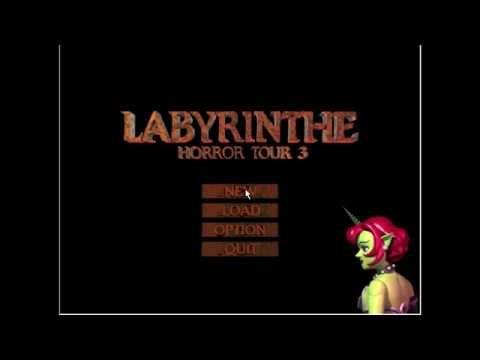
Earlier this week, a group of game archivists revealed that a trove of over 70 lost Japanese video games has surfaced, including the third game in the obscure Horror Tour trilogy of point-and-click horror games. The release of these games, from the personal stash of a Japanese collector, has touched off a debate about how unreleased or obscure games should, or shouldn’t, be shared.
A YouTuber named Saint posted a video playthrough of Horror Tour on June 4 along with a link to download the ROM. But it turned out that the information was taken without permission from the original collector, potentially making it even more unlikely that rare lost games like these will be publicly shared in the future.
The first Horror Tour was released on PC and Sega Saturn in Japan, and on PC only in the West as Zeddas: Servant of Sheol. Its sequel, Horror Tour 2, never left Japan. Labyrinthe, the third game in the series, is about solving puzzles in a castle in order to defeat an evil demon and is even more obscure. As Vice’s Motherboard noted in its report earlier this week, the game is a phantom listing on retail sites like Amazon Japan and, according to a 2014 article at Hardcore Gamer 101, was so rare some people remained convinced the game was never actually released. Based on the four-hour playthrough of the game uploaded by Saint, however, it’s very much real.
How the ROM came into their possession has become an even larger issue in the days since the discovery was shared, however. Japanese collectors can be very private about the unreleased games in their possession, only sharing them within small circles of other collectors they trust.
“I’m generalizing a lot here, but I think it’s important to understand that there’s a fundamental difference between Japanese and Western software archivists,” Frank Cifaldi, a fellow archivist and founder of the Video Game History Foundation, told Kotaku in an online chat. “For the most part, Japanese archivists don’t widely share their material, I believe out of respect to the original authors. This isn’t ‘wrong,’ it’s just a different approach, and one that I think we ought to empathize with and maybe even learn from. They tend to make the material safe, but keep access limited to a trusted group of like-minded people.”
“The guy who found and uploaded the game has uploaded a ton of Japanese PC games into a Mega folder which was only posted in the forums of a private torrent site,” Saint wrote in the video’s description. One of the folders within that mega folder read “DO NOT UPLOAD.” That’s the one Labyrinthe came from, which according to Saint was uploaded nearly a year ago. While the owner threatened to stop uploading games if stuff from that folder was leaked, Saint decided to do it anyway, noting how rarely anything there appeared to get updated. “If he gets pissed about me uploading the link I don’t care.” Saint did not respond to a request by Kotaku for comment about the matter.
The leak of Labyrinthe— and 67 GB worth of other obscure, unreleased, or otherwise previously unavailable Japanese PC games—has caused a new debate about how to balance efforts to preserve gaming history with the need to build trust among the collectors whose help is central to that effort.
Phil Salvador, a digital archivist who maintains the blog The Obscurity charting his experience researching old, rare, and lost games, originally tweeted out Saint’s video and listed other games that were in the collection, including a sports game called Cookie’s Bustle and a third game in the poorly documented Yellow Brick Road series. In a blog post, he also explained the games had been circulating since earlier in the year but no one had shared them publicly due to the personal relationships and circumstances under which the games were obtained.
Salvador, who is in possession of the collection, originally wrote that he planned to begin uploading them to the Internet Archive. Those plans have changed, though, due to the sensitive nature of how the leak came about, and he has since “redacted” his earlier blog post, saying he was overeager and doesn’t want to fray relations any further.
https://kotaku.com/saving-japans-games-1819339226
“Leaks like this happen from time-to-time, like the unplanned early release of the Pokemon Gold Space World ROM this month, but not often at this scale,” Salvador said in an email to Kotaku. “What all this tells me is that there’s a collector who was doing extensive work preserving games that no one else was focusing on, but they weren’t ready to share it yet. Someone within their circle betrayed their trust, which is how all this came out. While it’s exciting and important for more games to be available publicly, I worry about this discouraging collectors for doing similar preservation work in the future.”
Salvador has since updated his original blog post with a short paragraph reiterating his belief that leaks are not a sustainable way of working to preserve old games and gaming culture. “Private collectors have saved historical objects that otherwise might’ve been lost, and rather than demonizing people who are reluctant to make their collections available, we have to collaborate with them on the importance of preservation,” Salvador wrote.
With so many more digital troves out there like this one, Cifaldi believes it’s important not to alienate the actual collectors in Japan doing much of the legwork for the short-term gain of being able to play the games immediately. “There are only so many people actually doing this in Japan, we can’t afford to lose any of them,” he said. “If the cost of these games being online right now is that we lose what appears to be a tremendously talented archivist, I don’t know if this is really worth celebrating.”