
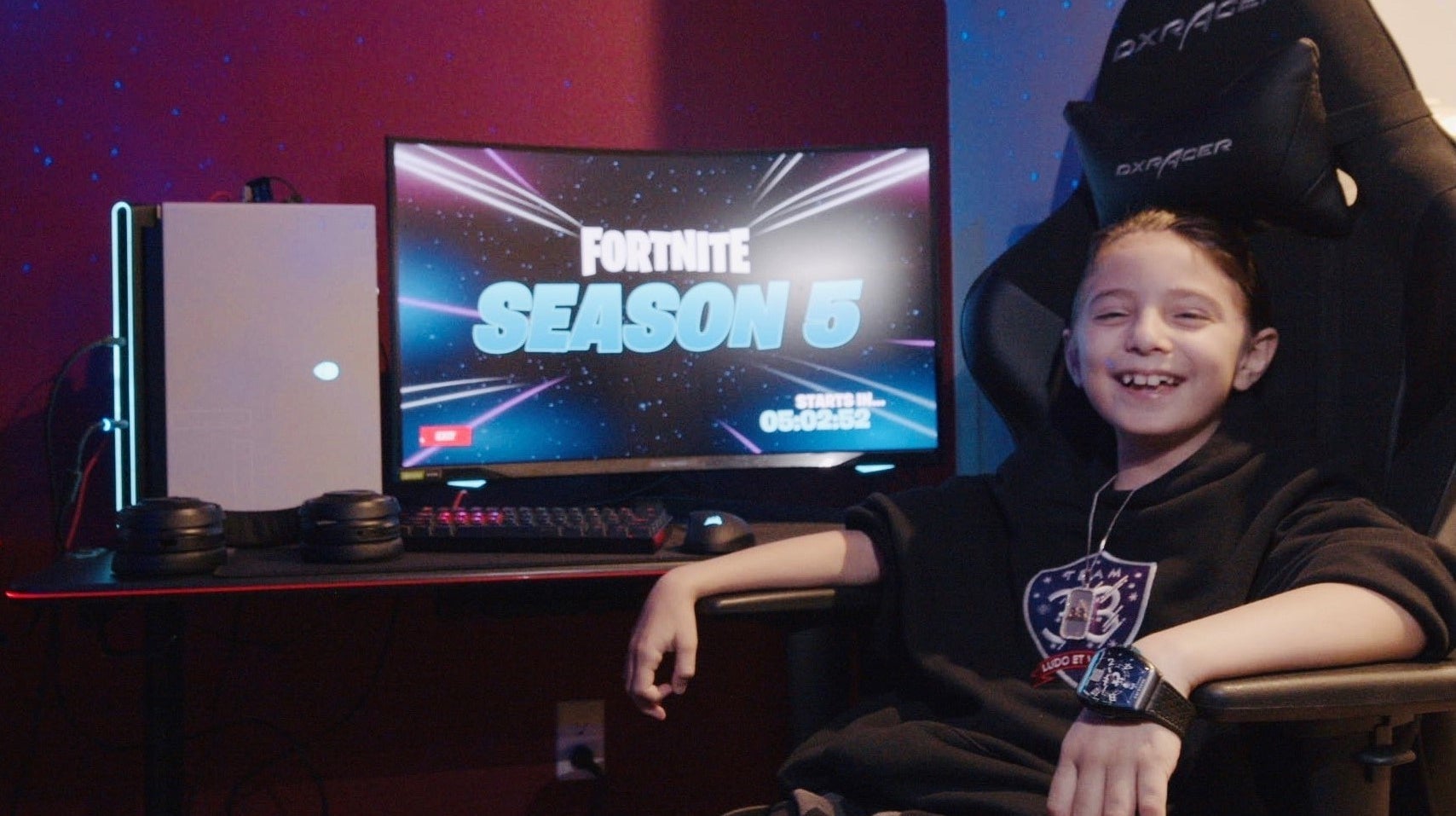
If nothing else, Team 33 certainly made a splash when it arrived on the esports scene earlier this month. In a press release, the previously unknown organization boasted of a Hollywood team house that had already played host to big names like Janelle Monáe, Post Malone, and Drake. But it wasn’t glitz and glamour that prompted a withering glare from the esports community’s eye of Sauron. Instead, it was the team’s first announced signee: a Fortnite player named Joseph Deen. He is 8 years old.
Deen is a child. To hear Team 33 founder Tyler Gallagher tell it, he’s an extremely skilled child, but a child nonetheless. Despite that fact, Deen is now a full-fledged member of a professional organization, and he’s got a $33,000 signing bonus and a brand new $5,000 gaming setup to show for it. When the signing was first announced, some esports fans declared Deen’s unlikely debut a dream come true, the sort of opportunity most kids would screech themselves hoarse over. But others looked on with furrowed brows and scrunched up faces. They smelled something fishy. At such a young age, how could he enter tournaments? And what could the team possibly have him do that wouldn’t violate child labor laws? Surely, fans figured, Deen’s signing couldn’t be legal
Extreme youth is not uncommon in the esports world, where teens become stars, and teams push limits to get an edge on the competition. Multiple Overwatch League teams have incubated underage players until they’ve hit the minimum required age to play on Blizzard’s big stage (18 years old). In 2019, then-16-year-old Fortnite phenom Kyle “Bugha” Giersdorf won the Epic mega-game’s $3 million world cup. Somewhat notoriously, 2019 also saw H1ghSky1—a player signed to esports behemoth FaZe Clan—get busted for pretending for years that he was above the minimum required age to stream on Twitch and compete in Fortnite tournaments (13).In reality, FaZe first signed him when he was 11. In response to this revelation, Twitch suspended his account, and Epic revoked his tournament winnings. He went on to stream on YouTube with direct parental supervision, per YouTube’s rules for young children, until he turned 13 earlier this year.

This is why many esports fans aren’t sure what to make of Deen’s signing: Yes, esports pros skew young, but Deen is young-young. If H1ghSky1, who was 12 when he had to briefly press pause on his career, couldn’t do it, how can Deen? According to Team 33 founder Gallagher, it’s simple: Deen won’t technically be doing anything that constitutes work.
“Essentially, there’s no labor laws, because he doesn’t have to work. He’s just gaming… He’s waking up on Saturday morning, or he’s coming back from school at 5 PM, and he’s gaming with or without us,” Gallagher, an alternative investment firm CEO who claims his company is worth a billion dollars, told Kotaku over the phone. “We’re not flying him out anywhere. He’s not entering tournaments. He’s playing like he would play on Saturday or Sunday. We’re legally allowed to give money to him because we believe in him and we’re making an investment.”
Deen’s contract, Gallagher said, is “confidential,” but in short, it does not specifically require him to do anything. If he doesn’t show up to weekend practice with other, still-unannounced members of Team 33, he will apparently face no consequences. If he is spending too much time gaming and not enough time on his schoolwork, there’s an option for his mother to break the contract entirely.
Gallagher characterized the contract as a representation of Team 33’s commitment to Deen, deeming it a “reverse contract.” The team is, per a contract stipulation negotiated by Deen’s mother and her lawyer, on the hook to build up his YouTube presence. It will also train him in games like Fortnite and Call of Duty in his free time, enter him in tournaments (with no prize money on the line), and create and sell merchandise based on him. Team 33 will take a 33 percent cut of profits from Deen’s YouTube and merch, which Gallagher said will help cover “all the things that we do marketing-wise, press-wise, building his presence, management of his social—all of that stuff.” However, he also said he intends to recoup his $33,000 investment and then some over the next few years. Should Deen exit the agreement, the YouTube channel and merch will belong to Team 33. When Deen turns 13 and is able to begin competing, Team 33 gets first right to refusal and can either opt to renegotiate his contract or let another organization sign him.
Gallagher repeatedly insisted that none of the above activities count as work, labor, or making money off a child’s labor. But this arrangement still raises questions: At what point does playing video games become work? And even if a contract doesn’t require a child to work, what other forces might cause them to essentially treat gaming like work? Is a regular routine or team practice schedule a means of compelling a child to work, especially when adults are the ones structuring it? What about a YouTube channel, with subscriber numbers that will not go up (and might even go down) if the child does not stream or appear in videos? What happens when any amount of money, no matter how small, enters the picture? And why aren’t there laws that discretely break down what is and is not allowed in situations like this one?
Legal experts also aren’t so sure that Gallagher’s claims about work are ironclad.
“If [Deen’s situation] isn’t work, at what point do you cross that line?” asked esports attorney Ryan Fairchild during a Discord call with Kotaku. “My gut says that a Commissioner of Labor or Secretary of Labor would want to look at this closely and probably not like it, but I don’t know what would stop somebody from doing it other than ethics or some Commissioner of Labor or Secretary of Labor coming out and saying, ‘No, this is work, you can’t do this.’”
As part of a phone call alongside his mother and Gallagher, Deen was exceedingly shy and unable to fully answer most questions, because he is 8 years old. He also could not explain where his nickname, 33 Gosu, came from, because it was Gallagher’s idea. That said, Deen told Kotaku he was inspired by other young players like Bugha and H1ghSky1, and he’s “excited” to be part of Team 33. He also said that his goal is to “get better and better” and “be the best player,” but that he doesn’t feel like he suddenly needs to practice extra hard in order to do so. However, his mother, Gigi, recounted an instance when he recently went a bit overboard.
“At one stage, he just couldn’t get off the game,” said Gigi. “And I said ‘No, you’re on an hour time limit.’ During the week, if he’s finished all his schoolwork at night, he gets an hour. But he wanted to be on there longer, so I grounded him for a week… He worked extra hard [in school] that week because he wanted to get his playtime back.”

Schoolwork, Gigi emphasized, comes first. Past that point, she said, she’s not pushing Deen to do anything he doesn’t want to do. She does not see herself as the kind of parent who would, for example, fake a Call of Duty ban to try to advance their kid through a competition hosted by FaZe Clan, like the parents of a 6-year-old gamer who goes by the handle RowdyRogan did just a couple weeks ago
“He just became a natural at [Fortnite],” she said. “You know how parents push their kids into acting or this or that? I’m not one of those… I didn’t lock him in a room for 10 hours a day and say ‘Do this.’ It was absolutely nothing like that. It was just his passion, something he got on and did and was just instantly good at.”
Deen backed this up by explaining how he taught himself an advanced Fortnite building technique by watching YouTube videos. “One day I was watching YouTube, and this guy, he made a floor invisible,” said Deen. “And I was like ‘Hm, why can’t I do that?’… You have to edit so fast consistently for, like, 10 seconds. And yeah, it goes invisible, and not much people [sic] could do that.”
These days, Gigi is in regular communication with Gallagher and Team 33 about Deen’s playtime and burgeoning career. She places a lot of trust in them.
“They’re just amazing, an amazing team,” she said. “Tyler is so good to him and very understanding of everything, with [Deen] being so young. My hope for him is to grow with Team 33.”
This has not always been the case, however. According to Gallagher, members of the team began playing with Deen two years ago, when he was only 6. For a while, Deen thought he was squadding up with regular friends he’d made online. In reality, they were testing his mettle to see if he’d be a good fit for their nascent organization.
“He just thought we were friends on Fortnite,” said Gallagher. “He didn’t know we were scouting him. He had no clue.”
When Gallagher said this, Gigi quickly added that she keeps Deen limited to “a certain amount of friends” and does not “open it up to everybody,” but also admitted that she wasn’t aware her son was being scouted by a covert esports operation, which is a real thing that can just happen to people now, it seems. Fortunately, Gallagher and company decided to contact her, first over in-game chat during Deen’s games, and then more formally.
Ultimately, Deen sealed the deal by outplaying another member of Team 33’s Fortnite roster, who Gallagher said remains secret for now but also has six million subscribers on YouTube. Around that point, according to Gallagher, another, better-known team also entered the fray to secure the ill-defined concept of Deen’s services.
“The only reason it was a $33,000 signing bonus was to beat someone else that was trying to get him, another massive team,” said Gallagher.

It is hard to say whether or not this actually happened, as Gallagher would not offer any details about which team it was. It’s also difficult to discern what kind of organization Team 33 is at this point, as Deen is its only announced player. Gallagher said he’s going to roll out more announcements soon, and that he’s kept things under wraps because he wants the team to make a splash when it begins competing in games like Fortnite, Call of Duty, and CSGO. He did, however, tell Kotaku that he intends to announce the signing of Jailynn Griffin, the 15 year-old daughter of musician Ty Dolla $ign, in the near future. Griffin did not reply to Kotaku’s requests for confirmation, nor did Ty Dolla $ign’s record label. This connection does make a degree of sense, however, because House 33 is advertised as a rentable recording studio, which explains why it’s played host to so many famous musicians. And while Team 33’s press release bills the house as “the team’s main training grounds,” Team 33’s website says that it only flies the team out to the house “once per year.” Gallagher did not reply to questions about this discrepancy.
But even if all of Gallagher’s claims are accurate and Team 33 is doing everything with utmost concern for Deen’s time and well-being, the precedent this signing sets is still concerning. If organizations can just say that playing video games, even under the auspices of team practice, isn’t work, then that opens a wormhole to a whole new dimension of potential exploitation. The esports world does not exactly have a spotless track record when it comes to practice schedules, an issue exacerbated by the fact that the whole industry is fueled by young people who believe themselves incredibly fortunate to be playing video games for a living at all. That in mind, what’s to stop another team from signing a young kid and similarly saying that he’s just playing games, only to pressure him into excessive labor when outside the spotlight’s ring of scrutiny? At the moment, not much.
Different states have different child labor laws, which muddies the waters of an already murky issue, but in esports there’s a more fundamental issue at play: Nobody is sure how to legally classify pro gamers. Depending on whether an esports pro is regarded as an athlete or an entertainer, different laws apply in states like California, where Team 33 is based. Entertainment laws are generally more permissive of work performed by children, which is where you get child actors and the like. But even those looser laws provide a form of regulation focused on limiting how much time kids can spend in the workplace. There is no such regulation that definitively applies to esports.
“We do not have a precedent, either in terms of direct legislation or case precedent, or even administrative precedent, to tell us how certain laws apply to esports players,” said Fairchild. “I was excited about [last year’s] Tfue-FaZe lawsuit because I thought we might see some of that, because it implicated the Talent Agency Act in California, as well as general contract principles. But that settled before we got a decision from the California Labor Commissioner.”
Even outside of esports, though, the law has failed to keep up with the ways various industries do and (according to current definitions) do not employ children.
“I think this is an area where we do not have good laws in place to address this situation, and I think we could look to other things where there are similar situations,” employment attorney Natalie Sanders told Kotaku over the phone. Speaking about the influence adults can have in such circumstances, she continued, “I think Olympic athletes and their situation is another example where you have very young kids, and they’re calling it extracurricular activities, not employment. But the control is there. It’s real, even if they say you don’t have to.”

This is a doubly pernicious power dynamic in esports, where it’s a common refrain that young people are lucky just to be living the dream of getting paid to play video games.
“I would say that’s true of most players,” confirmed sports attorney and professor at George Washington University Ellen Zavian while talking to Kotaku on the phone. “That’s why they’ll play for anything. And that’s why you eventually create unions, because that protects the athlete ultimately, right? But we don’t have a union yet.”
Sanders proceeded to express skepticism of Team 33’s specific approach, noting that if Deen is receiving a percentage of money made off YouTube ads and merchandise, “his efforts on behalf of the team are being rewarded monetarily through the team, so that sounds like compensation for the work performed.” If that’s the case, then the Fair Labor Standards Act (which limits the number of hours minors under 16 can work) and California child labor laws should apply. Moreover, if Deen’s ability to make money is tied to the success of a YouTube channel and merchandise born of his personal brand, then according to Sanders, “it would be unrealistic to say that his performance, whether he does anything or not, is irrelevant.”
But the legal system has scarcely begun to address bare basics of what it means to be an esports competitor, let alone granular specifics of child labor under that umbrella.
“It’s just such a modern situation,” said Sanders. “You’ve got laws that are designed for a certain type of thing, which was a movie/film/TV industry, and you’re trying to apply them here, or you’ve got some rules for professional athletes, but those are dealing with adults. [Is Team 33] doing anything wrong? I mean, there’s a difference between ‘Are they doing anything wrong?’ and ‘Are they violating any laws?’ I think it’s fair to say you can’t point to the situation and say they are clearly violating the law… It’s just not an assumption we can make, and more likely than not, there are not laws and regulations that cover this situation.”
Recommended Stories
https://kotaku.com/banned-fortnite-streamer-admits-hes-12-streams-on-yout-1835312481
https://kotaku.com/popular-twitch-streamer-tfues-contract-with-faze-leaks-1834987080
https://kotaku.com/how-pro-gamers-live-now-curfews-personal-chefs-and-a-1827017564