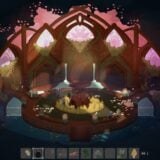
20 years ago Lance E. McDonald rescued an Amstrad CPC-464 at a market in country Victoria. He was six years old. Now, married with two young children, Lance is on a mission. He wants to make a video game like the ones he used to play, using the tools he first learned when he was in primary school. The video game is called Black Annex and he’s building it by himself. He’s building it using QBASIC. Lance E. McDonald is batshit insane.
—-
In country Victoria a six year old Lance E. McDonald sits in front of a computer. He types the following words onto his Amstrad:
10: INPUT “What is your name”; name$
20: PRINT “Hello “; name$
He types “RUN”.
His small jaw gapes in amazement. His life will never be the same again.
20 years later Lance E. McDonald types something different into a computer; into a digital thesaurus. First word: “Hostile”. Response: a stream of synonyms, among them the word “black”.
Second word “Takeover”.
‘Conquest’, ‘acquisition’, ‘invasion’. None of them are quite right. Annexation? Too clumsy. How about we shorten it. Annex… that’s good. That’ll do.
“Black Annex”.
Lance E. McDonald likes the sound of that.
5.30pm. The Customer Service department of an Australian ISP. Lance McDonald shuts down his computer. He leaves the office and walks home. He looks after his children. At 8pm his kids go to sleep.
From that point, until the early hours of the morning, Lance is Man Fight Dragon. And he is working on his brand new video game Black Annex.
You may have heard of Black Annex. It’s not like other video games. Black Annex fits the definition but it’s also a literal challenge; a testament to the stubborn lengths one man will go to in the name of nostalgia. With all the software available to independent developers, Lance E McDonald could make life easy for himself.
But no, Lance wants to make Black Annex completely from scratch. In QBASIC.
Black Annex is a game about subterfuge. It’s a game about corporate espionage and sabotage. But it’s also the story of one man building a video game like the ones he used to play, using the tools he once used when he was six years old and his jaw gaped in wide-eyed amazement.
“Well, I guess it’s that whole nostalgia thing. When I refer to “toys” I used to play with as a kid, I literally mean that BASIC was one of my favorite toys from my childhood.”
Lance E. McDonald has a room littered with relics; a house drenched in a once-hidden dimension of video game history that barely existed. He has a floppy drive atop a Super Nintendo that plays bootleg games. He has three different 3DOs. He has six different PlayStation 2s, including one of the old-as-hell external HDDs. He has every version of the PlayStation ever made including the ultra rare Net Yaroze that lets you create homebrew games.
“It’s literally just shelves and shelves of bizarre stuff like this,” he says.
He once built a telephone exchange emulator from a Linksys PAP2 for his Dreamcast, just so he could play games online using an ADSL connection connected to the Dial-up Modem in the Dreamcast.
“I just get an idea in my head like, ‘I’m gonna buy every modem that was ever released for home consoles and try them out’ and I just go on a binge like that.”
On a cold Sunday morning in 1992 a six year old Lance and his stepfather saw a sign next to an object lying on the ground and the sign said ‘computer’. Next to the sign lay an Amstrad CPC-464 and a sack of cassette tapes. The family had spent the last few years getting accustomed to video games, playing the Atari 2600 (“I really liked Lazer Gates and Demon Attack,” says Lance. “The rest of my family liked River Raid”). The rusty machine gathering dust on the market place floor had an air of intrigue to it. His stepfather bought the Amstrad and Lance brought it home.
“It was dumb, though,” remembers Lance. “No matter what you typed in, it would just say ‘Syntax error’.”
Syntax error.
Days later a friend of his brother came round. He dusted off one of the tapes, he typed “LOAD”. The machine emitted a high pitched screech and then stopped.
“RUN”.
And then, magic.
Buried deep in the library inside the primary school where Lance E. McDonald learned to read and write was a series of books called “UNDERSTANDING THE MICRO” and the librarian looked confused when a young boy tried to check it out. This was just the beginning.
“My step-brothers’ cousin had magazines with pages and pages of code you could try out,” says Lance. “I spent hours and hours entering other peoples’ code and writing my own.”
Years later Lance’s brother had a Super Nintendo. One of the games he used to play religiously was Killer Instinct. Killer Instinct was cool, but Lance wanted to make his own games. He stole the instructions, and made a text adventure in BASIC featuring the characters he read about it in the biography pages of the manual.
Lance E. McDonald had fallen in love with BASIC. Later his family upgraded to a 486. Cutting edge. It had a CD-ROM, a sound card, the works. But when another friend of his brother introduced him to QuickBASIC 4.5, a form of QBASIC that allowed him to write in BASIC and then compile his work into an exe. file, his eyes widened with the heightened excitement of endless possibility. Lance would go on to learn dozens of other, more powerful languages — and his job requires programming in PHP and Javascript — but when he gets home and everyone is dead asleep he returns to the his first love, the language he learned as a child, “HOW TO UNDERSTAND YOUR MICRO” weighing down his school bag, magazines scattered across his bedroom floor. A Killer Instinct instruction manual open at the biography pages.
“I still like to play with the toys I had when I was a kid,” explains Lance. “So I still use BASIC when I have a choice.”
What is Black Annex? Black Annex is a game much like the games you used to play, built in the way games used to be built, by a man who used to play these games as a young boy. Black Annex is an excuse; to do something insane in a modern age where modern tools are easily attainable and stupidly accessible. Black Annex is a self-inflicted wound; a borderline insane challenge; a labour of love.
“I guess it’s that whole nostalgia thing,” says Lance.
Black Annex is an isometric game in the vein of Syndicate, built entirely in QBASIC. So in that sense it’s a game about replicating those same feelings, that same experience, in the most authentic way possible. But for Lance E. McDonald those feelings run deeper; there’s an extra layer to his nostalgia.
“I guess it’s that whole nostalgia thing,” says Lance.
“It’s obvious that Black Annex is meant to refer back to games that people played a long time ago, but the entire development process, for me, has had that same appeal. Not just playing, but building Black Annex is a nostalgic experience for me.”
It’s one thing to build a game that looks and plays like the games you once played; another to build that game with the tools and language you once cherished. Black Annex plays into the nostalgia we all share for a certain type of game, but the guts of it are soaked in the efforts of one man grasping backwards towards a very personal and unique history.
“I hope the entire heart and soul of the game being built on my own personal nostalgic feelings will always be there in spirit,” says Lance. “It’s one thing to make a “retro” game, but to emulate the entire way you used to play around with building games when you were a kid really gives the whole product a different feeling deep down inside.
“Or maybe I’m just imagining the whole thing.”
Black Annex began life as a design document called “Corporate Firefight Game”.
Then it was a tech demo. A man walking around an office environment decked out with desks and chairs; faceless drones in the periphery. It was designed as an exercise. What was possible with BASIC, how far could Lance push it?
Pretty far.
Before long animation tech existed, the main character could destroy the furniture as a distraction to the drones; a ‘vision cone’ system was developed to add a layer of drama to the proceedings. At one point Lance asked himself a question: if I were to dedicate a serious amount of time to this project, what would be possible? What could I achieve?
“I opened up the design doc and started thinking about what I would created if I worked on this a lot longer than I’d initially planned.”
“I’ve always wanted to make an isometric game,” admits Lance. “It’s just a style that I love.”
Black Annex is the end result of an obsession that ekes through decades. It’s an interactive memory; one human being’s personal history collated into a single video game. Video games can be the end result of millions of man hours accumulated by hundreds of human beings bashing at code, fiddling with state of the art software at the behest of a publisher, and that’s fine but Black Annex sits static at the other end of that spectrum: a personal video game; every line of code written by one man huddled in a corner surrounded by old consoles and the library books he never returned.
“Black Annex is turning into a great example of a game I wanted to exist,” says Lance.
The next time we speak to Lance E. McDonald he’s just come back from E3 after winning an Industry pass; receiving what he described as “the wonderful chance to fork out a few thousand dollars and talk to people about Black Annex”. He hopes the media contacts he made over in Los Angeles can help transform his own enthusiasm for his very personal video game into something global in scale..
Next up is PAX Australia, Black Annex was selected among five other games to be displayed at the Indie Showcase, and it’s a far shorter trip than the one he just made to Los Angeles.
I gotta see if it holds up without any pretext like that.
Lance asks me a question. He’s been given a media list, most of the journalists who have expressed interest in attending PAX are on this list. When would be the best time to send those emails out? Maybe in the morning, I suggest. But not too early, around 9.30 in the middle of the week?
I’ll do that, he replies.
Make sure you mention that the game is written in BASIC, I add.
Nah, he says. I gotta see if it holds up without any pretext like that.
The last thing Lance sends me is an image: a screencap of a hundred emails in draft.
Every morning I wake up to press releases, sometimes dozens of them. They all say the same thing, my name clearly inserted into a template, mailed off to hundreds, maybe thousands of journalists. “My new mobile game featuring some sort of animal has just been released on iOS, please thank you to review.” Comes with the territory.
Lance’s email is different.
A hundred personalised emails, maybe more. Every subject line is different. I can see the opening line to every email, clearly manually written without a trace of copy and paste, every single keystroke made by a human hand.
“Hey Logan, Mark said you’d be at PAX, want to check out my game…”
“Hey, it’s Lance here, Aussie Indie video game dev person…”
“Heyo Matt, just wanted to shoot you a quick email…”
Lance could have written one single email. He could have bcc’d it to every single person on that list. He didn’t have to type it all out manually.
Lance could have built a video game using the same technology everyone else uses, but why would he want to do a thing like that?
You can check out Lance E. McDonald’s game Black Annex at PAX Australia as part of the Indie Showcase, or head to its Steam Greenlight page here
This story originally appeared on Kotaku Australia