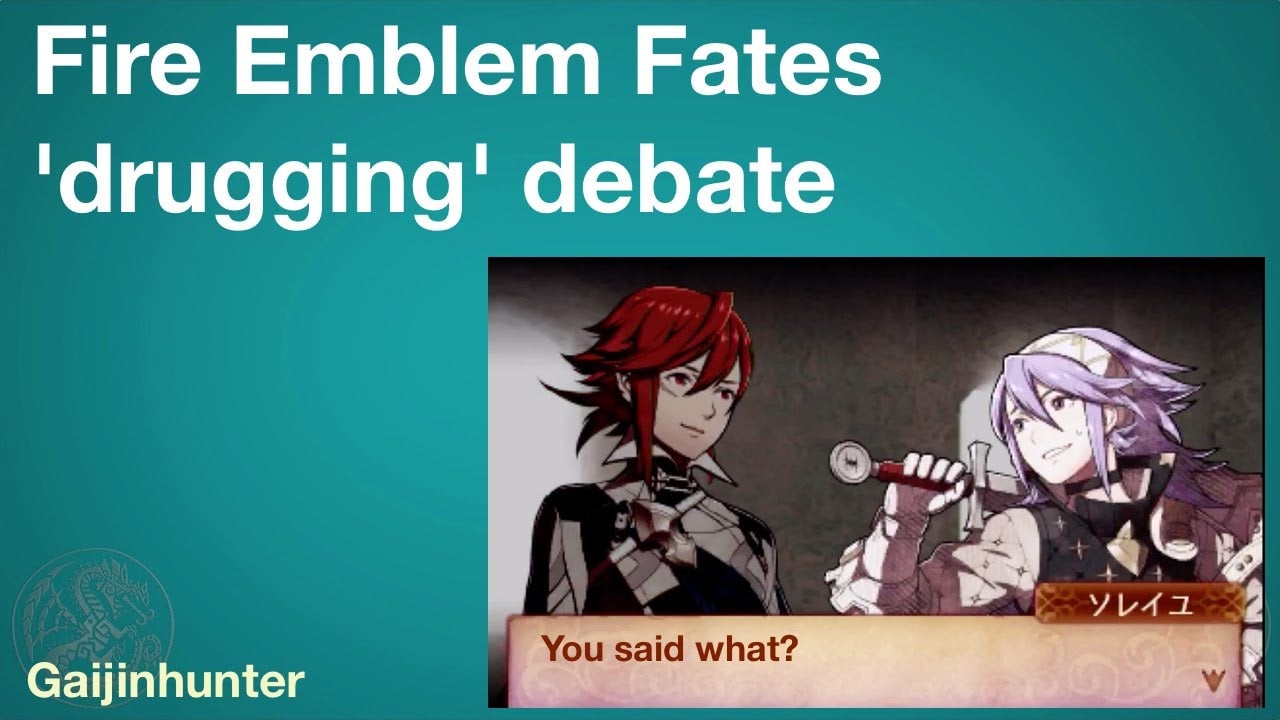
Last month, Nintendo announced that gay marriage would be included in the strategy game Fire Emblem Fates, a first for a series that has long included straight romantic relationships. This month, many are calling the game “homophobic” and criticizing it for allegedly featuring “gay conversion therapy,” all based on a Tumblr translation of the game, which is currently only out in Japan. Yikes! Let’s take a look and try to figure out what’s actually going on.
Update – 7/8/15 7:14am: See below.
Past Fire Emblem games have hinted (sometimes more strongly than others) that certain characters are gay, but Fates is the most matter of fact the series has been to date.
The new charge of homophobia in the game involves a character in Fire Emblem Fates: Conquest named Soleil and a “magic powder” spiked in her drink. Many of those charges are drawing from Tumblr, where the translations I’ve seen have lacked context and nuance. And some people have reacted based on those translations, which moves the controversy further from the facts at hand. I haven’t played through Conquest, but I have confirmed the Japanese dialogue scenes which have been uploaded to YouTube. More on that below.
Soleil likes women and often gets weak in the knees around attractive ones. I don’t know if Soleil is a lesbian, as the game doesn’t explicitly say she is gay. Then again, we don’t get an explicit announcement for which characters are straight. She does mention “girls’ love” in one event scene. She also likes to ask other women out and seems to have a hard time keeping herself together when she’s with a woman she finds attractive. This, says Soleil, is her weak point.
Soleil asks the game’s protagonist to help her overcome her weakness around “cute girls,” so that she can be a “strong, cool woman” herself. Her liking women isn’t portrayed as bad or wrong; her problem is that she lacks composure and comes off poorly. It’s to the point where if she sees a woman that is her type, she falls over. She asks the protagonist how can she be a “strong and cool woman” if she has this issue of getting weak-kneed around woman she’s attracted to. This might seem like an unusual character trait, but within the Fire Emblem series, it does have precedent. In Fire Emblem: Awakening, for example, the character Lon’qu has a somewhat similar progression, but in reverse. The character has a debilitating phobia of women, so if you are playing as a lady, you help him overcome his issue.
This personality quirk leads the protagonist to spike Soleil’s drink with a special powder that causes her to see all men as women and all women as men. We don’t see the protagonist spike Soleil’s drink. We find out about it early in a scene when Soleil doesn’t recognize the protagonist, who then realizes she sees him as a woman and that his plan has worked. He admits to spiking her drink and apologizes, explaining that he did it so that she can practice interacting with women and that she can act more suave around ladies she fancies once the magic wears off. The game’s dialogue does not state that the powder will cure her of liking women and, as unsettling a spiking someone’s drink can seem, the conversation in Japanese does not come off as creepy. The scene is in the clip below:
Game localizer Adam Evanko, who has worked on an array of titles, uploaded the above video and translated the dialogue. (Here are his two cents on Tumblr.) Evanko’s lengthy clip goes through the Soleil scenes, which he localizes on the fly.
During the marriage proposal scene that follows (English translation here), Soleil says she fell in love with the female version of the male protagonist while she was under the influence. But now, she stresses, she loves the male version. Her reason is simple: Whether he was a woman or a man, he sent her heart racing, which is why Soleil asks him to touch her chest. She’s not having him cop a feel, but rather, she wants to show that they’re soulmates, essentially, regardless of gender.
https://www.youtube.com/watch?v=ZstciDpNkBM
When Soleil does agree to marry Conquest’s male protagonist, she says, “I love you, too. Other than girls’ love, this is the first time I’ve had this feeling.”
In anime and manga, there traditionally has been some fluidity with gender roles. You can have women characters dressing as men or men dressing as women. A classic example of this is the Osamu Tezuka manga Princess Knight. (Tezuka, of course, was influenced by the Takarazuka Revue, which is an all-female theatre troupe with women playing both male and female roles.) And, let’s not forget Boys’ Love manga and anime, with their guy-on-guy love often aimed at straight women, allowing them to free themselves from predisposed Japanese gender norms and identify with whichever character they like best. Because of this fluidity, gender and sexuality are sometimes plot devices or genre conventions. It often feels like there isn’t much thought given to these storytelling mechanics. The real world is very different, but this is not the real world. It’s within this context that Fire Emblem Fates exists.
The issues evoked are real. While the game does not explicitly feature a “cure the gay” powder, you can see how people might be highly sensitive to these implications, especially after some early fan translations and internet scuttlebutt portrayed these scenes sans the necessary context to better understand them. It’s also no wonder people got upset, considering the history of people claiming that gay people need to be cured or medicated. Do I think that was the intent of the scene? No. I don’t think the developers were trying to be malicious or mock anyone’s sexuality or gender identity. The in-game language doesn’t come off as sinister, even if summaries of the scenes can come off poorly. It feels like less thought went into the larger subtextual readings and how said subtext can be construed or even misconstrued. At least, that’s my read.
The spiked drink is also understandably controversial, especially given that it’s done by the game’s protagonist (your character) as an odd way of supposedly helping another character. Spiking someone’s drink has all sorts of horrid baggage, even if the intent here was to help make Soleil better at talking to women. Honestly, though, with the recent problems in Japan with a new breed of quasi-legal drugs, which have caused traffic accidents resulting in people’s death and well as past date-rape incidents, I was slightly surprised to see a hallucinogen-inducing, drink-spiking powder mentioned at all. Though, the Japanese term for the magic powder, “mahou no kona” (魔法の粉), is also a product name for a seasoningto make food taste better, which for a Japanese player, might help neutralize the word somewhat.
When thinking through a lot of this stuff, it is important to think of cultural context and the medium of video games. The addition of gay marriage to the game, for example, might not seem like a big deal in America or might not seem shocking if this were, say, a TV show. But Nintendo is located in a country where gay marriage is illegal, and some people continue to hide their sexuality. Gay marriage exists in video games but is relatively rare. The fact Nintendo is even openly including it as an option in a big, mainstream title is progress, especially after last year’s Tomodachi Life controversy.
In late June, Nintendo of America issued the following statement to Polygon: “We believe that our gameplay experiences should reflect the diversity of the communities in which we operate and, at the same time, we will always design the game specifications of each title by considering a variety of factors, such as the game’s scenario and the nature of the game play.”
Nintendo’s statement sets expectations. Perhaps those expectations are too high for this fantasy game. Perhaps they are not high enough. Things we say and things we do can often be taken different ways, depending on the listener’s own life experience. This is exactly what happens when the real world meets the virtual one.
Update: Some have wondered about the reaction in Japan. Two of the country’s biggest game blogs, My Game News Flash and Hachima Kikou, have done posts on the controversy in the West. Take the comments in both for what they really are: Anonymously written online remarks.
That being said, in those comments, there were those who scratched the controversy off to inherent cultural differences or an insufficient grasp of both Japan and its language. There were some, however, who did feel Nintendo certainly should not have included the magic powder or the scenes at all, with a few even blaming Nintendo for bringing this upon itself by including gay relationships. Then, there were also inflammatory remarks about gay people or foreigners in general and statements about not understanding either. Which makes the comments section rather depressing reading if you know Japanese.
A couple of things, I’d also like to make clear. One is that an earlier version of this story stated that Soleil asked the protagonist for help. Rather, she related her issue and then wondered to the protagonist about how she could overcome it. She did not explicitly ask for help, so apologies for that. The above article has been edited to reflect this change. Also, to reiterate, my feeling is that Nintendo did not intentionally try to cause offense, and perhaps, in the future, the company will take a closer look at how things can be perceived. And finally: Trying to convert people’s sexual preference and spiking people’s drinks without consent are not okay. That goes without saying, but some people seemed to be under the impression that I or anyone else at Kotaku thinks that way. We don’t.
To contact the author of this post, write to bashcraftATkotaku.com or find him on Twitter@Brian_Ashcraft