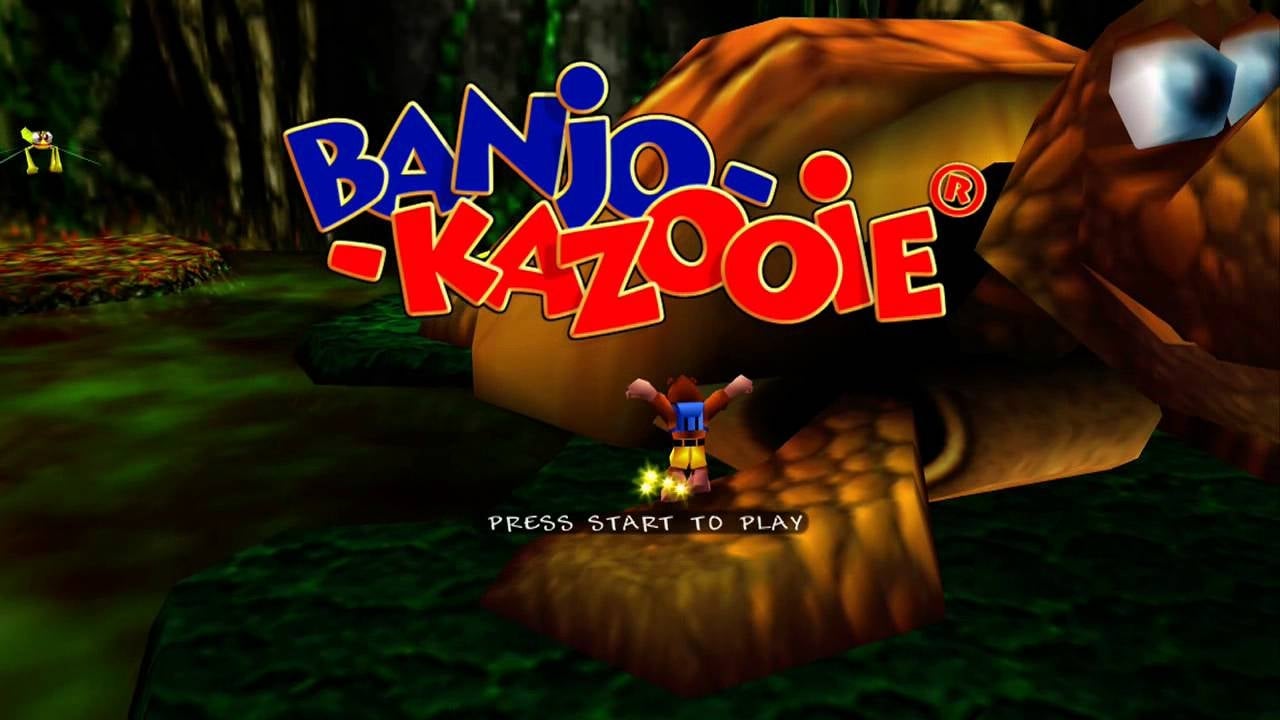
People poured money into a Kickstarter for a spiritual successor to the 1998 Nintendo 64 game Banjo-Kazooie. Why? Because Banjo-Kazooie was a wonderful game and no mere Mario 64 me-too, as some detractors claim.
This post originally appeared 5/11/15. We’ve bumped it up for the 20th anniversary of Banjo-Kazooie.
To properly appreciate the greatness of Banjo-Kazooie, fellow aficionado Patrick Klepek and I had the following chat. Hopefully at least half of the game’s humor and brilliance comes through.
We loved the game from the first time we played it on our N64s in the late 1990s. Here’s why:
Stephen Totilo: Patrick, before we can discuss Banjo-Kazooie’s greatness, we must first acknowledge that the love for any N64 game from someone who owned an N64 back in the day might be like the love a man stranded in the desert has for a newly-discovered and nearly-empty canteen. I owned no systems other than an N64, and when BK came out, I was quite thirsty. You?
Patrick Klepek: Hah! I owned more than an N64. At the time, I would do my best to convince (trick?) my brother into funneling our Christmas presents into one big one, which would allow us to keep up with the big, new systems at the time. We had an N64 first, though, which meant every few months, we’d make a trip to the Kay-Bee-Toys to get whatever the new game was—or to learn it was delayed.
Stephen Totilo: Right. I mean, back then I had probably convinced myself that Turok: Dinosaur Hunter’s campaign really was worth playing multiple times. The first I’d heard of Banjo-Kazooie was from IGN. They were calling it Project Dream and…it was delayed! Got bumped out of the N64’s second Christmas in favor of Diddy Kong Racing, another Rare game. Which was super-annoying because Mario Kart 64 had come out earlier in the year. We were bereft of games but getting TWO Nintendo-published Kart games in the same year. Ugh. Do you remember when you first saw Banjo-Kazooie in action or played it? I don’t.
Patrick Klepek: No, but I remember when I saw Mario 64 for the first time. My family used to frequent a particular theater together, and it was right next door to a place called Die Hard Game Club. This was when the N64 had come out in Japan, and wouldn’t be out in the US for some time. Remember when things came out in Japan first every time? They were actually CHARGING for you to play Mario 64. It was worth it. I bring that story up to tie together how I initially fell in love with the 3D platformer. When I was that young, I didn’t know the distinction between Nintendo and Rare. If Nintendo, the creators of Mario 64, were putting out a new platformer, I was there.
Stephen Totilo: Yeah. I remember seeing a Japanese version of Mario 64 through the window of some import shop near Penn Station. I was stunned. I think I’d seen Virtua Fighter through that same window. Polygonal gaming was mind-blowing. I was excited for Banjo because I’d loved Mario 64 and wanted something, anything to play. By the time it came out, Rare’s game GoldenEye had come out, so this was somehow the geniuses behind GoldenEye doing the design of Mario 64 and I for some reason expected that to be amazing.
And, holy shit, it was.
Patrick Klepek: Ever since this Yooka-Laylee Kickstarter took off, I’ve been trying to think about what I loved about that game so much, since I became rightly obsessed with it for months. I played it multiple times, and found everything the game was hiding. It was one of the first games where I would read GameFAQs message boards to discover fan theories about what secrets went beyond what the game was asking you to do. And I think Banjo-Kazooie gets a bad wrap, in retrospect, because we accuse Rare of being responsible for collect-a-thon design. Banjo-Kazooie is what kicked off that trend, so far as I remember, but Banjo-Kazooie did it so well. I wanted to collect everything, because it was hidden in fun, out of the way places. The designers were playing tricks with you, and finding them meant you were playing along.
Stephen Totilo: Ok, first of all, to be a high-minded critic for a moment, fuck that. The collecting in Banjo-Kazooie was fine.
Super Mario 64 has coins in it, and it needed coins, since you were no longer on a 2D plane. The collectibles helped guide players toward things. Breadcrumbs, basically.
BK had musical notes, puzzle pieces and Jinjos (note to people reading this… this is all from memory, so if I get anything wrong, that’s why; if I get anything right, that’s how much I loved Banjo-Kazooie).
Anyway..
The musical notes were Banjo’s versions of coins. They were like little characters or something, weren’t they? I remember them seeming friendly.
Patrick Klepek: Like so much of Banjo-Kazooie, everything was infused with character!
No one talked in Mario 64, but everyone talked in Banjo-Kazooie. The world felt alive.
Stephen Totilo: The puzzle pieces—this was cool—they unlocked the worlds, and that fed into the whole idea that the overworld was itself a very tricky, puzzle-filled world that you had to go through and solve.
The Jinjos… they made noises, right? So there was sound-based gameplay to finding them.
Patrick Klepek: Gosh, I can’t remember. Sure, probably. Everything made noises in those games.
Stephen Totilo: And didn’t you pay Mumbo Jumbo, the witch doctor guy, some of this currency to transform? You could turn into a washing machine! (Or was that Banjo Tooie?)
Patrick Klepek: I get those games confused because I became utterly captured by the way the two games were supposed to connect with one another. Remember how there was going to be a Sonic & Knuckles-style contraption that let you bring your saves over between the games, and the sequel would actually unlock hidden areas in the original game?! That stuff drove me up the wall—in a good way.
I think they actually made good on those promises in the Xbox 360 version.
Stephen Totilo: Do I remember Stop N Swop? Dude, off the top of my head, I can recall a blog post about… was it subfrog and icemario? Did it begin “In the best of times, in the worst of times”? Let’s google and find out!
Patrick Klepek: Wow, yes. I haven’t heard that phrase in…15 years? Probably more. Banjo-Kazooie came out when I was 13.
Which helps explain how I had no problem collecting everything and anything
Stephen Totilo: It was subDRAG
And here I am in 2008 reminiscing:
http://multiplayerblog.mtv.com/2008/05/23/sto…
Do you know what Stop N Swop refers to? If not, stop reading. This post won’t mean a thing. If you have heard of it, then you, like me, probably played
(Hey, 2008, that’s when we last worked together!)
Patrick Klepek: Synergy.
It drove me nuts because I’d have to read about this stuff in EGM rumor columns or GameFAQs message boards. There wasn’t much real-time authority back then, so it was all playground rumors.
Stephen Totilo: But, yeah, let’s talk about the ending. And by “talk”, will you allow me to wax nostalgic for a moment?
Patrick Klepek: I’m not going to tell my boss no.
Stephen Totilo: Good man. Hang tight in that backpack for a second.
I remember thinking I was at the end of the game, right after the amazing game show sequence that we should discuss. But back to that later. I’m playing the game, and I think I’m done. I’ve obtained a lot of the puzzle pieces, a lot of the notes. I’ve cleared the desert world and the haunted world and the goddamn brilliant four-seasons world. And I’m thinking I’m done, but, no, there’s a fake-out ending. If I go back and get more jigsaw pieces then I can get to the real final battle.
So I do that—and I assume you did too. I wind up on top of some castle or something, fighting Gruntilda. And what do you know, right as I’m about to lose, right as she’s about to crush me, all those Jinjos I collected swoop in—baby-Metroid-saving-the-day-in-Super Metroid-style—to kick her ass. A vindication for all that collecting.
Then the credits.
Then… oh man, Patrick, then that moment.
Banjo lounging in a deck chair or something. And Mumbo Jumbo shows up with polaroids and starts showing him (me) areas of the levels that we could never access. And then says we can only access them when the sequel comes out. And then NAMES THE SEQUEL.
Patrick, I think that might be the most mind-blowing thing in games of all time.
(Aside from the Dagobah mission in Force Unleashed II, of course)
Patrick Klepek: I completely forgot that’s how it worked, and it explains why I lost my shit.
I think…look, Donkey Kong 64 was a bad game—is a bad game. What I loved so much about Banjo-Kazooie is that it encouraged and rewarded exploration. Yes, there was platforming, and some of it was challenging, but it wasn’t a game of dexterity and controller finesse in the same way as Super Mario 64. And while I didn’t know it at the time, I can appreciate now that it’s the reason Banjo-Kazooie was such a lovely, wonderful game. It was funny, winked at the player, and wanted you to enjoy what it’d built in a way most games tried to keep you on-the-trails. The way the ending plays out epitomized this approach, but it was sprinkled in every level.
https://www.youtube.com/watch?v=z3ZuPO3CVP0
Stephen Totilo: Yeah, it wasn’t as fun to control as Mario 64. Which is like saying your current favorite NBA player isn’t as good as Michael Jordan. Nothing in gaming will likely ever feel as good to input as Mario’s triple-jump in that game. But BK had that sense of humor. Mario was confident and sweet. Banjo was confident and goofy. You knew that from the start when its all-time-great soundtrack started playing. High-energy, silly music. (And adaptive music, too, right? The instrumentation of the music in the hub area changed depending on where you were, if I recall correctly).
What worlds stand out for you?
Patrick Klepek: Going by pure memory, there were two that stood out, and I make no guarantees one of these happens to be in the sequel.
One, the stage with the huge submarine. Stages like that underscored what was so incredible about Banjo-Kazooie, at least at the time. The camera would swoop through these just…enormous areas. It was hard to take in, and that’s what made it so exciting. What’s up there? What’s up there?! In the case of the submarine world, it wasn’t just what was UP there, but what was beneath the surface, too. It was just such a big game, and that was both novel and exciting at the time. Games were opening up!
Two, I recall an Egyptian-themed stage that involved lots and lots of careful floating from platform to platform. That was the other thing I loved about Banjo-Kazooie: you had a freedom of movement, an ability to cross vast distances, that wasn’t possible in other games, thanks to the limited abilities of your bird friend. In that stage, if you used him correctly, you could make it to places that seemed unfathomable when you first entered.
You? I know you mentioned four-seasons, which I don’t remember very well.
Stephen Totilo: Patrick, Patrick, Patrick. Huge submarine?
Patrick Klepek: Uh oh.
Stephen Totilo: Or do you mean, Huge Submarine Shaped Like a Giant Shark?
Patrick Klepek: Holy shit, yes. It’s even better than I remembered!
Stephen Totilo: Mario had the sub, and I think some of the Banjo worlds where basically Mario 64 levels but funnier.
So instead of a sub, we had Clanky or whatever he was called. Clanker, maybe? And he was held by a chain that you had to loosen while also exploring inside him, I think.
Patrick Klepek: Yes, yes, yes.
Stephen Totilo: And, yeah, Kazooie gave you the flutter jump. Basically, if all Mario 64 was going to do with Yoshi was stick him on the roof for a useless cameo, Banjo-Kazooie was going to put Yoshi/Kazooie in play to give you a proper flutter jump. It was very helpful.
I liked those levels, but the level with the seasons. The big tree level… Click Clock Wood, was it called? That level is one of the most smartly-designed levels I’ve seen in a video game.
Patrick Klepek: Man, I gotta play this game again.
Stephen Totilo: Do you remember what season you started in? I’m thinking it might be spring.
Patrick Klepek: That sounds right.
Stephen Totilo: I didn’t get the concept at first. You couldn’t. Because it seemed like, okay, the final level of this game is based on climbing a big tree and dealing with some chipmunk-looking enemies who patrolled around and on it.
Then you figure out that you can leave and re-enter and have it change seasons. All four seasons.
In the spring, the branches have leaves you can stand on. In the fall, the leaves have fallen into mounds you can climb up. In the winter, the water at the bottom of the tree is frozen, so you can walk over it.
But the best was those little enemy guys. In the summer, they wore no shirts!
Patrick Klepek: Rare was really funny before they were forced to make Kinect games.
I’m sure it had a great soundtrack, too, though none of the tunes immediately come to mind. The Donkey Kong Country soundtrack was one of the first gaming soundtracks I listened to completely outside the game.
Stephen Totilo: Yeah, that level’s music changed with the seasons, I think. I was so charmed by it in part, because Mario had laid so much of the template for platforming worlds. So many games had had snow worlds and fire worlds and desert worlds. A world based on a cycle of seasons was a nice fresh final world, and a reminder that they weren’t just re-jiggering Mario ideas but pushing platforming ahead.
I think that’s why people liked the game so much. It didn’t just feel like a me-too, even though it seemed to emerge as a project designed to ape Mario 64. It wound up exuding so much personality of its own.
Patrick Klepek: Re-jiggy-ing.
Stephen Totilo: Yes! Do you know why I remember so much of the game?
Patrick Klepek: Were you one of the people obsessed with Nuts & Bolts?
Stephen Totilo: Well, yes. But that’s not it! Do you remember the game show at the end?
Patrick Klepek: Vaguely, as has been the case with most of this chat.
Stephen Totilo: I think only one of us wasn’t doing drugs when this game came out, Patrick. I won’t judge.
Patrick Klepek: 13-year-old Patrick really wanted to live it up.
Stephen Totilo: Ha ha. Ok, so to remind you of what your teenage self probably loved…
The supposed finale of the game (before all the other stuff I described above) involves the main bad guy, Gruntilda, putting you in a game show.
It’s a quiz show, and she’s asking you questions… about the game you just spent many, many hours playing. Here’s a sound effect. Which character made it? Here’s a zoomed-in bit of graphics. What level is it from? I loved this, because it’s a very special, smart example—and a rare example, no pun intended—of a game incorporating into its design the idea that, when we play a game for dozens of hours, we absorb a lot of its sights and sounds into our brain. Subconsciously. A lot of it sticks with us (well, some it sticks more with SOME of us, clearly). And as the game show happens, the designers at Rare are essentially letting you wind the game down with a fun nostalgia trip. Remember this? Remember that? It rewards an awareness that players who enjoy a game have.
And what we’re seeing now on a meta-level in 2015 is that Stephen Totilo, who had no other systems to play games on, must have played Banjo-Kazooie through many more times than Patrick Klepek who had other systems. I had but this game to stare at. I had no PSX to distract me. Just my N64 and playing Banjo-Kazooie one summer again and again. Oh, the sad sad memories (it was great!).
Patrick Klepek: Not a bad game to play over and over, though. And who knows, maybe you’d be the one to solve the Stop ’n Swop!
Stephen Totilo: It brings us back to that, huh? And maybe that at some level is part of the reason there’s all this love for the Kickstarter. Because think about the narrative for Banjo post-BK. The sequel, Tooie wasn’t as good, but what I remember more frustratedly is how Stop n Swop wasn’t in it. A poor version of it was inserted instead, to appease people.
Patrick Klepek: The ending of Banjo-Tooie promised Banjo-Threeie, but it never happened.
Stephen Totilo: Ha, and that. You could sense that a company had pushed back on these designers. The rumors online were that Nintendo didn’t want to support the original SnS idea because it might break the N64 (it involved removing one cartridge and inserting another without powering the system down). And if you think Nintendo derailed Banjo greatness, look what Microsoft got blamed for!
So now these guys are free to FINALLY make Banjo without a corporation limiting them.
Patrick Klepek: And if the not-really-convincing-but-who-knows rumors about a new Banjo from Rare pan out, we’ll be swimming in Banjo games soon enough.
Stephen Totilo: Yeah, could be! I wouldn’t mind that. And to be clear, I don’t quite buy the idea that companies held the Banjo team back. But seeing them have a chance to do their thing again—and seeing them have the chance to make a kick-ass 3D platformer at a time when even Nintendo seems hesitant to fully commit to that genre, well, I get why people are psyched.
I am going to play some Banjo this weekend. I hope it’s as good as I remembered it!
Patrick Klepek: Let’s ruin our memories of a great game together.
To contact the author of this post, write to [email protected] or find him on Twitter @stephentotilo.
All assets in this post captured by Kotaku from the Xbox 360 re-release of the Banjo-Kazooie, with the exception of the YouTube videos for Click Clock Wood and Grunty’s game show, which we found from Let’s Play folks on YouTube.