F-Zero GX was a critical hit that, 13 years later, stands as a racing game classic for Sega and Nintendo. It was the latest in a string of excellent F-Zero games. It was also the last one ever made for a console. Nintendo has largely neglected the series beyond the mid 2000s, and as such F-Zero sits on the margins of Nintendo’s portfolio of games.
One more F-Zero followed. But after F-Zero: GP Legend came out on the Game Boy Advance in 2004, there wasn’t much to be heard about from the franchise.
The Nintendo Wii arrived in in 2006. F-Zero, along with Star Fox, would be left cold without any release through that entire console lifecycle. Nintendo spent the subsequent years calming fans’ impatience with empty teasers and throwaway statements. A model of the signature F-Zero vehicle, The Blue Falcon, in Wii U 2012 launch game Nintendo Land is more of a sad joke than a heartening cameo. It underlines the company’s apparent disinterest in the series. The existence of F-Zero-style third-party games like Fast Racing NEO only highlights the original’s glaring absence on recent Nintendo platforms..
F-Zero Changes Racing On The Super Nintendo
F-Zero began as a response to the popularity of another sort of driving game experience. In 1993, the most common sort of racing video game you could find was a Formula 1 racing sim. Formula 1 racing isn’t very popular in North America but it’s one of the oldest styles of the form. There were more F1 games released in the 1990s than pretty much every other decade combined. The Super Nintendo had a ton of them, including GT Racing, Arcade Racing, even MotoGP
Many racing games on the SNES happened from a top-down perspective. Others were played from a behind-the-car, forward-facing angle. Those games signaled road turns on the screen to compensate for the limited depth of what you could see of the track in front of you. Still others took a stab at cockpit view. Those were the most interesting to play. Nigel Mansell’s World Championship (1993) was fast and exciting to drive in its mandatory cockpit view.
Downward-facing, and full 90°-facing games aren’t as fun to play, but Exhaust Heat is interesting for the complexity of its tuning system, with options that are pretty impressive for a game in 1992.
Despite their differences and nuances, these games drew from the same themes, goals, and source material. They couldn’t be truly realistic but they could aspire toward a feeling of realism. It wasn’t just about a real sense of physics but a realistic sense of place. They offered the feeling of being a legitimate racing professional, touring around the world doing qualifiers, talking to coaches, and driving on legitimate-looking racing tracks. (‘Looking’ is the key word here, as none of them were emulating actual licensed racing courses).
On Super Nintendo, F-Zero represented the polar opposite. Released behind a sea of faux-realist Formula 1 sims, F-Zero was a conceptual racer, a game that used the internal logic of its own universe. It was built on sci-fi fantasy, yet it managed to feel wholly different from the well-worn ‘80s Mad Max apocalyptism of games like Battle Cars and Rock ‘n Roll Racing. It’s fantastical, but it wasn’t goofy like Biker Mice from Mars. Its aesthetic is grounded and thoughtful, its score moody and articulate, and its tracks feel distinctive and expressive, something that no other racing game on the system was able to achieve.
The game features futuristic race cars that have no wheels and hover over the track. Your car has a health bar that doubles as a boost bar that can be refilled by energy strips laid out across the track. When you speed up, your bar decreases, and your car is more prone to being destroyed should you bump into a wall or another racer.
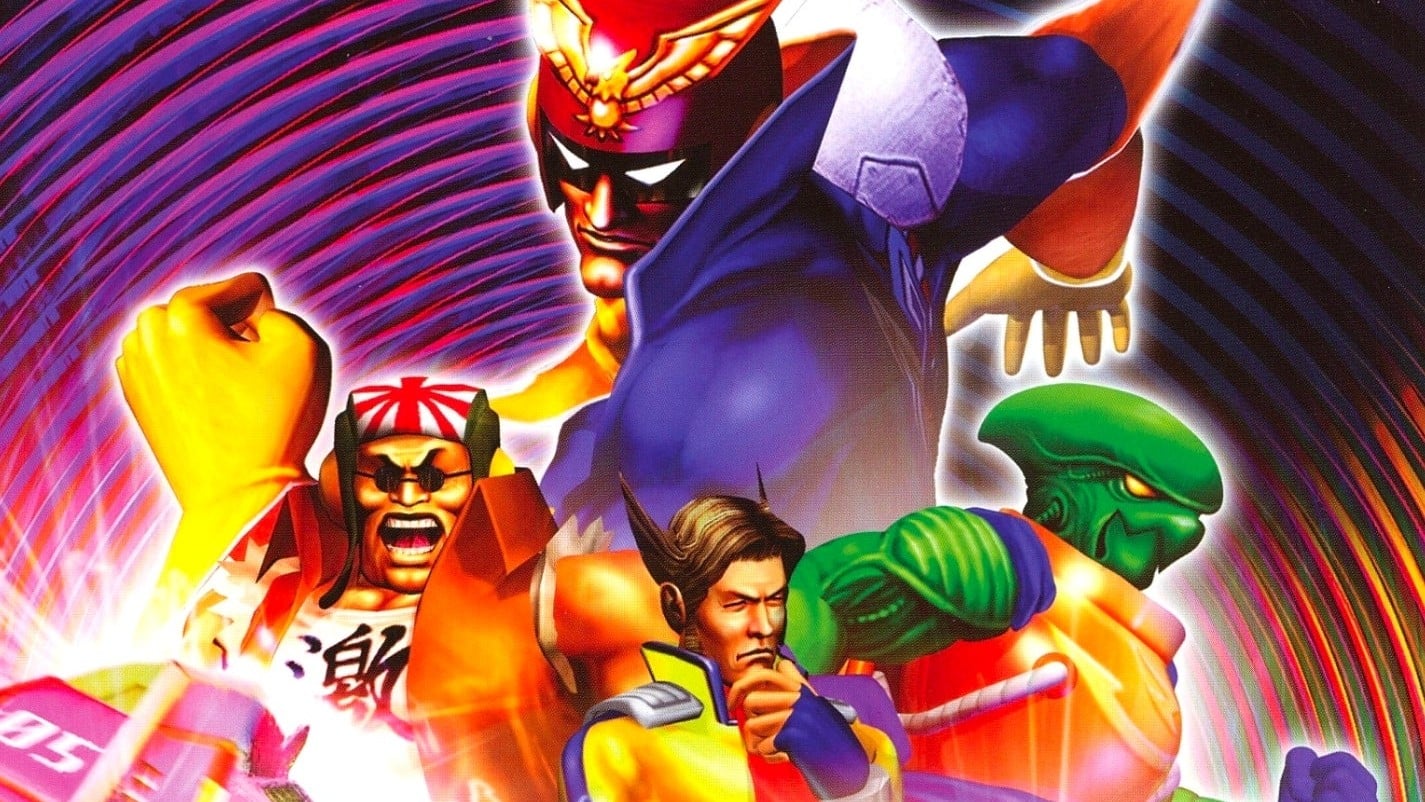
F-Zero surpassed the thematic strength of the more conceptual racing games on the SNES but also rivaled the complex driving logic of a dedicated F1 racer. F-Zero didn’t have tuning, but it did have uncommon dynamics which established many interesting ideas ahead of their time. There’s a clear distinction between its tracks and its four cars. Unlike the anonymous pilots in Outrun 2019 or Super Hang-On, these vehicles were driven by explicit characters: Captain Falcon of the Blue Falcon, Dr. Stewart, Pico and Samurai Goroh.
F-Zero isn’t well balanced, and it becomes clear after several breakthroughs that Goroh’s vehicle is the only one that can drift a sharp turn without hassle. Its tracks emphasize those hard, sharp turns, many of which are bent at 90 degree angles as well as hairpins and long straights. F-Zero went the extra mile in making its tracks easily readable and distinguishable. There’s no time where you feel like a turn is coming onto you without warning, and that has a lot to do with the very smart design of the screen positioning. As you can tell in the graph below, F-Zero has its cars very low on the screen, and the rendering height of its mode-7 projection is far away from the car to maximize viewing space. In Aguri Suzuki, by comparison, the view-space is very small, which makes the game much more difficult to play.
F-Zero is one of the few racing games of that era with an explicit health bar and recharge system. In addition, the video game representation of drifting, in which you loosen the steering grip of your car to make a sharp turn, was central to F-Zero’s design.
Many of the games on Sega’s MegaDrive were still hanging on to Yu Suzuki’s Hang-On design, a series that used time-limited zones tight roads built to encourage lane-to-lane movements, a generous amount of incline, and artful attention towards scenery. Those traits weren’t readily found on racing games for the SNES. But driving in F-Zero is expressive in a way that few other racing games have been able to capture.
Every track in Nintendo’s original futuristic racer had a vocabulary. Every race formed a narrative expressed through its systems, its physics and the setting established by the game’s coloring and scenery. The game’s five-lap elimination structure makes races feel exhaustive and lengthy. Its health regeneration system, carried out through a single strip on the road, is supremely ungenerous: a single pass through the strip probably restores between 10–35% of your health, depending on which car you’re using. And unlike Suzuki’s beloved straights and inclines, F-Zero has harsh cornering that really punishes a poor turn. One bad hit into a wall or “paint trade” can lead to several more and a serious loss of health that your car won’t recover.
The narrative of F-Zero is harsher than Suzuki’s romantic vision of young racers chasing the sublime of the open road. Under its bright colors is a real sense of struggle, danger and uncertainty. Even now, it’s still surprising how effective F-Zero is in establishing its fiction. Its experience is profound in a way that many other racing video games in its generation weren’t able to surpass.
F-Zero X And The New Step Forward
Like many cultural works that become masterpieces of their form, the Nintendo-made F-Zero X was unappreciated and misunderstood in its time. In 1998, James Mielke, in areview for Gamespot.com, deemed F-Zero X to be “uninspiring,” a game that, despite being “practically flawless from a technical standpoint,” ultimately “lacks a soul.” What he was referencing was X’s artistic design. X diverged from contemporaries like Extreme-G and Gran Turismo by presenting minimal texture detail and scaled-down environment models.
It’s an established point-of-fact that F-Zero X was a title that helped establish a vision for what we now call the futuristic racer. What isn’t well understood is why. What exactly made F-Zero X so special? The most noticeable trait of F-Zero X is, ironically, its character. When a videogame doesn’t seem to have much of one element, it’s because the game is trying to emphasize something else. F-Zero X not having hundreds of boring models of buildings, crowds or whatever else filling its spaces doesn’t really matter in the larger picture, because it’s a game that’s clearly spending its energy on other ideas.
F-Zero X’s character gets expressed via a very strange, multi-layered set of themes. On the surface is a comic-book themed design. Unlike contemporaries relying on poorly aged 3D models, F-Zero X went to illustration to visualize its fiction and its characters. That decision resulted in a design with strong colors and flaming gradients, all-caps poster type that pops onto the screen, and slick sliding frames that use laser guns as menu sounds.
F-Zero X’s ethos comes across as sleek and exciting in almost every way. The game pulls you into its fiction very quickly and makes the racing you do feel like something that really matters.
By comparison, Wipeout 64, an N64 port of Sony’s competing Wipeout franchise, is hideous to look at. Despite its detailed models and environments, the game fails to prevent its races from feeling pointless and uninteresting. The Wipeout games on the first PlayStation could rely on the console’s power to push its shadows and local light sources. F-Zero X used directional lighting (lighting that is “infinitely far away,” like a sun) and ambient light coming from its models and roads to create more even illumination across its tracks. The game focused more on its color and textures than trying to give an illusion of complex shadows.
Unlike the dark, rough look of Wipeout and Wipeout 2097, F-Zero X comes across as vibrant and blooming. Every stage pops in a way that very few racing games of its generation do. It very clearly has an explicit design and consistent vision for itself, a vision that was unfortunately glossed over by shallow standards of “good graphics.” F-Zero X absolutely has a ‘soul’.
There’s another reason why F-Zero X doesn’t emulate the environmental design of the other racers in its time. With a lack of environmental detail, F-Zero X can emphasize the most important part of its vocabulary: the shape and design of its racing tracks. F-Zero X’s roads are smoothly textured with abstract patterns that emphasize their elasticity. They don’t really suggest any material, like brick or concrete, because you’re supposed to be able to think of them as potentially being anything, something whose conceptual holes you fill with your imagination. The act of asking unanswered questions—”what is this stuff?”— creates abstraction and adds to the game’s sense of fantasy.
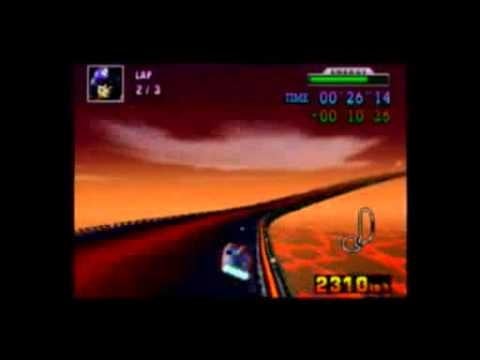
https://www.youtube.com/watch?v=U2oPg3Om0gw
Like a work of sculpture, every track makes a unique point, using thematic hooks that often reference back to the original F-Zero. The hook of Sand Ocean I is the giant pipe that you race inside for the majority of the track. The hook of Silence is that it’s just one giant straight that allows you to hit the fastest speeds possible in the game without flying off into space. (It’s also on the moon, which is pretty cool.)
The arc of Fire Field I is the build of tension generated by driving up its long upward ramp, which climaxes in the large jump you make over its impossible zig-zag corners. The point of Big Hand is that’s it’s, well, a giant hand shaped into a racing track and, as such, it has extremely tight roads and corners. It’s a visual pun that’s also the most difficult track in the game, the final race of the Joker tier series.
Sector A doesn’t really have a hook so much as it’s got a peculiar set of well-designed downward inclines, turns and curves. Spooling out on tight, thin roads, Red Canyon II’s high walls push the 30 cars on the track into dense straights and roller-coaster style slopes, making the race a slow and careful shift from your normal speeding.
F-Zero X challenged the boundaries of its design in ways that were both provocative and nuanced. Its physics implementation also stands out. In contrast to the later GX, F-Zero X makes you feel weightless on and off the track. X gives you enormous air-time. You’re virtually floating in space when you drive off a road on the right conditions. With controlled downward tilting in the air to increase your velocity, you can hit incredible speeds and make remarkable jumps if you’re skilled enough.
In X, a controlled turn happens as tilt on the x axis (think of how a plane tilts left and right). A “slide,” which is a turn that’s due to a loss of control, occurs as a rotation on the z axis (how a real life car makes a turn). So, while you’re always doing a little bit of turning, F-Zero X is mostly a game of Doom-style strafing and overtaking, combined with using the ‘drift’ button to make sharp turns. X has no sense of excess force, meaning that if you push the joystick in a direction and then take my thumb off, the car will immediately snap back into a neutral position. All of this combines to make F-Zero X feel lightning-quick and instantaneous. Compared to the first game, laps are reduced from five to three, and healing strips restore energy very quickly. The average lap goes for about 30-40 seconds, in races that are no more than three minutes, tops. Front to back, the entire game moves at an incredible pace.
The consistency and coherency of F-Zero X makes it impressive. It achieves everything it sets out for itself, something so few video games seem to do, especially those of the late 1990s. F-Zero X was one of the first video games I fell in love with as a child. Playing it now, it still excites and inspires me. I believe that any racing game creator should look to F-Zero X, the milestones it hit, and the influence it continues to have for its genre and style.
F-Zero GX and The Future
F-Zero GX was the last console game made by Sega’s Amusement Vision, a subsidiary company of Sega run by Toshihiro Nagoshi, before it would be dissolved into Sega proper a year later. Amusement Vision, which also made the GameCube launch game Super Monkey Ball, was the embodiment of a relationship Sega forged with Nintendo in 2001.
GX was meant to show how Sega could still be relevant after the failure of the Dreamcast and their steep fall from console-making powerhouse to average publisher. But Sega struggled from then on, publishing sub-par titles and releasing yearly Sonic games that deteriorated in quality throughout the decade.
F-Zero GX was tamer than F-Zero X. The detailed representation of its setting is a big shift away from the series’ reliance on abstraction. It is much cleaner visually and has a more typical sci-fi future design. When I played GX as young pre-teen whose father bought him his first GameCube, I was unimpressed with the change. I saw it as a ‘dumbing down’ of X’s challenging, radiant vision. But, as I’ve gotten older, I’ve learned to appreciate that the game makes sense for the Gamecube’s technology and Nintendo’s goals for the console.
Like X before it, F-Zero GX distinguishes itself through its physics. GX is inarguably the most complex F-Zero game, largely because the game feels heavier. The cars have a remarkable sense of weight that was pretty much non-existent in X. Yet, unlike X, the cars you use don’t tilt. They turn like regular cars, which means the metagame isn’t about strafing but about predicting the directions you’d like to go in.
A player can’t cleanly weave through cars like they did before. Instead, you need to pick a better angle ahead of time and consistently boost. The game’s air physics are much less generous. You can’t just zip my way through the air with a well-tilted dive. you need to manage the car’s tilt to be fast enough to move forward and sufficiently level with the ground so that it gets decent speed when you actually hit the ground.
In GX, you don’t necessarily need better reaction times but you definitely need a much more nuanced understanding of the tracks you race on and the car you’re using.
Weight balance has always distinguished F-Zero from Wipeout. I find the Wipeout games to be slow and clunky. They’re frustrating and unsatisfying to drive in. In any Wipeout, you drive a very long racing car, much longer than it is wide, and the center of mass is in the back of the car. What this is means is that, when you turn, you’re not tiling like in F-Zero X. You’re not really turning like a regular car. You’re awkwardly throwing your weight around, in what is basically a constant state of oversteer, which is when the rear wheels of a car slide out on a turn. By comparison, the center of mass in F-Zero is always in the center of the car bodies, which may vary in shape, but are still fairly even between their widths and lengths. Playing Wipeout feels like trying to steer a speedboat through a racing course. Playing F-Zero–and GX in particular–is closer to controlling a speeding bullet.
GX’s story mode is still infamous for its difficulty, but I feel like the mode was designed to teach these kinds of lessons. F-Zero GX cares about its dynamics in a way none of the previous games did. It wants you to learn how to be economical with your boost/energy and to think carefully about where and how to use the power contained in the vehicle you choose.
F-Zero GX still carries X’s playful approach to road shape and design. It’s just a bit less wild. The game gives you lots of opportunities to engage with its characters, and is full of quirks,secrets and extras. GX’s sense of personality and palpably felt design mechanics set it apart from other racing games in its time.”
F-Zero’s disappearance is, paradoxically increasingly apparent. Among the constant talk of fans wanting a new entry, we’ve seen amateur fan games run failed Kickstarters and a wave of racing games—games like Distance, Drift Stage, and Fast Racing NEO try to live up to the sensibility that F-Zero and the Sega racing games of the 1990s had established.
Of course, the new generation of futuristic racers have no obligation to anyone. But what needs to be learned from the F-Zero games is their willingness to always challenge and expand the boundaries of their designs. F-Zero was not only a series that was reinventing itself with every main installment, exploring every corner of its concept. Each game carries its own unmistakable sense of identity.
Any true successors will need to not only nail key design mechanics but present a vision of futuristic fiction, a vivid sense of imagination, and an aspiration towards experimentation, that fueled Nintendo and Sega’s wonderful and badly missed F-Zero greats.
Zolani Stewart is the founding editor of The Arcade Review, a digital magazine about experimental games and art. He’s also a huge Sonic nerd, in case that wasn’t clear. You can follow him at @Fengxii