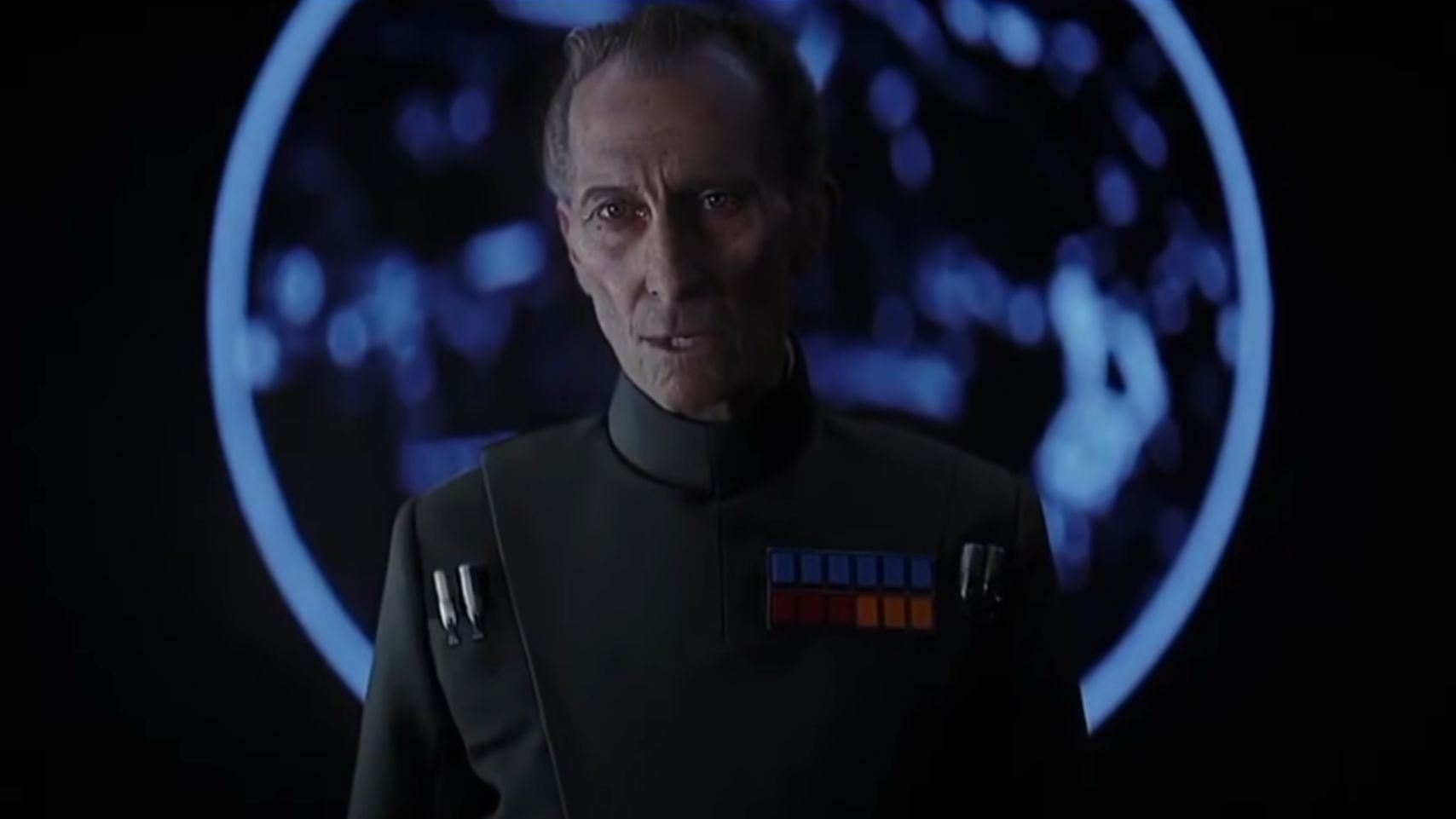
Remember that moment during Rogue One: A Star Wars Story when you felt pure, unadulterated horror, brutal shivers down your spine as a flock of geese trampled your grave? Brrrrr, that first time you see the ghoulish CG soup that is supposed to be a reanimated Grand Moff Tarkin. It turns out that, some eight years later, a close friend of the late actor Peter Cushing is claiming his permission should have been sought, and is attempting to sue Disney.
As reported by the UK’s The Times, one Kevin Francis is taking Lucasfilm to court on the basis that Cushing had arranged with him that no one should be allowed to recreate the actor’s visage without Francis’ permission. Disney had previously attempted to have this thrown out on the basis that there was no evidence of “unjust enrichment,” but London’s High Court said nay, and are allowing the proceedings to continue.
Peter Cushing lived a long life until 1994, when he died aged 81, leaving behind a legacy of wonderful cinema and radio. To Brits, he and his long-time colleague Christopher Lee are the iconic actors fronting a million gloriously hammy horror films, the likes of The Satanic Rites of Dracula, The House That Dripped Blood, and my absolute favo(u)rite, Island of Terror*. To Star Wars fans, they’re Moff Tarkin and Count Dooku respectively.
Come Rogue One, a film apparently everyone but me really likes, it was decided therein to revive the character of Grand Ol’ Tarkin, via Modern Movie Magic. Which is to say, that wretched uncanny valley horror-mask deep-faking that is the CG faces that plagued the movies of the 2010s. (See also Tron: Legacy.) The gloopy plasticine rendition of Cushing’s face was clearly meant to be a crowd-pleasing moment, but instead drove children screaming into rivers.
While the use of dead actors’ faces in movies and commercials is a frequent topic of ethics, it seems in this case Kevin Francis is certain Disney and Lucasfilm didn’t have the correct permissions, because he claims Cushing had specifically asked him and his film production company, Tyburn Film Productions, to protect his image after his death. He’s also suing, according to The Times, the executors of Cushing’s estate (who are dead), and Cushing’s former agency, Associated International Management.
Francis, who made horror movies with Cushing in the 1970s, says Cushing signed a contract with him in 1993, that didn’t allow others to use his image without Francis’ permission. He’s seeking something under £500,000 from Lucasfilm.
Disney, meanwhile, are saying that they didn’t need anyone’s permission because of the contract Cushing signed back in 1977. Which…well, you can see why a judge might be interested in seeing this go to court. Can a contract written in the 1970s possibly contain clauses that allow a company to use state-of-the-art (albeit god-awful) computer technology to recreate an actor’s face and voice some 40 years later? When Cushing’s agent coughed loudly at Disney back at the time of Rogue One, they paid a rather paltry £28,000 ($36,600) to clear the use.
Disney first attempted to have the case thrown out in December, lost and appealed, and this week lost again. So it goes to trial! And it should be a fascinating one, given the power discrepancies involved, and the tenuous nature of everyone’s claims over the dead man’s face.
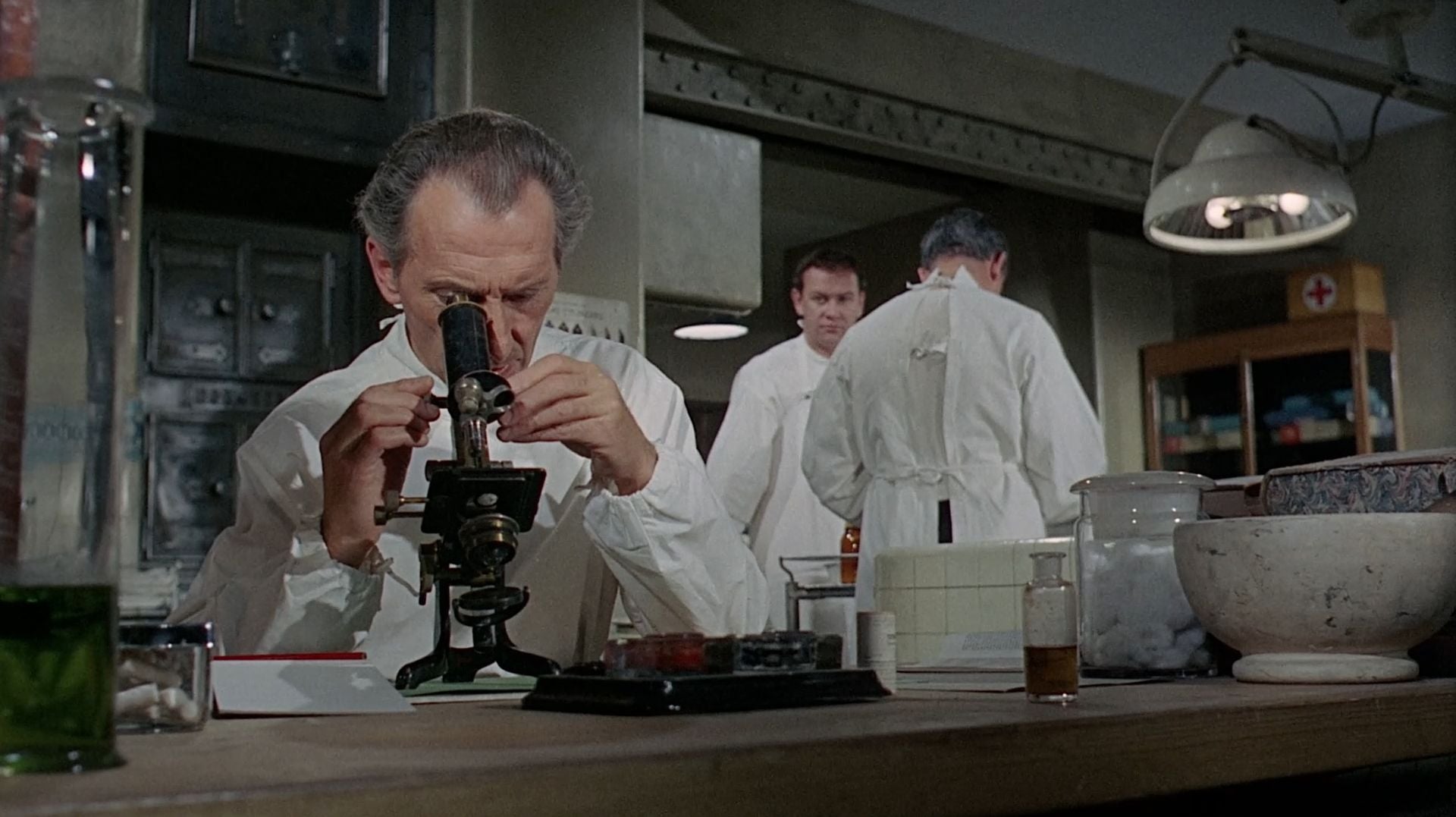
*I can’t not bang on a bit more about Island of Terror. The 1966 film is set on a remote island off the coast of Ireland, where dead bodies are showing up without any bones inside them. It turns out the cause of this is some silicate monsters accidentally created by a Dr. Lawrence Phillips, after his attempt to cure cancer when horribly wrong. He made the mistake of using silicone atoms instead of carbon, so the rest was inevitable.
And if this weren’t “say science words and hope no one is paying attention” enough, at one point noted London pathologist Dr. Brian Stanley (played by Cushing) is attempting to understand what could have gone wrong. He stares through Phillips’ notes, then looks up in confusion and says, “But look at this protein structure. It isn’t adenosine triphosphate!” Which, if you remember your biology, is something you’d rather hope it’s not.
You should definitely watch it at the nearest opportunity. And if you aren’t yet convinced, this scene should do the trick: