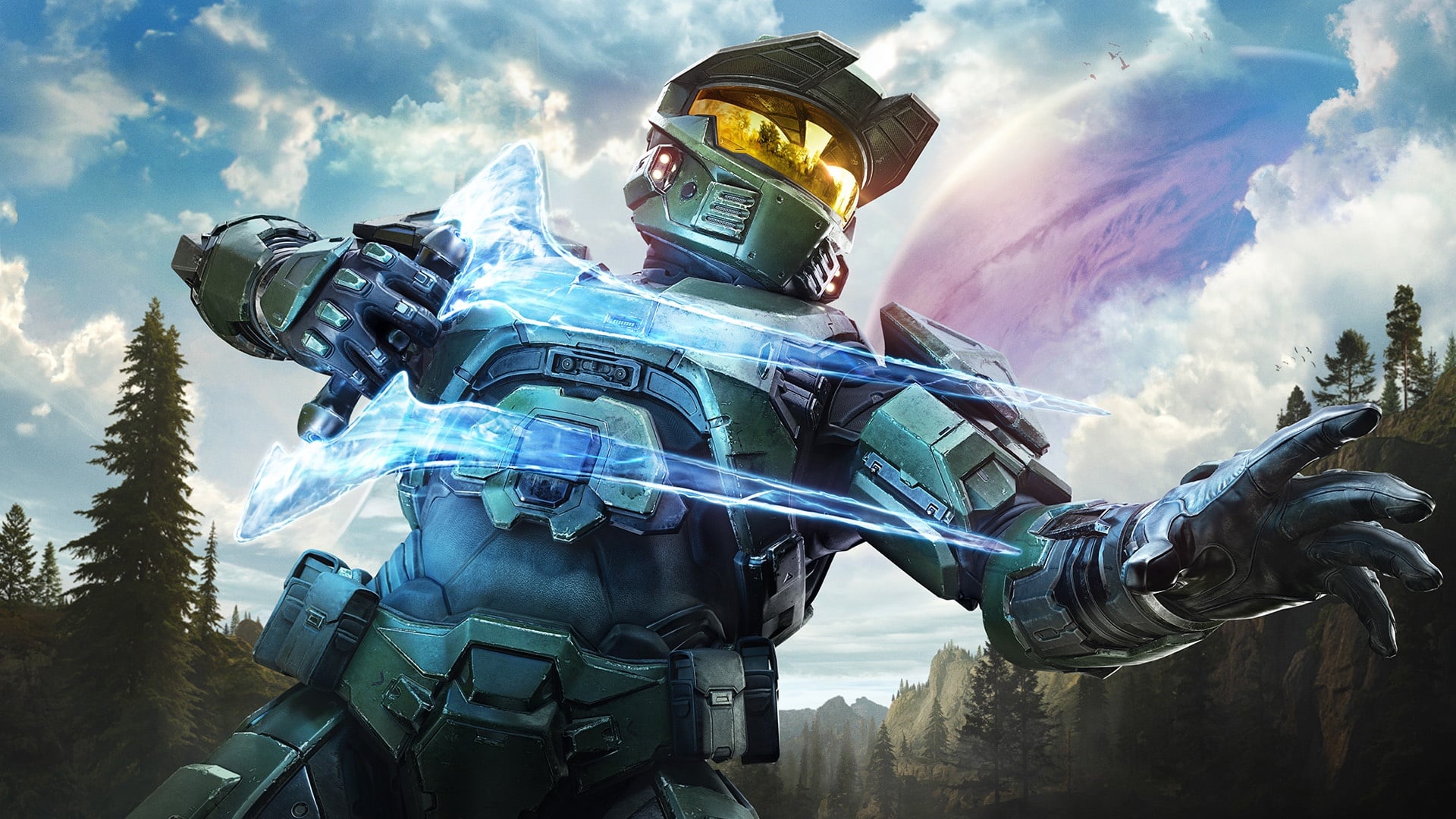
Halo Infinite almost lives up to its title.
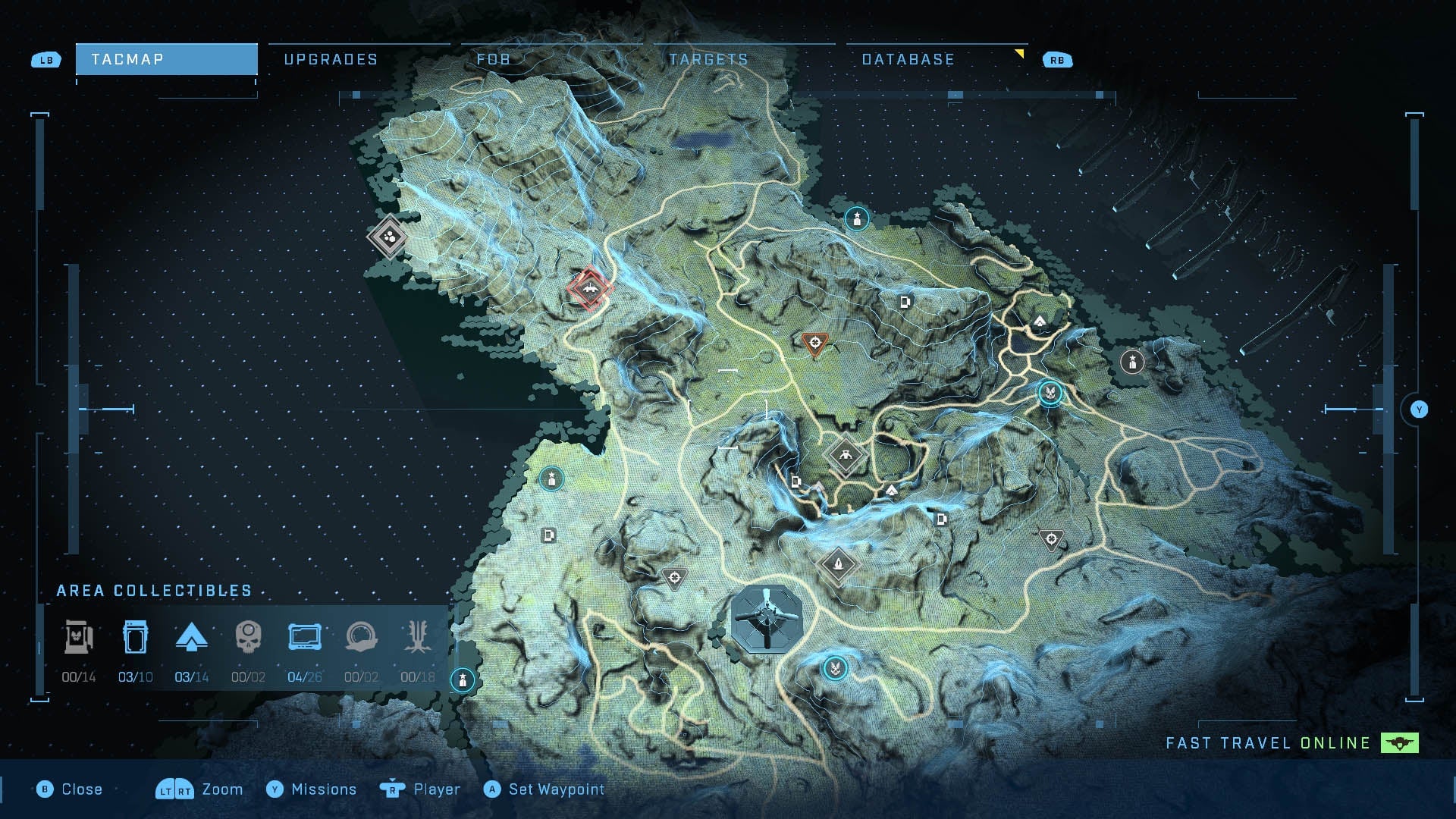
Early on, you’ll find the playground for this tentpole shooter isn’t just big—it’s enormous, veering on the edge of what you’d find in a true open-world game, à la, say, anything in Ubisoft’s portfolio. The format is a marked departure from previous Halo games, which have always played out as linear sci-fi shooters largely set in hallways of various grays, purples, blues, and greens, with occasional larger landscapes beyond. Over the past six weeks, I’ve played a lot of Halo Infinite. Despite the size of its objective-peppered map, I’m not entirely convinced it’s an open-world game, at least not in the way we’ve come to think of it.
Clue #1: When I recently spoke with two creative leads on Halo Infinite, associate creative director Paul Crocker and character director Stephen Dyke, neither said the phrase “open world” once over the course of our nearly hour-long discussion.
Clue #2: Halo Infinite, an approximately 17-hour game for most players, is neatly broken into three parts. The first section is a two-hour linear section that doubles as a tutorial (for newcomers) or a walk down memory lane (for lapsed players). The second third is a series of subsequent sprawling open areas, replete with side-quests, hidden collectibles, fast-travel spots, and bases you can capture, with every region culminating in a bombastic mission or two. The final third is a four-hour linear sprint to the finish.
Clue #3: That final section? Once you start it, you can’t fast travel back to what Dyke calls “the more open areas.” And you don’t get a heads-up about the point of no return. It’s a little annoying, for sure. (“That’s on us,” said Crocker.) But it’s also a quiet rebuttal of the formula established by so many true open-world games that have come before.
Clue #4: Halo Infinite is, by most accounts, a manageable game. It eschews the “if you see it, you can go to it” ethos that’s come to define the open-world genre, a genre that so often demands a triple-digit playtime commitment.
Read More: Halo Infinite Is Harder Than You’d Expect, And That’s By Design
“We never wanted to make a 100-hour drag for the player,” Crocker said. “It still had to be this focused … experience as opposed to, ‘Now Master Chief needs to go hunt some space crocodiles or something just to be able to carry on.’ It works for other games, but it doesn’t work for Chief.”
Master Chief, for those who don’t know, is Halo’s longtime protagonist, and is the backbone of Halo Infinite, following the series’ dalliance with other playable characters in Halo 5. As Chief, you can forgo your primary objectives to rescue a group of stranded marines or take out an enemy commander or track down hidden tech that’ll improve your abilities. And there’s a crop of cosmetic options, typically tucked in the furthest reaches of the map, that you can find for use in Halo Infinite’s standalone, free-to-play multiplayer portion. The optional stuff in Infinite is by and large rewarding.
“Ideally, at least, [players] say, ‘Oh, that was cool,’” said Dyke. “Our goal was never to make those things that are off the beaten path feel grindy or feel like a way of inflating the amount of time.”
But the constant narrative thrum nonetheless compels you to hit the next main mission. If you veer off course, your companion, an artificial intelligence unit known as the Weapon, repeatedly urges you to get back on track.
“Constantly shouting ‘Go, go, go’ to the player basically encourages them to finish the game as quickly as possible, right? If the story is telling you the world’s going to melt, you’re not going to hang around to investigate that smoke on the horizon,” said Crocker. “The tricky part is making sure it feels important but not urgent—or, very specifically, if it doesn’t break the character of Master Chief, it doesn’t break your intent as a player, but still feels that you’re part of this thing that’s moving forward.”
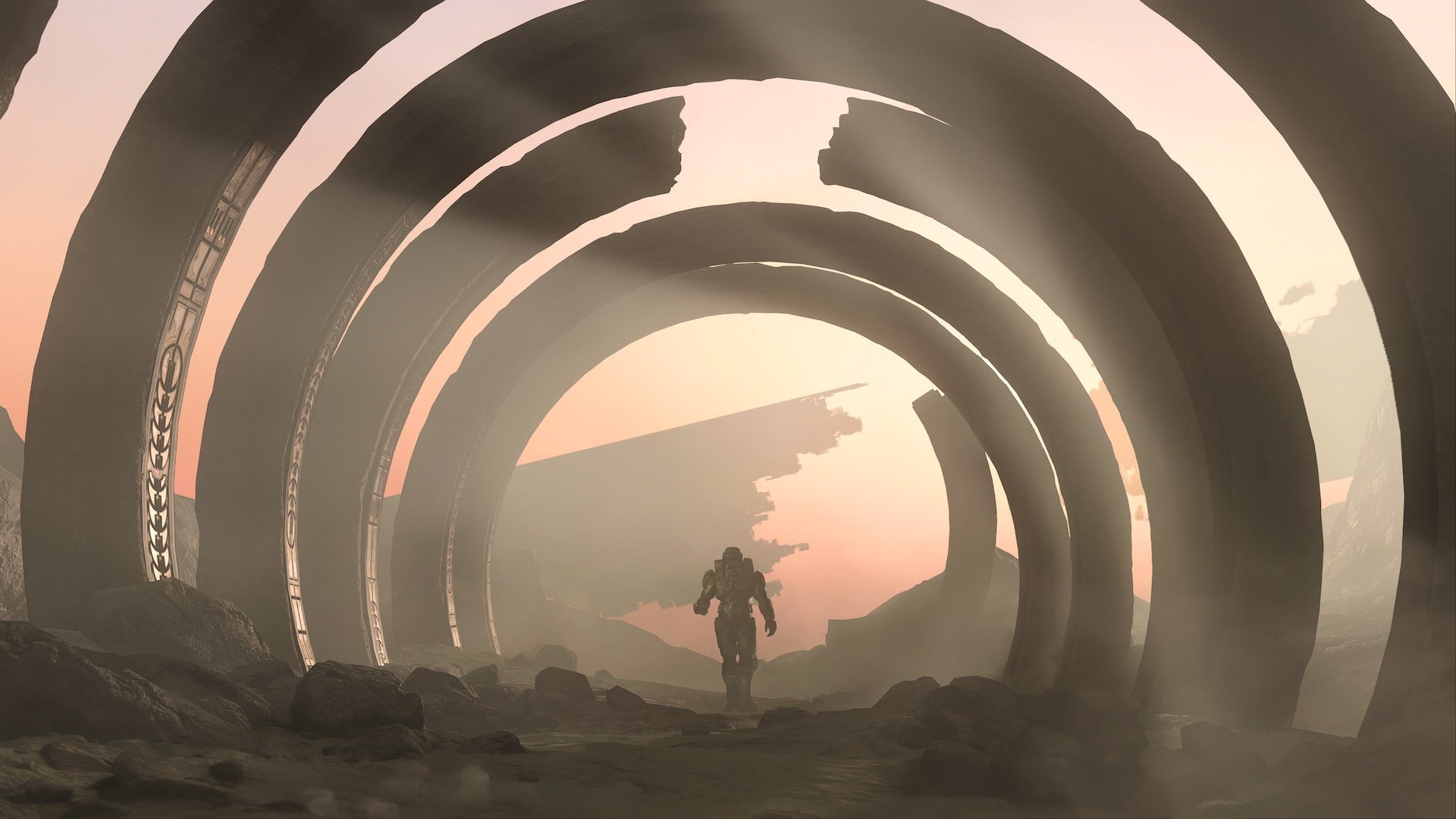
Halo Infinite indeed moves forward at breakneck pace, thanks to a plot underscored by mystery. Prior Halo games generally sported the same solid if expected narrative chassis: pick up the big gun, beat the big bad guy. Halo Infinite, however, turns Chief into an unreliable narrator for the first time. And then there’s the giant question mark posed by Infinite’s setting: Zeta Halo. It looks like a Halo (an ancient ring-shaped space station) but is inexplicably shattered, and is apparently capable of secret functions beyond the one for which Halo stations are known: galactic elimination of sentient life. (In this regard, Infinite isn’t exactly subtle. At one point, in case you’re not getting it, Master Chief literally says Zeta Halo is “not like the others.”)
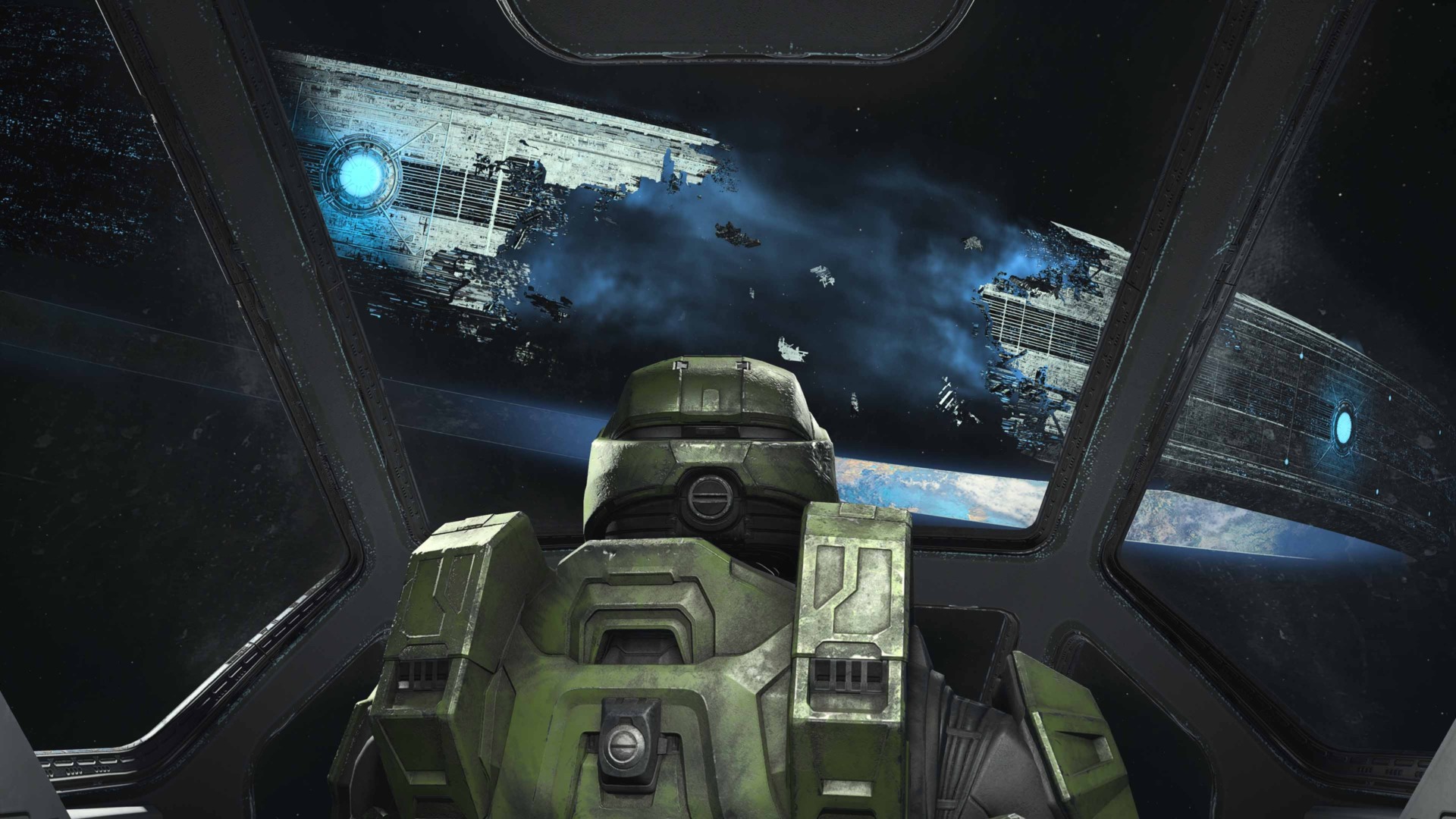
Crocker, who cited Halo: Combat Evolved’s “Halo” level as a north star in development, and Dyke, who said the same about that game’s “Silent Cartographer” level, wanted to capture the bottled lightning that put Halo on the map two decades ago.
Both of those early missions share a similar throughline: You start alongside a crew of headstrong marines, you have access to a minor fleet of futuristic vehicles, and you can approach your tasks—firefights set in expansive exteriors and claustrophobic interiors—in a manner you see fit. But beyond the mission structure, “Halo” and “Silent Cartographer” both conveyed a sense that Halo was far more grand, in terms of scale, than what you could see on the screen—a necessity, given the technical confines of the era.
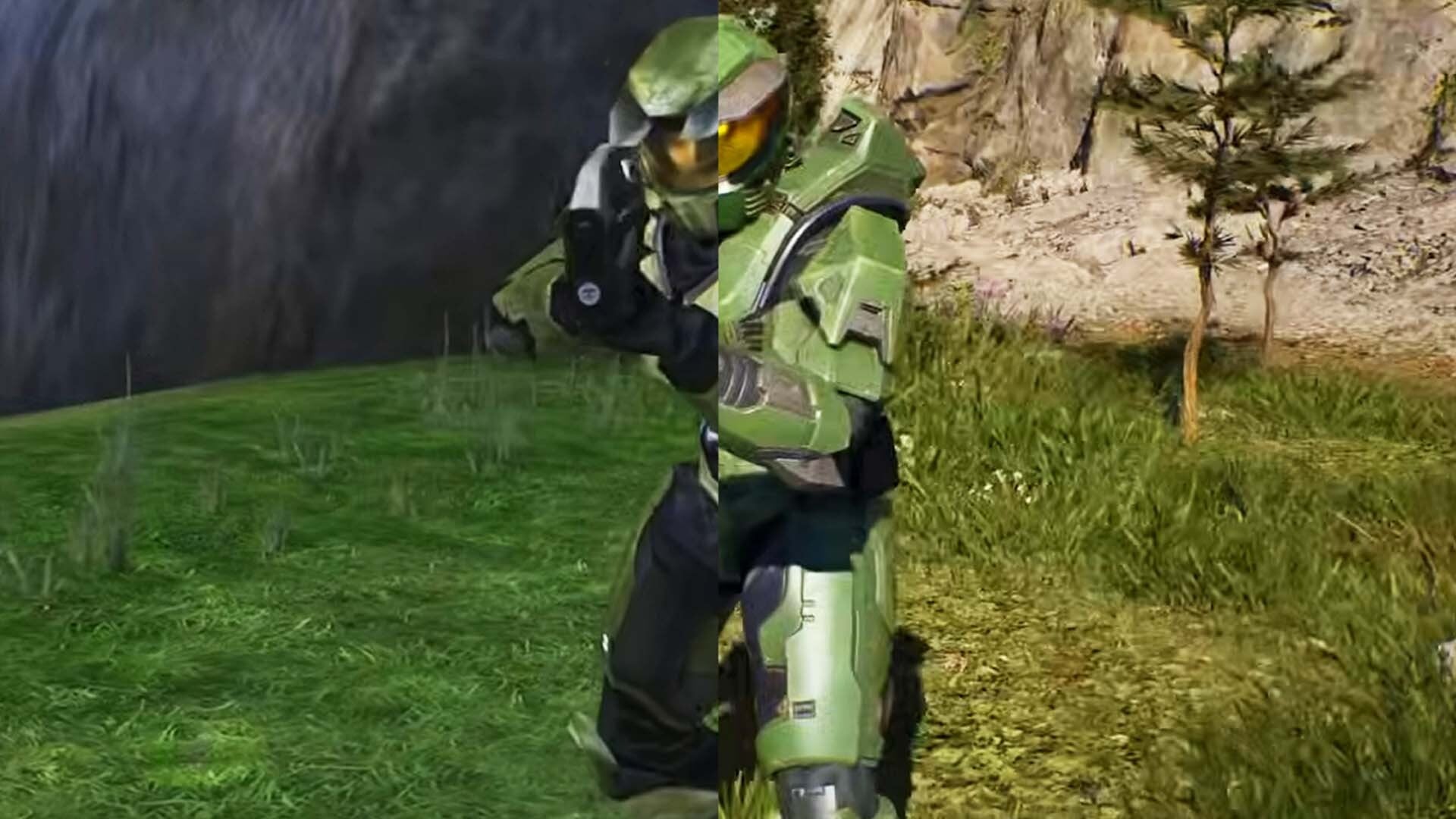
“I remember, 20 years ago, playing it and going, ‘This is amazing! Look at the grass! Look how wide this corridor is!’ when you first land. Then you go back, looking at it, and it’s not really that wide, but it’s wide enough at the time,” Crocker said. “[For Infinite], we wanted to figure out how many walls we could break down and keep you feeling the same way you did—that sense of awe and wonder and mystery that you had 20 years ago.”
These days, game development isn’t so limited by technology, and the team at 343 Industries has the tools at their disposal to realize the dream posed by those early Halo levels. If Halo’s early levels sketched out the blueprint, Halo Infinite is the finished house.
“To me, [‘Silent Cartographer’] is one of those missions where it’s, like, that, but scaled, is just a great representation of what we’ve delivered with Infinite,” Dyke said.
You can see this most clearly during a mid-game level called “The Sequence,” the final “more open area” before Halo Infinite reverts to the framework of a linear shooter. In “The Sequence,” you have to extract data from four towers in your near vicinity. The region is interspersed with more than three dozen optional objectives—bases to capture, squads of marines to save, high-value targets to eliminate, collectibles to find—that you can tackle en route from tower to tower.
Or you could capture an aerial vehicle and knock out the whole thing in under an hour.
Open-world games sell you the promise of infinity—that you can go anywhere, see anything, do whatever you want whenever you want to. In Halo Infinite, “The Sequence” segment no doubt gives you a healthy sampling, preceded, in earlier levels, by appetizer-sized portions of the same dish. But it ultimately circles back to, and spends a bulk of its time on, the reliable alien hallways that make a Halo a Halo. Yes, Halo Infinite is huge. It’s still finite, though, and those tighter, more focused sections that bookend the game still feel so central to Halo’s identity—too central, in my view, for Infinite to truly bear the mantle of an open-world game.
“We wanted to start in a linear fashion and end in a linear fashion, and then everything in between is encouraging you to go out and explore,” Crocker said. “We wanted to make the end feel very impactful.”