Cars 2 was not a classic film. It was unfocused and a bit too dependent on plot rather than characters. But it was a solid film. It had great action set pieces and ‘blink and you’ll miss it’ humor. And it doesn’t deserve the death by omission it is currently enduring.
I watched Cars 3 on its debut weekend with my son. He’s two and a half; to him, the Cars franchise is manna from heaven. He loves it all: the TV shorts, the books, the clothes, the toys. He has an encyclopedia with the names and biographies of all the ancillary characters, and he pores over the expanded universe at any opportunity.
But the universe my son loves recently got a lot smaller. In Cars 3, Cars 2 never happened. There are no references, even in passing, to Holly Shiftwell, Finn McMissile, or the international World Grand Prix that was the backbone of Cars 2. The lone acknowledgement, if one could call it that, is that Lightning McQueen now had headlights instead of stickers, which Ramone installed in the prior film. If there wasn’t a ‘3’ on the end of the title, one could easily mistake Cars 3 for a first sequel, rather than the third part of a trilogy.
I’m not the only one who’s noticed this blatant omission, which is contrary to Pixar’s previous, multiple defenses of Cars 2. In an interview with the New York Times in 2011, Cars 2 director and current head of Walt Disney Animation Studios John Lasseter responded to accusations that Cars 2 was a cynical cash grab. He said:
I don’t know what to say about that. Well, I guess I do. It’s not true. It’s people who don’t know the facts, rushing to judge. I recognize my place in the Walt Disney Company, but my job, my focus, my deepest desire is to entertain people by making great movies, and we did that with Cars 2
Brook Barnes, who conducted the interview, noted that the critical response to the film had “dented morale” at the studio. Later, in the same interview, Lassetter insisted on the film’s personal importance:
I reached deep into myself and saw what this film was about, and I think it’s clear that audiences have responded. It’s is a very, very special film to me.
The Cars films have always been personal to Lassetter, whose interest in cars stated early; his father owned a Chevrolet dealership. But in his more recent statements, particularly in the run-up to Cars 3, he appears to distance himself from Cars 2. In a 2016 interview with Entertainment Weekly, he said:
Cars 3 is a very emotional story. It’s a little bit more akin to Cars 1, where you get into a deep emotion with [Lightning McQueen]. It’s really a special story.
This is a common sentiment that multiple people involved with the new film espoused—that Cars 3 gets back to “what Cars was about.” That it goes back “to the roots of the franchise.” It sounds like massive dog-whistle for what they are all implying—that Cars 2 was a big mistake that Cars 3 corrects.
There is nothing, however, that needs to be corrected.
The original Cars’ universe was small; it focused on NASCAR culture and the economic plight of small-town America. Cars 2 expanded that universe by creating a global community of cars. Because of the film’s overarching premise—Lightning is competing in the World Grand Prix—we got to see cars-inhabited versions of Japan, Italy, and England. The quality that many critics point to as a flaw—the film’s sprawl—is what makes it watchable. Its international scope allows for some of the best visual gags of the franchise, such as this shot of a Japanese car using a hubcap as a gong:
Or this shot of the Pope car in his Popemobile:
Or this shot of cars going through airport security by taking off their tires, rather than their shoes:
Thanks to my son, I’ve seen the first two Cars films numerous times, and I prefer rewatching the second one. There are little jokes and details in every frame. They get better with repeated viewings, and I catch new ones every time.
I like the film’s maligned spy subplot, a clever commentary on the conflict between newer alternative fuels and their fossil fuel predecessors. It manages to be both Cars-centric and relevant to the audience’s real world concerns. It’s a bit fantastical and tonally dissonant from the first film, but it’s intriguing, with a couple of cool twists and swerves before the final reveal.
The most vocal Cars 2 criticism has to be the emphasis—critics might say overemphasis—on Mater. In Cars 1, the rusty tow truck was a supporting player with punchlines. In Cars 2, Mater is the star and featured protagonist, and Lightning takes a backseat to his ‘aw shucks’ best friend.
While critics have been ambivalent about Mater’s simple-minded characterization, he has more appeal than Lightning ever will. Even though Lightning is the star, he is the weak link of the franchise: he had no personality outside of his cockiness and arrogance. After he learned humility in Cars 1, there was nothing else to make him compelling. Even in Cars 3, Lightning still lacks a discernible personality; newcomer Cruz has to supply the charisma for the both of them.
Mater has an arc in Cars 2, which can be summed up by the value he places on his body’s “dents.” He refuses to get them fixed:
Mater: I don’t get them dents buffed, pulled, filled or painted by nobody. They way too valuable.
Holley: Your dents are valuable? Really?
Mater: I come by each one of ‘em with my best friend, Lightning McQueen. I don’t fix these. I wanna remember these dents forever.
Mater is flawed. He makes a lot of mistakes. But those experiences are a part of him, and he doesn’t think they should be covered up or denied. There’s a cute irony throughout the film: during the entire time that Holly and Finn mistake Mater for a spy, he is actually a very good one. It isn’t because he pretends to be one. Rather, it’s because he acts like he normally would, using his knowledge and experience to draw correct inferences. There’s value in being oneself, dents and all. And Mater learns not to feel shame for this.
https://www.youtube.com/watch?v=6ILbqMMqz8w
While Lightning doesn’t change as much as Mater, the film does take him in another direction rather than rehashing the plot from the first film. In Cars 1, he was a jet-setter who balked at the provincial Radiator Springs. Eventually, he came to appreciate the town’s slower pace and rustic authenticity. But Cars 2 inverts that conflict. Lightning may have appreciated his new friends’ small-town outlook, but to what extent did he actually view them as his equals? Would he be embarrassed to introduce them to his more worldly friends and bring his two worlds together? Could he accept, in a public sphere, this new, less-refined aspect of his identity?
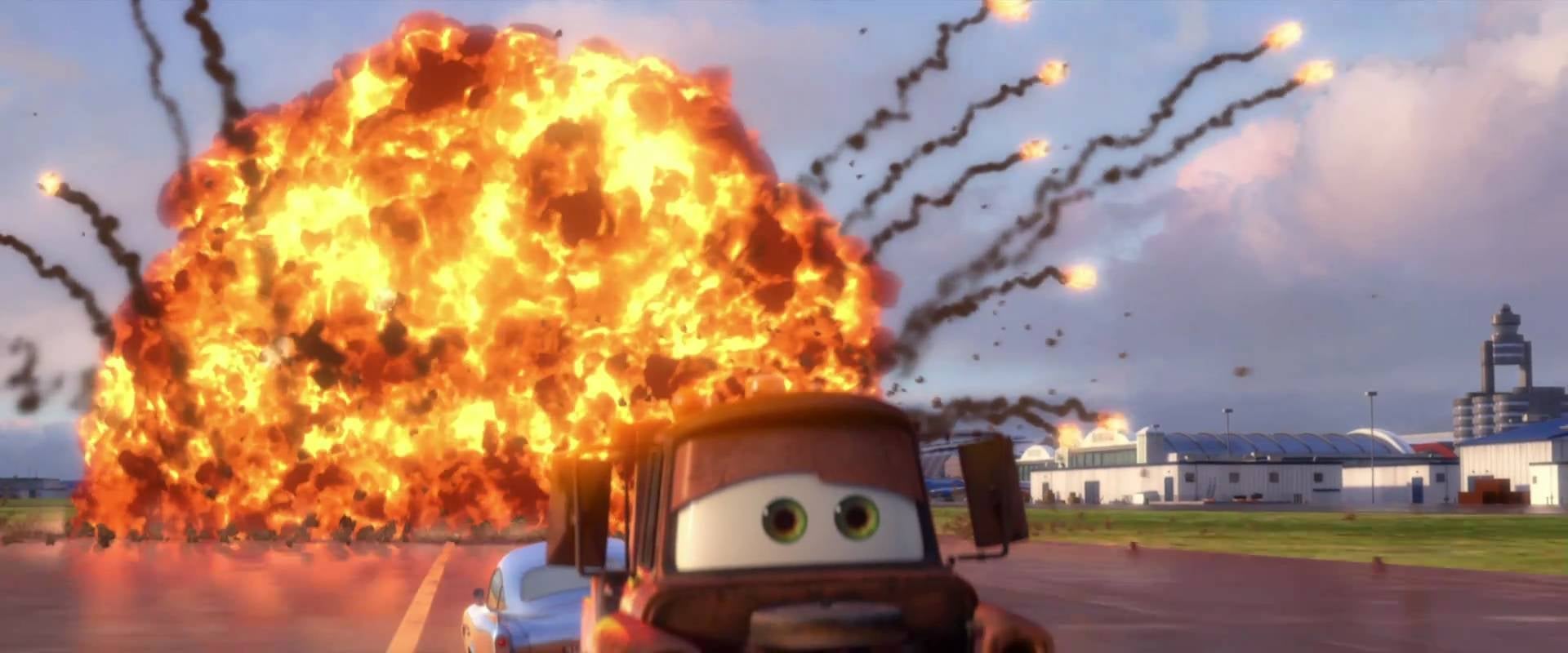
Cars 2 asks these questions against a backdrop of explosions, spy shenanigans, and gunfights. This is the most violent Pixar film to date and features the on-screen murder of a car.
https://www.youtube.com/watch?v=pu2ktAU51jk
Cars 2 is, at its core, a big-budget action flick, with all the inherent flaws. But the deeper questions and meanings are there, albeit buried deeply.
And after this big, expansive, world-building sequel, we get Cars 3, which takes a more narrow scope than Cars 1. It’s a road story that zeroes in on two characters, Cruz and Lightning. The other cars in the movie have bit roles or one or two lines, if that. The filmmakers caught flack for shallow, mindless action in Cars 2. So for Cars 3, they overcorrected, with a deep character dive into Lightning, to the exclusion of everything else.
The problem, however, is that Lightning himself lacks the personal depth to sustain this sort of character study. It’s why Cars 3, for all the celebration over its return to roots, is curiously bland, in the same manner as Cars 1. Cars 2 has an energy and excitement that the two films bookending it lacked. Which is better? The film that sets its sights highly and doesn’t quite reach them, or the film that sets its sights lower, and reaches them comfortably?
Ultimately, Cars 2 is a victim of Pixar’s prior success; the studio, up to that point, had released critical hit after critical hit. It was was inevitable that the studio would miss eventually, and it happened when Pixar released this flawed, but not terrible film. At one time Pixar stood by a film that clearly took a lot of effort and creativity and was popular with audiences. Lasseter made a big show of stating “I don’t make films for film critics” back in 2011. Now, the change in public attitude is striking.
Even if the filmmakers think that Cars 2 was a misstep, they could certainly take a lesson from Mater. There’s no need to fix the dents. It’s the dents that make us who we are.