How Fish Is Made is a horror game about life-altering choices. You can’t immediately tell from the free Steam game’s dumpy sardine graphics, I know. It and its new Katamari Damacy-type expansion, (which primarily serves as an entertaining ad for Swedish developer Wrong Organ’s forthcoming game Mouthwashing), are short and crude. But playing it moved me in a way few games have this year.
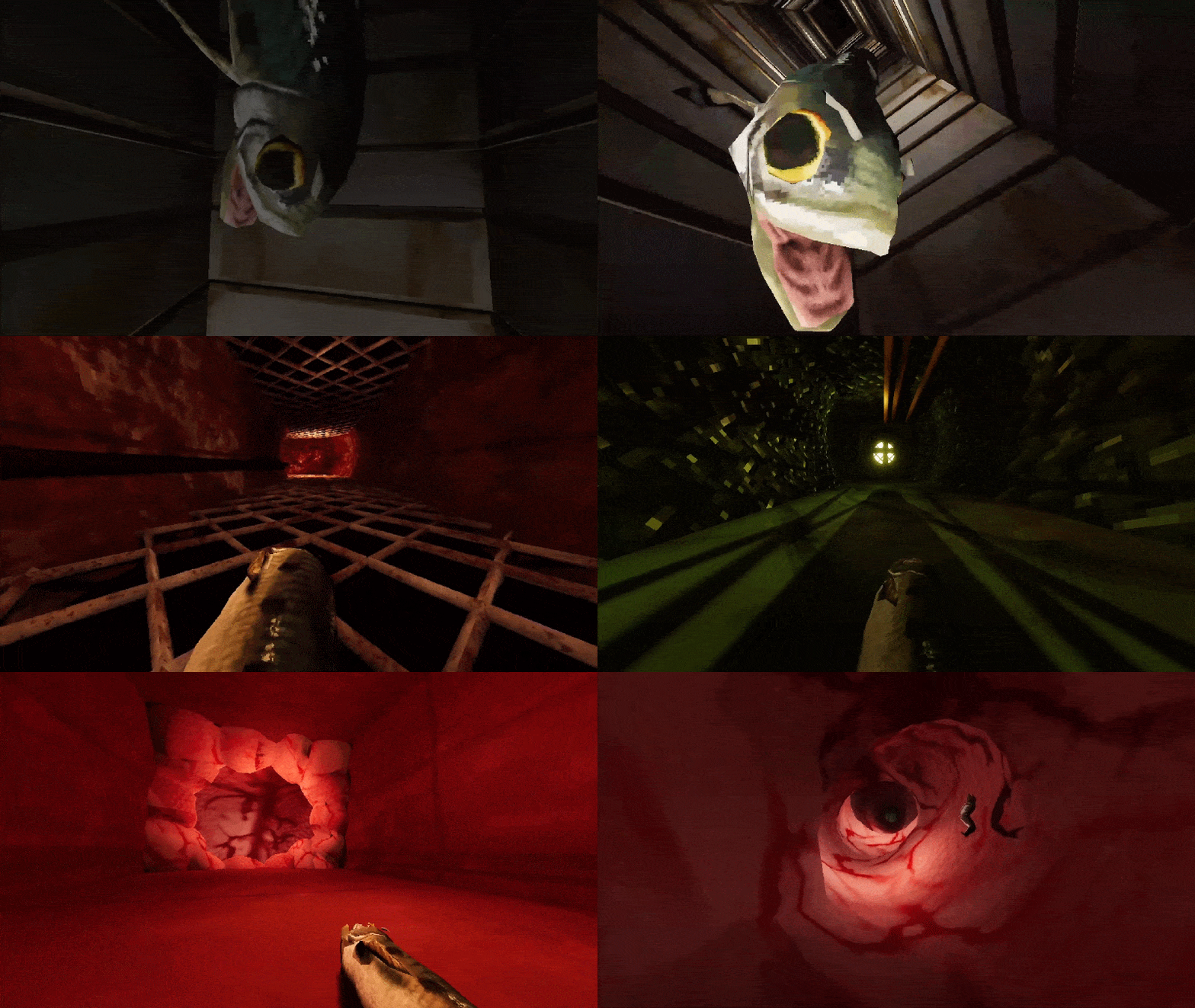
The 40-minute long narrative adventure first enjoyed YouTube fame in 2022 shortly after it released. It put me in a sardine’s scaly body, which seems to have no needs and looks like it was born from a PlayStation 1. I’m out of water, but still alive. A bigger fish confronts me immediately: up or down?
“You’ll have to make up your mind by the end,” it says.
I have no idea—but I choose down, for now, and flop through a factory’s rust looking for answers, or a way underground.
That’s the extent of How Fish Is Made’s gameplay. I lie on my side, my mouth permanently shocked, and I spasm through pixelated red tunnels leaking mystery tears. There isn’t anything to do but push forward, or talk to other twitching fish that spinning, coin-shaped icons encourage me to click on. When I do, they give me abstract, contradicting opinions on the merits of up or down. One fish might feel intrinsically that down is the right decision, but another fish’s family insists there’s nowhere to go but up. Another fish is trapped in a condom; in How Fish Is Made, everything alive is polluted.
“Do you understand yet?” one sardine eventually asks me, pressing the game’s balanced tone—half amusing (the fish are talking to me like God would) and half disturbing (the fish are talking to me like God would)—lower into serious commentary on existence. “This choice that has been given to a worthless critter like you?”
Kind of, I think. In a translation of existentialist bible Being and Nothingness, Jean-Paul Sartre writes that “anguish has not appeared to us as a proof of human freedom; the latter was given to us as the necessary condition for the question.” I imagine the same applies to sardines.
That’s sort of still funny, like How Fish Is Made’s mini-expansion, in which I roll my sardine around in a tonsil stone lump. I thoughtlessly absorb whole fish into my crinkles. But, earlier in the game, I trigger a nearly three-minute-long parasite montage, delivered by a tongue-eating louse I find in my fish comrade’s mouth, which insinuates my death. I shove my way through a throbbing pink tunnel, and I feel like I’m watching myself undergo a moral colonoscopy.
There’s the magic part of this strange little video game, which pokes and taunts its player more than the idiot fish on screen: it makes me sit with uncertainty, a clouded mirror I hate looking in.
The horror of How Fish Is Made isn’t the loose bones I gasp under, or the plates of flickering eyeballs that watch me as the game progresses and becomes even more surreal as I get closer to choosing something certain, up or down. I’m a fish with no freedom, the game suggests—no freedom, only a finite number of choices.
There are benefits to embracing a game like that, playing catch in your mind with how often you’ve chosen wrong, and why. Putting so much value in your actions can make you feel like you really are alive. There are consequences to it, sure, but there’s also relief you identify as grief. Or, maybe, the weird, free Steam game is only a weird, free Steam game. Either way, I’ll be thinking about How Fish Is Made for a long time.