Astro Bot is one of the most entertaining and depressing games I’ve played in ages. It’s a loud, unrestrained explosion of creative energy, it’s an antiseptic corporate product drowning in brand fellatio. A shining example of what current-gen first-party games can be, a dreary reminder of everything they’re not. PlayStation is dead; long live PlayStation.
Over the past few years I’ve gotten pretty good at being able to quickly intuit whether a piece of media is real or fake. Anyone can hone this skill and I enthusiastically recommend doing so. For example: I have not yet seen Cloud, the new feature directed and written by Kiyoshi Kurosawa. Kurosawa is a more spatially proficient filmmaker than about 95 percent of his contemporaries, and even just watching the trailer, it’s abundantly clear: this is a real movie. I also have not seen Piece by Piece, an upcoming documentary about Pharrell Williams where everything is made out of Legos. And yet, beyond a shadow of a doubt: fake movie.
Astro Bot broke my streak. I could not, for the life of me, figure out if this thing was real. My social media feed presented me at turns with videos of gorgeous, snappy, virtuosic platforming, and of a miniature Nathan Drake piloting a spaceship shaped like a giant PS3. I’d played—and enjoyed—the game’s predecessor, Astro’s Playroom, an hour-long pack-in PS5 title that existed mostly to explain why DualSense controllers cost 70 dollars. The Sony veneration made sense there, in a free hardware showcase. It was even charming. But I had no idea what to make of it here, in a full-price game that doesn’t actually need to sell me on anything. I already bought the damn PS5. I bought it for Final Fantasy XVI, which sucked. What more do you want?
Complicating matters further is the fact that, yes, Astro Bot is actually good. I honestly didn’t expect it to be, because relentless trademark fetishism isn’t usually where good design lives. But I abide by a strict self-imposed rule: do not develop strong opinions about games you haven’t played. (This rule is exceedingly difficult to follow, and I break it all the time.) So after firing off a few grouchy tweets, I put my money where my mouth is, and played it. I played the wheels off of it. And I stand before you now, wild-eyed, repentant, my frigid hater’s heart thawed by the sheer corporeal pleasure of a really good jump, to proclaim that Astro Bot is probably the best 3D platformer published by Sony Interactive Entertainment since Ape Escape 3
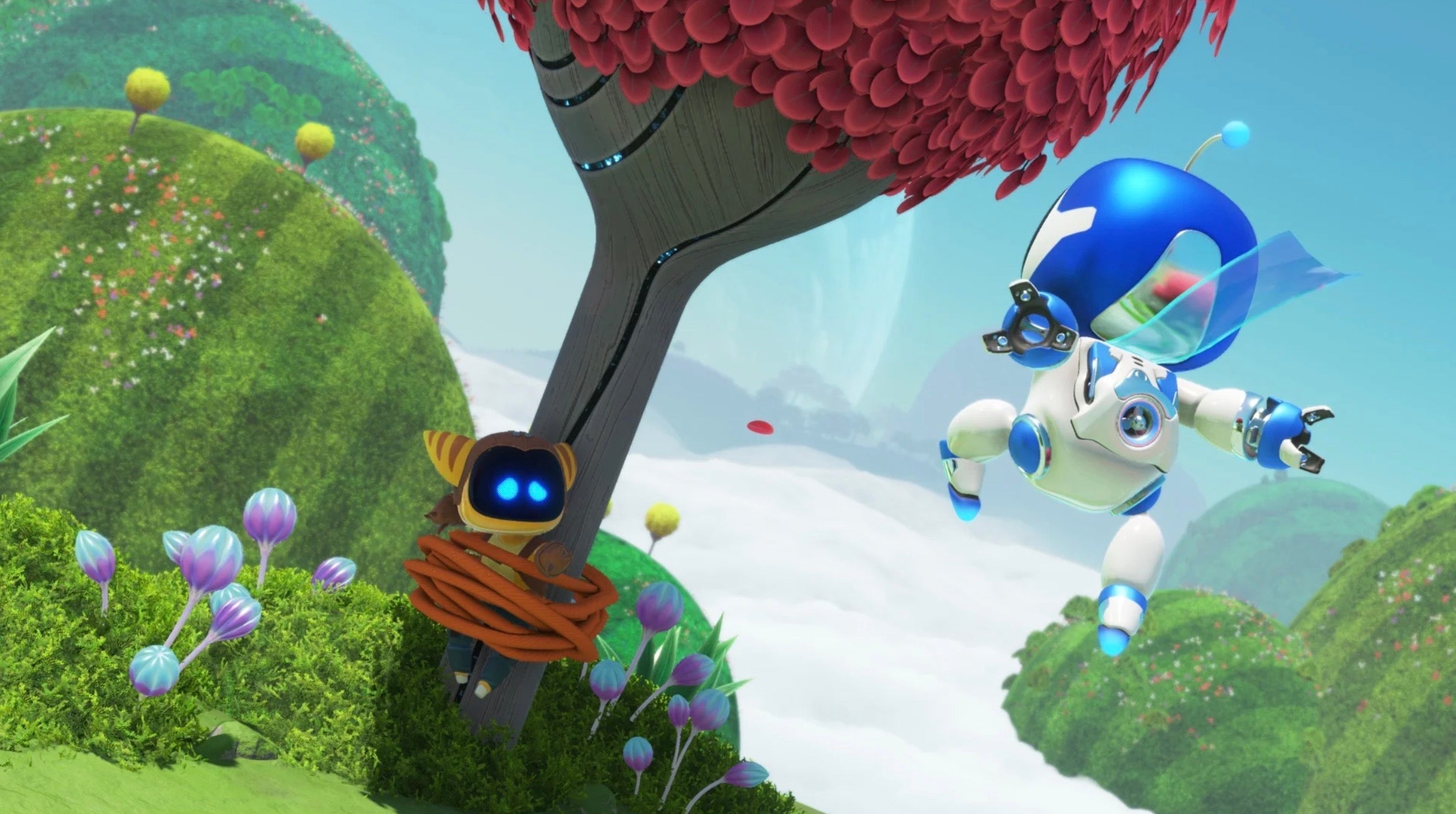
So why the insecurity? Why build on such a sturdy foundation with so many appeals to nostalgia? A nostalgia that, in spite of developer Team Asobi’s best efforts, I have difficulty reading as productive–Astro Bot’s idea of a “loving tribute” is dressing up its little Funko Pop-esque mascots as Something You Recognize, turning them into collectibles, placing them all in a big empty field together, and urging players to walk up to them and punch them in the head, at which point they’ll perform a canned animation referencing whatever game they’re from. I won’t pretend to be made of stone–I smiled when the Psycho Mantis bot made my controller rumble, and my eyebrows hit the ceiling when I saw that they included anything Incredible Crisis-related at all. Nevertheless: this is, for the most part, not something actively, inquisitively engaged with the history of video games as a medium. It’s a parade float game. Which would be fine, if it didn’t feel like the parade floats were crashing into a dinner party.
Sony has never really settled upon a single mascot for its consoles, though it’s maintained a small, rotating roster of contenders over the years. Crash Bandicoot, Toro Inoue, Ratchet and Clank, Nathan Drake, Aloy… none feel totally representative of the company, and maybe that’s by design. Astro, on the other hand, seems representative of the company by default: mostly featureless, infinitely mutable, able to stand in for any other character with a quick wardrobe change. (They already sort of tried this with LittleBigPlanet’s Sackboy, though he at least has the benefit of not being designed to resemble a PlayStation controller.) His goal in Astro Bot is no less impersonal: the story hinges on the recovery of several internal components for, literally, a giant PS5, referred to as the “mothership” (and its inhabitants, collectively, as the “PlaySquadron”). It’s all way too promotional, too inexpressive. The game’s identity is brand identity.
Maybe I wouldn’t be as wary of this if Astro Bot wasn’t clearly a testing ground for future smaller-scale first-party Sony titles. In a just world, its reception would lead to more games as inventive and iconoclastic as the ones it’s referencing. The levels based on Ape Escape and LocoRoco are especially great, and though they still bear more than a whiff of corpo-stank–it’s hard to ignore how aggressively toyetic the whole dress-up-as-your-favorite-character conceit is–there’s genuine mechanical interest and investment in what those games are doing, and it’s an assertive (albeit small) reminder that, put simply, weird stuff owns.
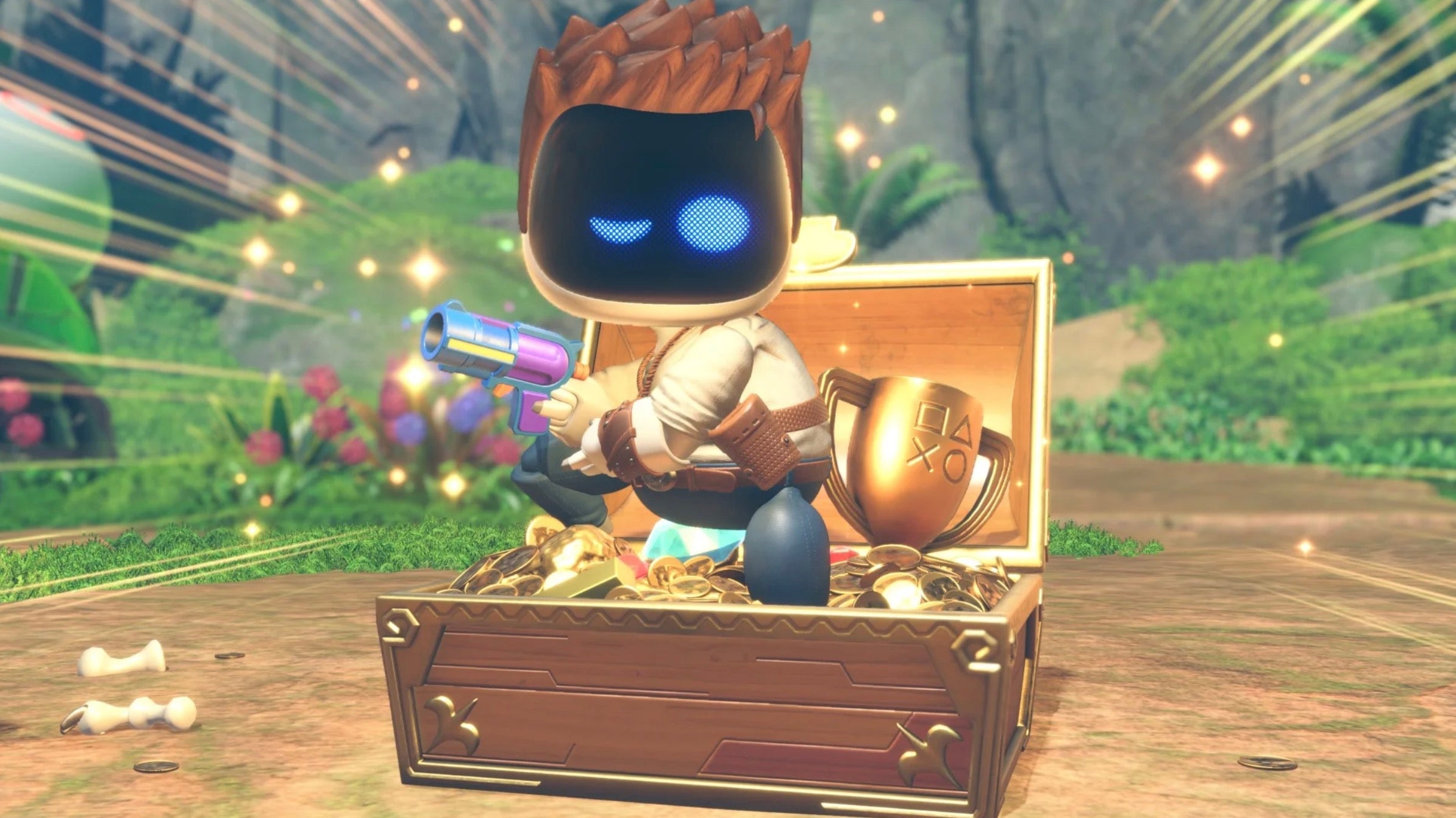
On the other hand, it’s possible—and worryingly likely—that Astro Bot will be taken as another win for IP-first, art-by-committee video games, its critical and commercial success attributed not to its savviness nor its economical scope but its willingness to play to expectations. Risk-taking, in this era of protracted development cycles, inflated budgets, and constant mass layoffs, is not usually the operative mode of publishers like Sony. There are good games coming out of the first-party space, sure, but how many can really be called meaningfully subversive or formally audacious? When was the last time Sony put out something that actually looked and felt new?
Astro Bot, it pains me to say, does not qualify. For all its competence, for all its spirit, I’ve played it before. The game is largely a compilation of Super Mario Sunshine and Super Mario Galaxy’s greatest hits, with a smattering of truly distinct ideas (the shrinking power-up, which only appears in one level, is good enough to carry a whole game; the stopwatch isn’t far behind). Novelty certainly isn’t a prerequisite for quality, far from it–it’s partially because of its established format that Astro Bot is able to hone in so acutely on the fundamental joys of 3D platforming design. But if we’re going to continue having conversations about what first-party publishers could be doing to nurture artistry in video games, we need to resist equating polish with innovation.
It should go without saying that this innovation vis-à-vis 3D platformers is alive and kicking in the indie space. I’d be remiss not to mention the excellent Penny’s Big Breakaway, or the diamond-dense Pseudoregalia. And I’d be a world-class rube not to mention Spark the Electric Jester 3, which games twenty times its size will probably still be catching up to a decade from now.
But originality can, and should, be cultivated elsewhere. Astro Bot, in its panoramic brand reverence, unintentionally acts as a reminder of a time when Sony was known for taking risks, often on first-time developers whose prior lack of involvement with video games led to radically unique interpretations of what they could be. Several of these developers’ franchises are given nods, though those who have seen Astro Bot through to 100% completion will know that it seems especially keen on PaRappa the Rapper–a game that underscores the shift in Sony’s publishing philosophy more than perhaps any other.
PaRappa the Rapper was the brainchild of musician Masaya Matsuura. Prior to the game’s release, Matsuura was one half of the prolific J-pop duo Psy-S, who put out eleven original albums between their formation in 1983 and breakup in 1996. (Can’t go wrong with any, but I’m partial to 1991’s Holiday.) He began experimenting with interactive software in the early 90s, mostly because he wanted to. Sony, having released all of Psy-S’s projects under their Sony Music label, supported him. It’s because of that support that PaRappa was born, and with it, rhythm games. Matsuura wasn’t trying to invent a genre; he was only trying to do something interesting. And in his brilliance, he saw past the next thirty years of imitators by implementing a freestyling system, which rewarded players for diverging from onscreen prompts and making something uniquely theirs.
It’s not like this sort of talent vanished into the ether. It’s right there in Team Asobi, which is composed primarily of developers from the now-disbanded Japan Studio–one of Sony’s most renowned partners, responsible for masterpieces like Shadow of the Colossus, Gravity Rush, and, yes, Ape Escape. These people don’t only know how to make good video games; they know how to make real video games.
I don’t think Astro Bot is asking for anything quite as insidious as brand loyalty, but it’s somewhere in that ballpark. Brand appreciation? Brand wistfulness? A desire to see its old IPs resurrected, and its current ones sustained? I balk at that almost as much as I do at the fanservice itself. Yes, of course I’d buy a new Dark Cloud day 1–but we should demand more from this industry than familiarity. The next Masaya Matsuura is already out there. So is the next Kaz Ayabe, and the next Hideo Kojima, and the next Kazutoshi Iida, and the next Fumito Ueda. They won’t show up unless we let them work.