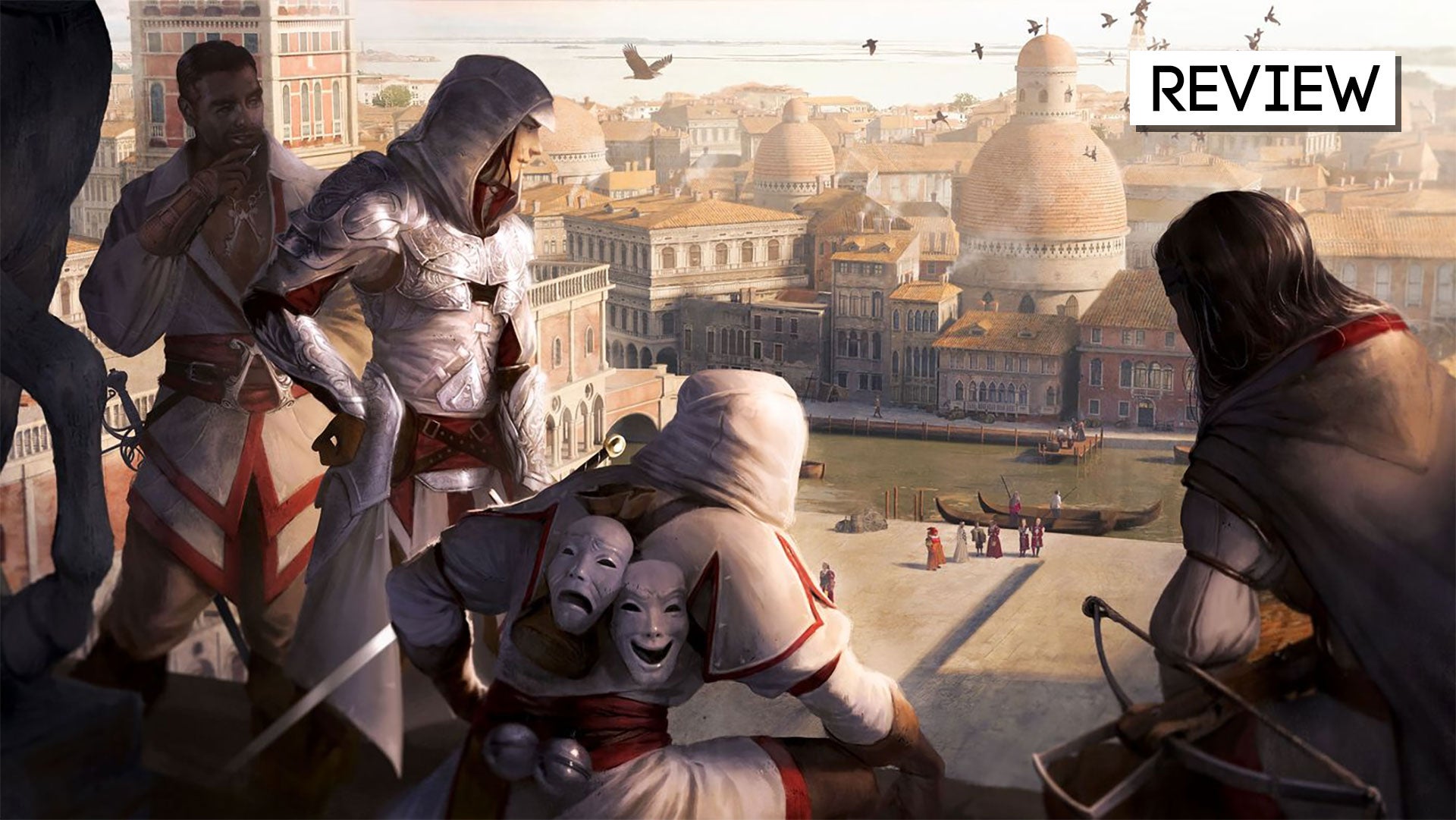
One of my favourite board games of all time is V-Commandos, a co-op World War Two game that’s all about stealth and covert warfare. Now, years later, the team behind that game have taken everything they’ve learned from 1945 and put it to work on something from around 1459 instead: Assassin’s Creed: Brotherhood of Venice.
This isn’t the first Assassin’s Creed board game, but it’s easily the biggest, something I’ll get into in more detail later on in this review. But for now, know that this is a pretty promising fit: not only do creators Triton Noir have pedigree with games about sneaking around, but the design team have ex-Ubisoft developers in their ranks, one of whom worked directly on the fiction of the Assassin’s Creed universe.
After a long wait—the game’s Kickstarter ran all the way back in 2018—Brotherhood of Venice is finally here, and it’s not your average board game adaptation. Like I’ve said the designers have Assassin’s Creed experience, while Ubisoft’s current Assassin’s Creed writing team have also helped out on some of the content that ties into the game’s existing canon in all kinds of interesting ways, making this more of a continuation of the lore than a mere adaptation of stuff we’ve already played through with Ezio.
Brotherhood of Venice comes in an enormous box that’s full of cards, stage tiles and a whole army of miniatures. The game is built around a long, narrative-driven campaign that has players opening envelopes to discover mission objectives, building maps out of modular tiles, then playing cooperatively to sneak past/kill guards and accomplish objectives. Each mission you play runs for around an hour, and in between them you get to retreat to a headquarters—represented physically, as its own map tile with places to store items—where you can rest and resupply. It’s a lot of administrative work, but it also helps maintain an air of secrecy as far as the campaign’s missions and items go.
Gameplay is very similar to V-Commandos, in that players get to go first, taking turns to move and complete actions. You do this in a way that’s essential for teamwork—and it’s one of the most satisfying parts of the game when you can work together to pull stuff off—by spacing out those actions. So, say, if I have four actions this turn, I can take two of them to get into the same room as a guard, then a friend can jump into the room and kill that guard, then I can spend my last two points hiding the body and legging it out of the room again. Teamwork! You don’t have to do this, but when you’re playing with friends it’s definitely the coolest and most satisfying way to get the job done.
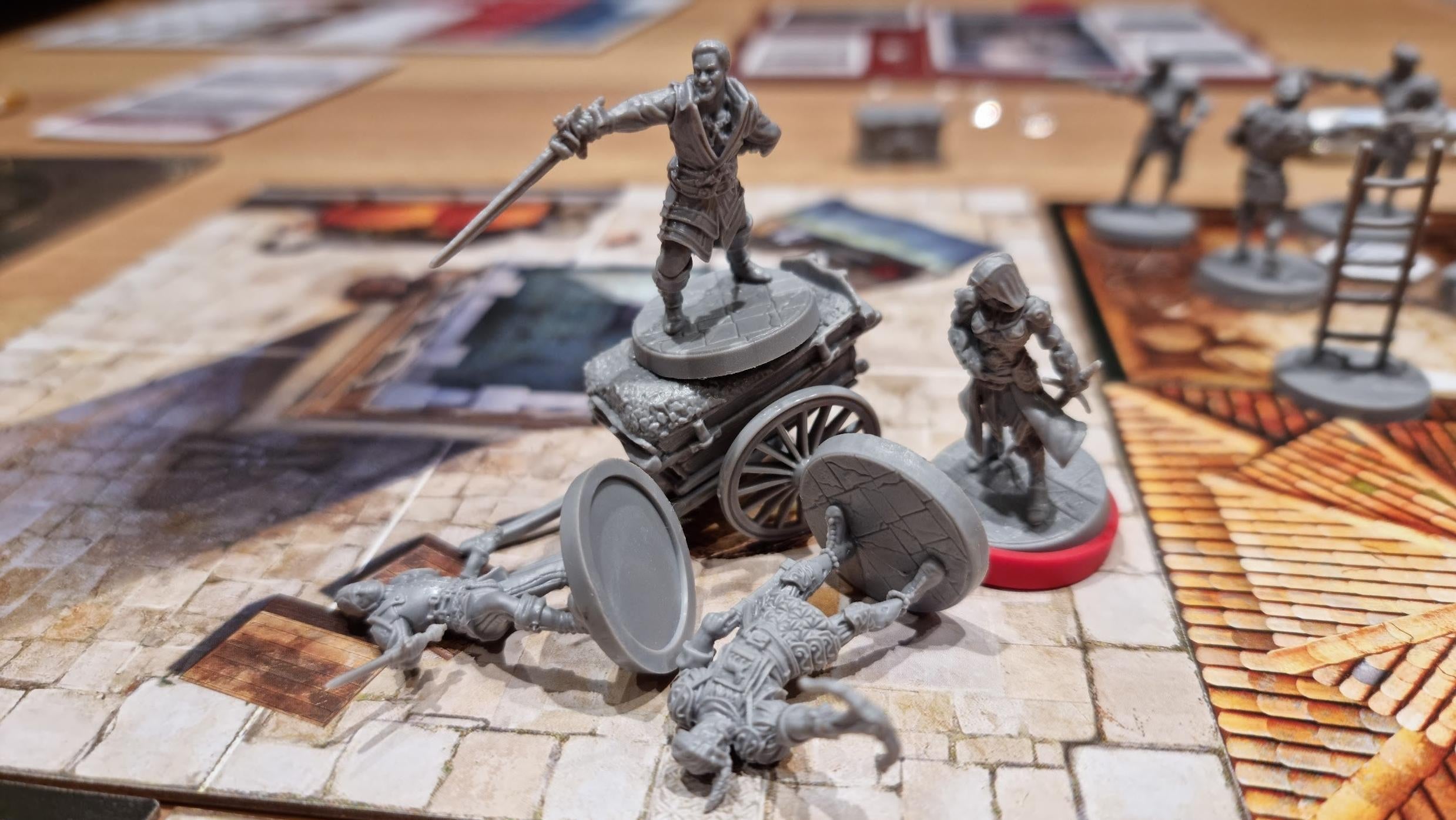 Once all the Assassins have moved, it’s the enemy’s turn. Your opponents are controlled by a very basic AI system, where that turn’s event card has a compass direction printed on it, and every guard that can move (many are stuck in place by various jobs/conditions) will go that way, unless players have been spotted, in which case guards will head towards them instead.
Key to this whole idea of detection and movement is an alarm state that is triggered when you’re spotted, which not only attracts guards but also affects the reinforcements step that takes place at the end of every turn. If the alarm is silent then you’ll get fewer bad guys to deal with, but if it’s tripped you will have to face a lot more. Ideally you don’t want to trip the alarm ever, but it’s also largely impossible to manage that for an entire mission, since whether you’re spotted or not is largely determined by dice rolls. You have to assume that eventually things will go to hell and you’ll have to improvise (which is often when your teamwork and coordination are the most enjoyable).
I liked this system in V-Commandos—it’s a lot more elegant than it sounds, especially since you can see which direction the enemy will move during your turn, letting you account for it—but it’s even better here, maybe because it feels more appropriate. The mix of stealth and open combat, the emphasis on hiding bodies, the need to pick out spots to leap out from the shadows, the constant risk of an alarm being raised, it all feels exactly like playing Assassin’s Creed, only now you’ve got wingmen and everything’s moving a lot slower. As tabletop adaptations of video games go, this is one of the greats.
Especially if you’re a big Assassin’s Creed nerd. In addition to playing like an Assassin’s Creed game, Brotherhood of Venice feels like one, dropping almost instantly into the series’ labyrinthine lore with a story that continues through each mission. There are plenty of characters fans will know, including Ezio himself, and the way the story develops along with your characters’ levelling up and gaining new abilities and items really helps tie together what could have been a disparate and disjointed set of missions.
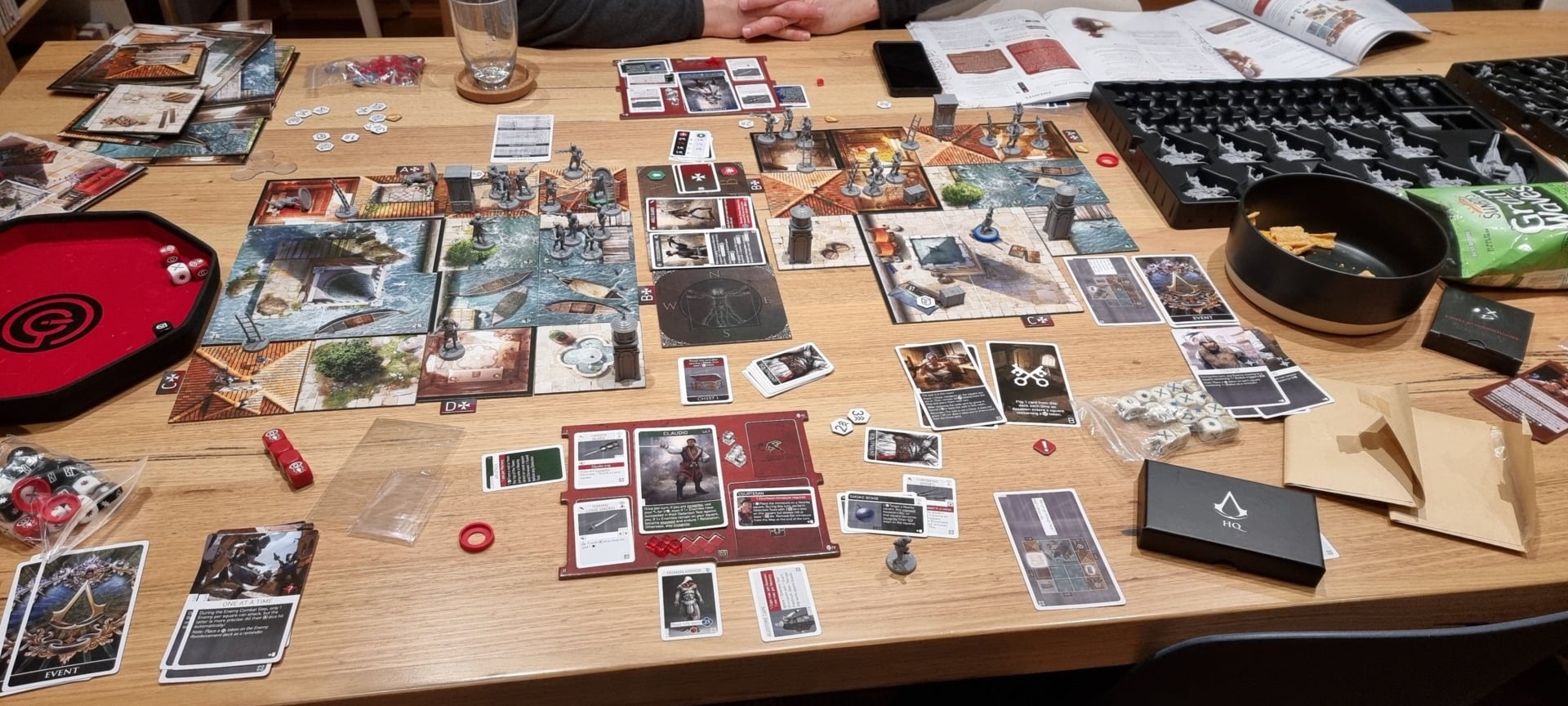
The thing is, in trying so hard to play just like the video games on the tabletop, Brotherhood of Venice has managed to let some of the franchise’s bloat and tedium creep in where this medium could and should have actually kept things leaner. Basically, I found this game too big. It’s too big literally, coming in a comically large box, and when unfurled taking up an enormous amount of space on the table, with Assassin player mats, a game map or two, multiple decks of cards, some other big mats for enemies and a compass, a huge HQ tile with its own cards, stacks of envelopes containing the game’s missions…it’s an enormous task setting this game up, and an even bigger one packing it away and keeping things organised so you can play it again.
I’ve got a pretty big dining table, but as you can see below that didn’t matter to Brotherhood of Venice, which just keeps on getting bigger, and bigger, and bigger. And the photo below is from a night when just two of us were playing!
 But it’s also too big in its scope. There are over 20 missions to play through as part of the campaign—loads more if you’ve got the three expansions—and each one lasts for roughly an hour, or even longer if you’re playing with a full complement of four Assassins and you have to wait for everyone to strategize and take their turn. Do the math on that, then work in how difficult it can be getting 3-4 people together in the same room, throw in the administrative burden of keeping all the cards and events and items up-to-date as part of an ongoing campaign (which can take forever), and you’ll see how big an investment it is committing yourself to Brotherhood of Venice.
If that sounds like something you and your friends could handle, then great! Maybe you’ll be away for a weekend/week and can just power on through it. Maybe you’ve got a games room or dedicated space where you can leave it set up and not have to worry about rebuilding the whole thing every time, then packing it away. Maybe you’re just an Assassin’s Creed obsessive who doesn’t really have much going on for the next few months and think everything I’ve just said is fine and acceptable to you in your current circumstances.
 Anyone ticking those boxes is in a good place to adore this game. And in most ways I do too! But even then, even though I wanted to, I just couldn’t get to the end. I have a video game website to work for 9-5, I play football, I have two kids, there’s a pandemic going on and, maybe most importantly in this context, I have board gaming friends who like to play other board games, not the same one for months and months on end. I get that this is my personal circumstance, but it’s my review, and I think the scope of this game, combined with the hassle of keeping everything filed and sorted correctly mid-campaign, makes this worth keeping in mind.
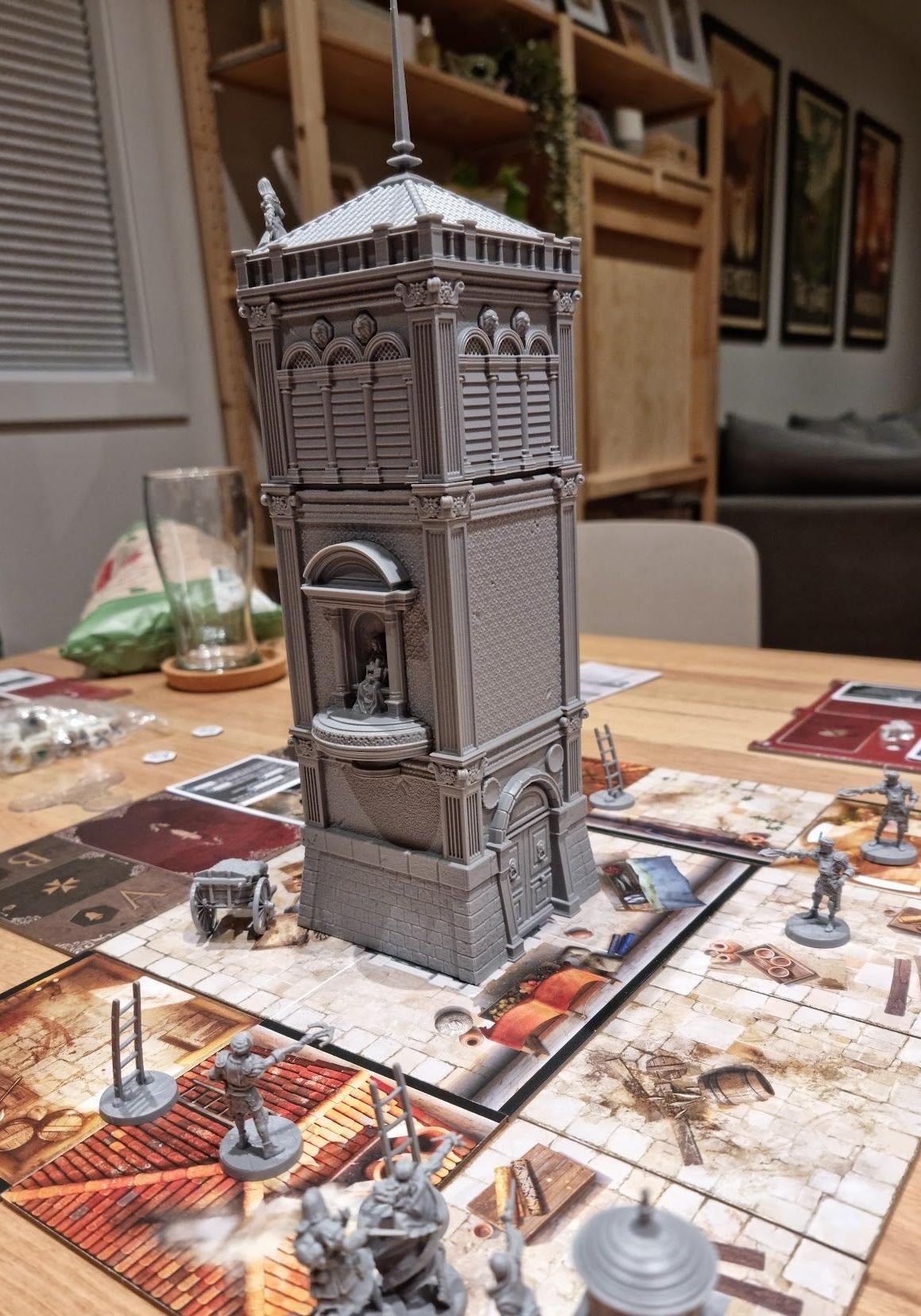
Which is a damn shame! Because as far as the game itself goes, I loved it. I love how smart and snappy it plays, and how elegant the enemy system works, and because I haven’t mentioned it yet I also really liked the way this game is just a pleasure to be around. It’s easy to make fun of the amount of plastic miniatures used in licensed board games these days, but Brotherhood of Venice uses its guards, ladders, chests and [spoilers] to great effect. Nearly everything you do in this game is represented by a token or miniature, which gives the game a great sense of physicality, while the map tiles and card art are rich and vibrant and slot in seamlessly alongside what you’d be accustomed to from the video game series.
Sadly it was just a bit too much for me, which is pretty funny when you think about it, considering, “being great but asking too much of its players,” is the exact same problem I think the video games are suffering from at the moment. At least here that equation is variable depending on your individual situation. So like I’ve said, if you can get a campaign rolling and keep it going, this is a fantastic, albeit slower, version of the Assassin’s Creed experience.
(If you want to see in detail how the game works, this Dice Tower video is a good place to start!)