Tech manufacturers seem to have an instinctual need to remove functionality from their products. Forever chasing sleeker designs, the holes on all our stuff are getting plugged up. With laptops these days, you’ll be lucky if you have more than a single USB port. We even saw this with our phones when they got rid of the AUX port (still big mad about this one). What this means is that if you have an accessory-heavy mindset to be at your peak productivity, you’re going to need a good docking station.
Anker has marketed its Prime Docking Station as a 14-in-1 solution. It can charge multiple devices, transfer data rapidly, and connect to several displays.
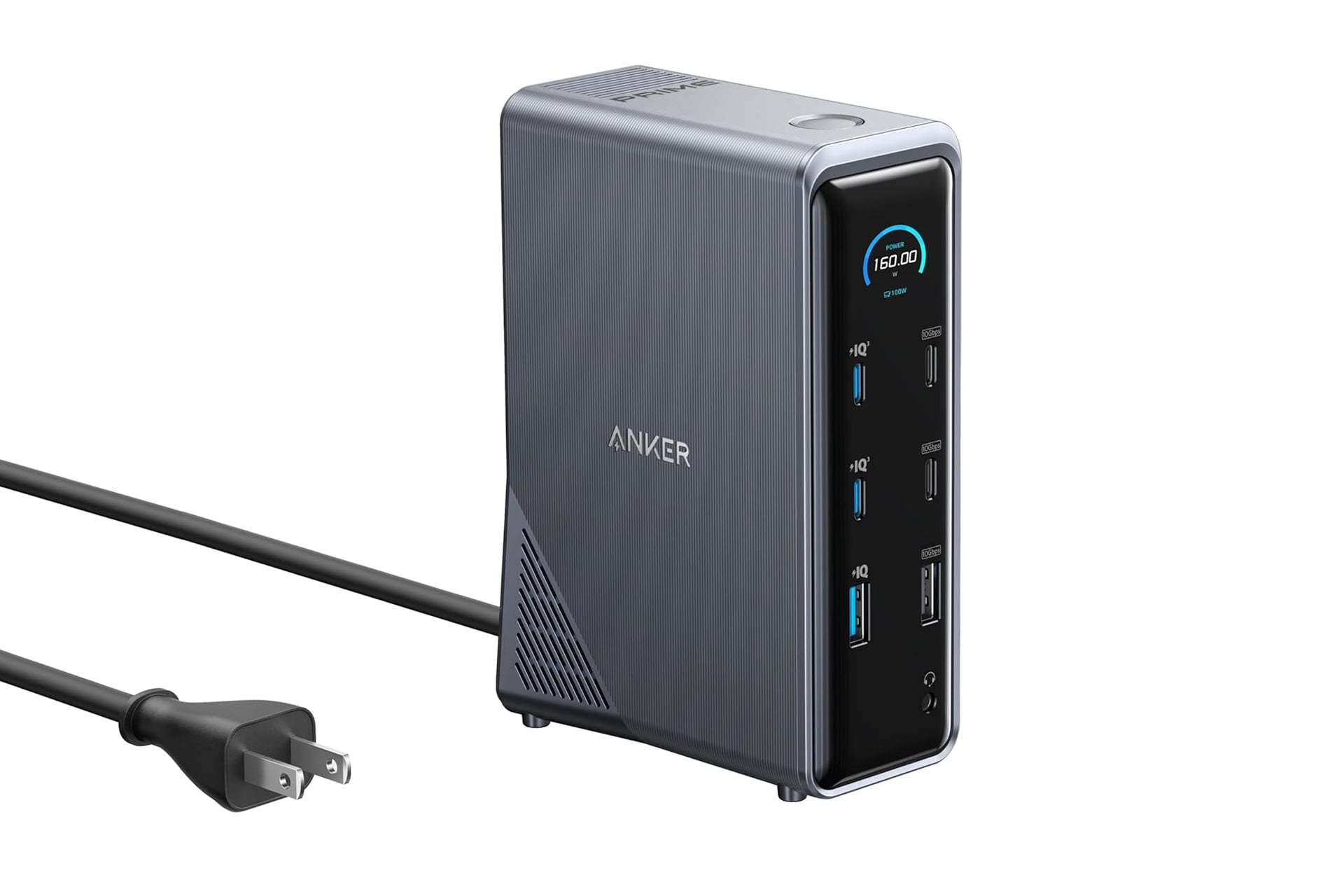
All together, the Anker Prime Docking Station houses 10 separate USB ports. The front of the unit is split vertically between ports meant for power distribution and those meant for data transfer.
The left-side power ports include two USB-C ports capable of 100W Max charging which can quickly top off a phone, tablet, or other device. The USB-A has a 12W Max.
The right-side data transfer ports include two USB-C ports and one USB-A port which can each read and write at a speed of up to 10GBps. Three more USB-A ports can be found on the back, capable of speeds up to 480 Mbps. The back is also where you’ll find the USB-C upstream port where you’re be plugging your laptop into.
Real-Time Status Visualization
The front also features a digital display which can provide real-time date on your plugged-in devices. It can provide insight into the total wattage used, interface status for each individual port, and other visual alerts including an overheat alert to caution users if one of the charging devices is reaching high temperatures.
For display, you’ll find two HDMI ports on the rear, letting you connect to up to two screens at once (three including your laptop’s). Note that with a macOS, you’ll only be able to duplicate the two external monitors. Window users can display three separate screens if they please. Users can display in up to 4K over either HDMI at up to 60Hz.
Beyond that, an Ethernet port capable of 1Gbps can let your directly connect to your router instead of going over Wi-Fi. And lastly, we have my dearly, beloved, AUX port—allowing for connection to wired headphones.