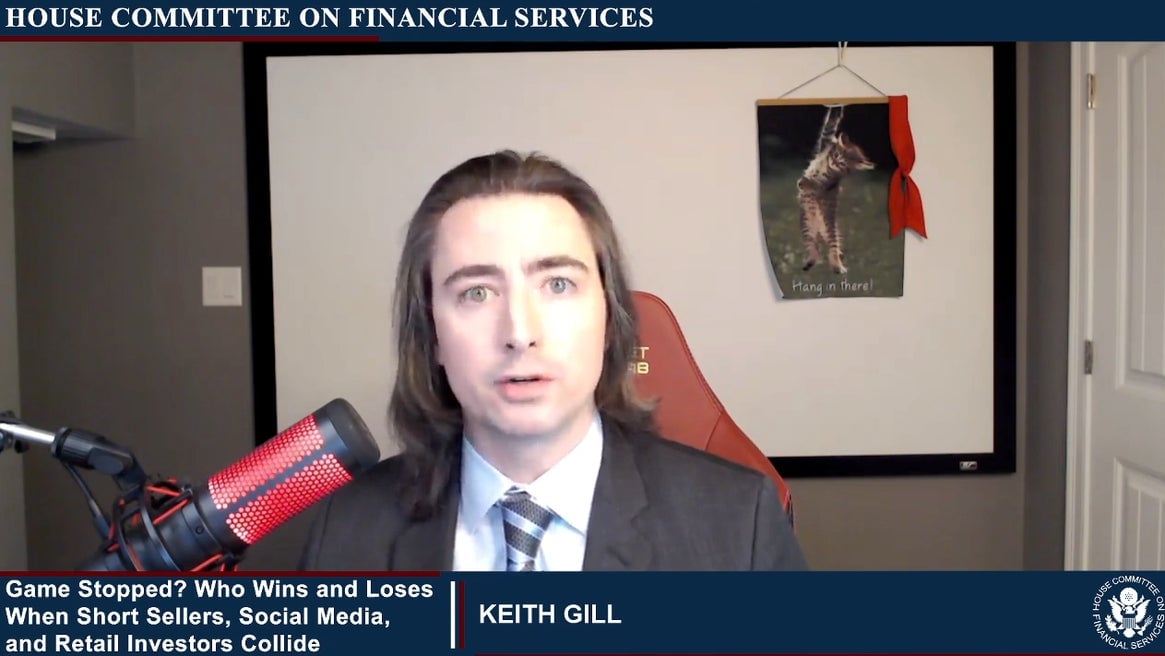
The last we saw of DeepFuckingValue, aka Roaring Kitty, aka Keith Gill, he was giving testimony to Congress and standing accused of market manipulation over his part in hyping up GameStop stocks earlier this year. Now his former employer, MassMutual, has been fined over Gill’s conduct while working there.
As The New York Times reports, Gill’s, “relentless cheerleading for shares of GameStop,” while employed at MassMutual, was in part the company’s problem. State officials said the company, “failed to adequately supervise his and other agents’ trading and online activity,” and that, “Mr. Gill was carrying out trades on behalf of three other people not affiliated with MassMutual without the insurer’s approval.”
William F. Galvin, the secretary of the Commonwealth of Massachusetts says, “As far as MassMutual is concerned they were obviously totally at fault for not supervising him. I mean, it was beyond a small matter of negligence. It was complete and thorough.”
Gill had been working at MassMutual while initially giving GameStop stock advice on platforms like Reddit and YouTube, and didn’t resign his position until January. In addition to MassMutual not “adequately supervising” his conduct, he also stood accused of trading on behalf of three other people without getting his employer’s approval, something a broker needs to do.
This state investigation didn’t lead to any charges, and didn’t directly involve Gill. Instead MassMutual has accepted a $4 million fine, along with agreeing to “an independent compliance review and other measures,” while at the same time refusing to admit guilt or deny the charges. A separate inquiry into Gill himself and his own actions remains underway in Massachusetts, as does a class-action lawsuit
Gill and others made names for themselves on the WallStreetBets subreddit for GameStop’s stock, which had been in the tank since the rise of digital game sales starting in mid-2019. Other observers began to notice that GameStop stock was massively shorted by some big hedge funds. This would go on to create a feedback loop by which investors, including amateur traders on commission-free platforms like Robinhood, could propel the price upward simply by purchasing more and more of it.
These market dynamics, combined with hype on WallStreetBets, the ease of making trades on your phone, and moves by big institutional investors, eventually turned GameStop into a meme stock bubble that peaked at over $450 in late January, before plummeting back down to earth in early February.