
I can’t stand Elmo, just can’t deal with this damn Muppet anymore. He’s cute, he’s shrill, and he has made Sesame Street worse.
Originally posted December 6, 2015.
I write this knowing that many people love Elmo, but Sesame Street’s most-marketed character is an over-exposed drag. He has managed, ironically, to make a children’s show too childish. Thanks in large part to Elmo, Sesame Street is now a less sophisticated and less useful tool for kids to learn from.
This sentiment may hurt, but it’s time to do something about this furry, red problem.

Elmo took a rocky road to his current, unprecedented popularity. Muppets creator Jim Henson believed in allowing a character to grow organically; his guiding philosophy was that each Muppet had a distinct personality; it was the job of the puppeteer to uncover it. Thus, Frank Oz (Grover, Bert) or Richard Hunt (Don Music, Gladys the Cow) or Fran Brill (Prairie Dawn) would slowly experiment with voices and personalities, however long it took, until something stuck.
Nothing, however, seemed to stick for Elmo.
Elmo was a background character starting in the early ‘70s, but he never made a mark, and was kicked from puppeteer to puppeteer until 1984. That’s when Hunt, the latest performer to give the furry red monster a whirl, threw the Muppet across the room, where it landed in the hands of Kevin Clash, as the story is explained in a documentary about Clash and Elmo. Hunt, a veteran on Henson’s crew, challenged the young Clash to see if he could devise a new voice.
Hunt hated the little red Muppet, then called ‘Baby Monster.’ He thought Baby Monster was too cutesy, and indeed, the design of Elmo was more adorable and accessible than most Henson creations. The Muppets that preceded Elmo were huggable, but they had an edge to them—a bold facial feature or eccentricity that kept them from saccharine territory. And some of the monsters were downright scary looking. Take a look at this guy:
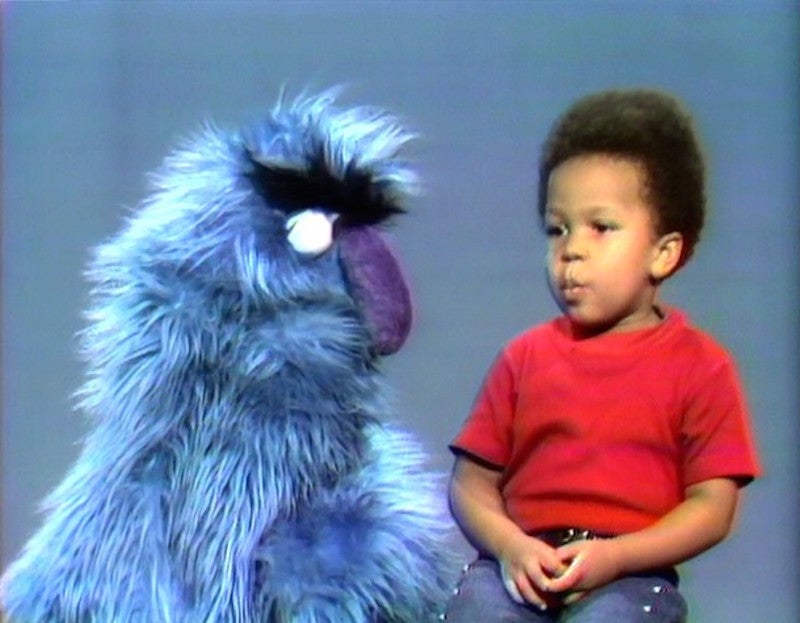
Or this guy:
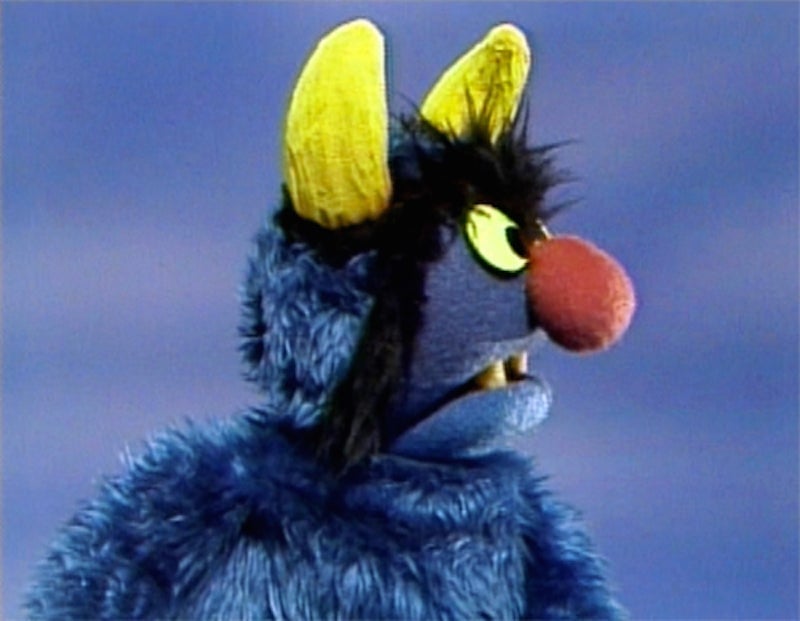
Or how about this guy:
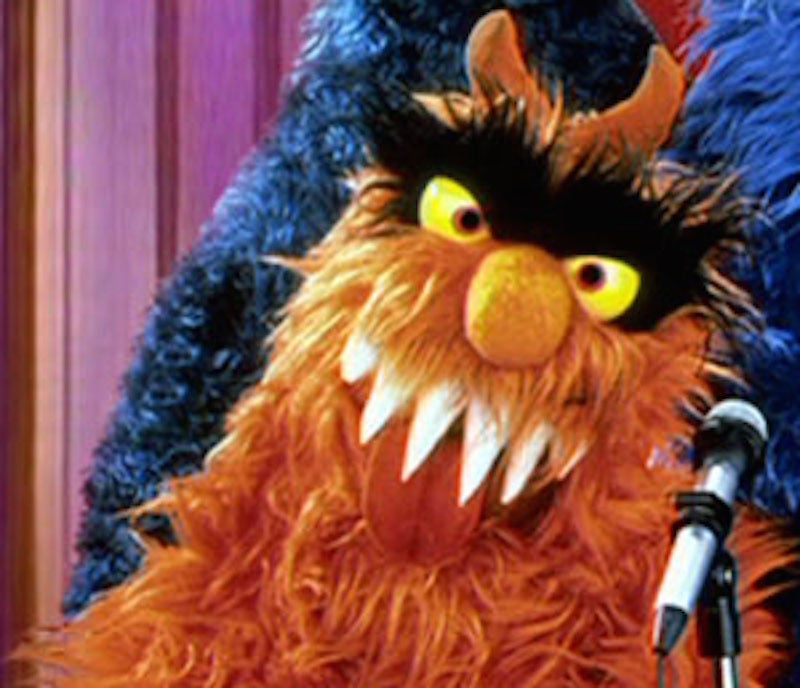
Clash’s interpretation of Elmo aged the character down. Whereas Hunt had given the character a gruff, caveman gimmick, Clash molded the Muppet into a three-and-a-half-old who embodied love—lots of hugs and lots of kisses. And thus, Elmo was born.
Taken by himself, the character was lovable, but not substantial. His main job was to be unfailingly cute, cheerful, and naive—namely, to act like a happy three-and-a-half year-old. It’s extremely appropriate that Elmo refers to himself in the third person, because Elmo is the only thing that Elmo is concerned with. Other characters were more grounded and had specific, research-based reasons for being on the cast. Oscar the Grouch was created as an indirect representation of the poor and underprivileged—easily judged from the outside, but possessing a good heart on the inside. Herry Monster was a stand-in for every oversized kid, who felt big, awkward, and clumsy versus his peers. Telly Monster stood for all the worries and anxieties that a child might have, when trying new things or confronting old fears.
But Elmo only stood for Elmo—how the world would affect him, rather than how he could affect the world. Or, to paraphrase Louis C.K., three-year-olds are assholes—they’re selfish and unaware by their very nature. But this wasn’t necessarily a bad thing, especially when Elmo had a foil character, who could highlight his childishness.
Take a look at this early sketch, which pairs Kermit the Frog and Elmo to hilarious effect.
The essential thing to note is that Kermit garners our sympathy. Elmo is cute, sure, but he’s also a massive pain in the ass. This is the sort of dynamic that the Muppets thrive upon—taking two characters, and letting their differing personalities drive the sketch—Elmo’s relentless, oblivious enthusiasm versus Kermit’s patience and overall squeamishness.
There are many antagonistic, odd couple pairings on Sesame Street, just like this one. Bert and Ernie. Prairie Dawn and Cookie Monster. Grover and Mr. Johnson. We loved Ernie, Cookie Monster, and Grover, and laughed at their antics. But at the same time, we knew that we shouldn’t behave like them in public.
The same used to be true for Elmo. He may have been closest to his audience’s age, but he was not the one that the kids were meant to aspire to. Like in this sketch, where Ernie clearly takes a big brother role in the dynamic.
Elmo was one small part of a large, repertory cast, which is how it should have remained. But at some point in the mid-’90s, Elmo began to hog more and more real estate on the show.
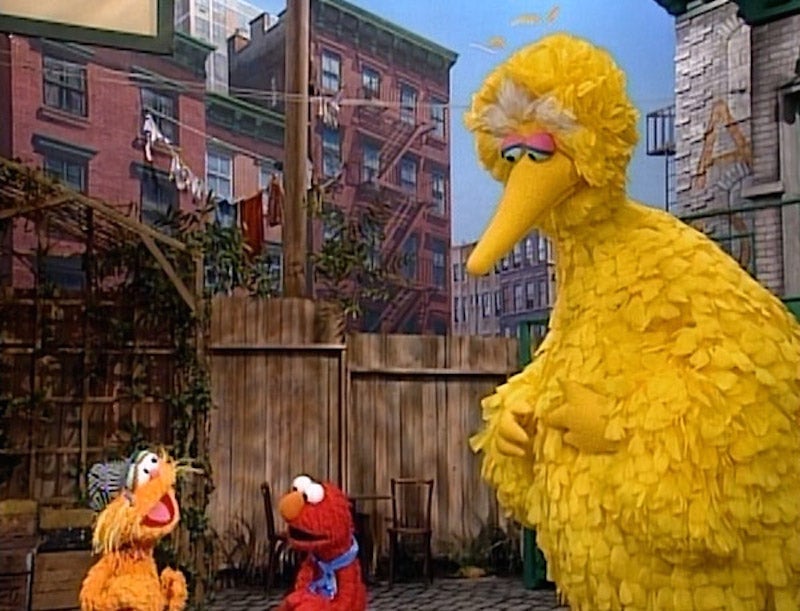
It started in small ways. A lot of stories used to be based around Big Bird, who was psychologically characterized as a six-year-old. And in a lot of ways, this was ideal—six years old was on the older end of Sesame Street’s age demographic, and Big Bird served as both a role model and a peer to his audience. Big Bird’s comparative maturity also meant that he could project a wide range of emotions—he was ‘old enough’ to understand mature concepts, such as the permanence of Mr. Hooper’s death.
The writers even felt confident enough write a divorce storyline for his best friend Snuffy—although that episode would be nixed before it went on the air. And more recently, Big Bird’s nest was destroyed in a storm—a story inspired by Hurricane Katrina. The writers could always trust Big Bird to tackle emotionally complex issues about loss and its consequences.
Elmo stories, on the other hand, tend to affirm and celebrate the child’s perspective. Rarely, if ever, is Elmo’s innocence challenged, or is he forced to think about someone’s happiness other than his own. He spends most of his time hanging out with Zoe, Abby, Telly, and Baby Bear—Muppets who share his emotional maturity, and unlike Grover, Kermit, and Ernie, do nothing to push him. In fact, he is the de facto leader of his group—the dialogue lowers to Elmo’s level, rather than rising to an older character’s. And while this is cute and fun, it gets old fast, and it doesn’t really go anywhere. Elmo is learning about counting to four and different shapes, but he’s not learning a whole lot of life lessons.
At his worst, Elmo encourages immature behavior rather than discouraging it. I remember a storyline years ago that perfectly encapsulated this: Episode 3280, Season 26. The storyline begins with Gina’s boyfriend, Jesse, reading a story to Elmo and his friends. After Jesse is finished, all the kids want to take the book home. But, luckily Jesse has a copy for each of them. It was a cheap dodge to a teachable moment.
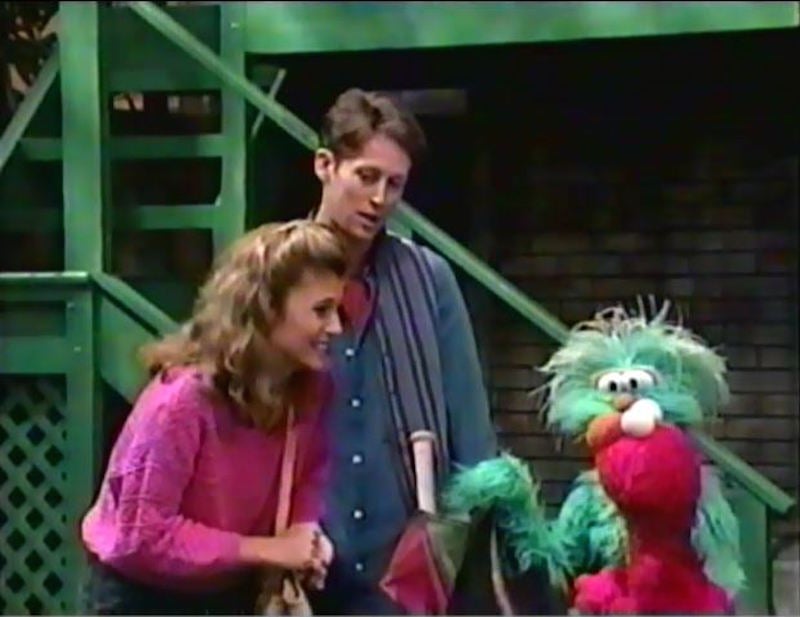
Later, Gina and Jesse plan a picnic date. Elmo wants to tag along—in fact, he assumes he’s tagging along and gears up, without asking for permission. Gina tells him that this picnic is for grown-ups. Elmo is visibly sad and downcast. He guilts the couple. So the boyfriend cracks and lets Elmo tag along. No gentle reprimand. No establishment of boundaries. Just a full-on, unreserved capitulation to Elmo’s wants and needs.
“YAAYY!!”
What message does all this send? It’s easy to imagine Gina telling Big Bird, “Sometimes, Big Bird, adults need time too. If you want to go to the picnic you should ask for permission.” Nah. Elmo’s method is better. Intrude on personal space! Whine and quiver your lip, kids! Guilt gets things done! Cuteness will get you everywhere!
That’s not to say that Elmo does not occasionally star in ‘serious sketches’—he does. A new friend might be autistic or be HIV Positive, and Elmo helps to dispel common myths and stereotypes. That’s fantastic, but notice how it’s always about what he can do to help others fit in—he’s never had to fit in himself. He never experiences the pain directly—he always experiences it secondhand, from the perspective of an outsider looking in.
And then there’s the 9/11 episode, which, again, missed a teachable opportunity. When Hooper’s Store almost burns down, the firefighters take him around the firehouse to show him there’s nothing to be scared of. The resolution is too simple and immediate: Elmo’s scared and then Elmo’s happy again. He expresses his fears principally through body language and silence; he doesn’t ask the questions that many kids would need the answers to.
https://www.youtube.com/watch?v=EyC4lG0IliU
Big Bird, on the other hand, always vocalized his concerns directly, and wrestled with scarier, connected questions about abandonment. And Big Bird held onto those sad memories afterwards, even after he made peace with them; that hand-drawn picture of Mr. Hooper hung by his nest for years.
Now admittedly, it’s impossible to get a three-year-old like Elmo to care about someone’s needs before his own, let alone ask important, deeper questions about solitude and personal safety. But that’s exactly my point; a three-year-old Muppet should not be the lead for this show. Elmo used to embody childlike characteristics that children should be moving away from. But now, he’s modeling, for four and five-year-old children, behavior they should have already left behind. The show used to recognize this and poked gentle fun at Elmo’s immaturity. But in recent times, the writers have forgotten to.
Elmo’s omnipresence also comes at the exclusion of the remaining cast. So many characters, both human and Muppet, have been all but evicted from Sesame Street. Herry. The Two-Headed Monster. Grover. Prairie Dawn. The majority of their appearances are from old, recycled sketches. They have been reduced to side characters and are rarely given big storylines or equal screen time.
And the newer Elmo playmates? They’re lamer substitutes for the original Muppet cast members, and they interact almost exclusively with other Muppets their age. Zoe was, for all intents and purposes, a girl Elmo, who was researched for appeal and mass consumption. Baby Bear had no personality aside from acting like a baby. Abby Cadabby was cute, sure. But remember when Muppets didn’t have to be cute? Abby was a magical girl stock character, created with marketing near the forefront.
The Elmo obsession reached its nadir when the writers started “Elmo’s World.” For an entire decade (1999-2009), Sesame Street dedicated the last 15 minutes of its show to this ridiculous pile of pap starring Elmo. No one else. Just Elmo speaking to the camera, a goldfish, a weird mime named Mr. Noodle, and a bunch of crayon drawings that established the setting. And it’s not like they fenced off Elmo from the other 45 minutes, which would have allowed them to focus on the remainder of the cast. Elmo would often time star in the main storyline, and in the sketches, and in the concluding “Elmo’s World” segment.
When “Elmo’s World” ended, that wasn’t the end of it. Oh no. Instead, it was replaced with “Elmo the Musical,” a new 15 minute segment with more songs, more locations, and more CGI Muppets—a horrifying, recent trend, which does a lot to strip away the show’s warmth. And like “Elmo’s World,” “Elmo the Musical” is almost completely disconnected from the rest of the street. Elmo disappears into his own little technicolor world of fantasy and imagination. That leaves his audience’s imagination behind, by doing all the mental work for them.
The show’s Elmo obsession shows little sign of stopping—he’s the ‘go to’ for talk show appearances and celebrity cameos. Marketing continues to place him from and center, often with no one accompanying him. His commercialized face is plastered everywhere. And that’s unfortunate. It’s a blow to the show’s diversity and integrity, and it’s a blow to fans like me, who have followed Jim Henson and all things Muppet-related for 30+ years.
The new HBO version of Sesame Street will not stem the tide. They’ve already announced that Elmo will be one of the main characters on the show (they’re actually limiting the cast of Muppets even further). And since the show is now going to run for half an hour instead of its usual hour-length, the fight for character time is going to be even more fierce.
I’m doing something about this.
I have a 13-month-old son, and my wife and I have laid down some basics boundaries for his protection. No cable news on TV—he may not be able to speak, but he still can pick up on other people’s stress. No daily photo updates on Facebook—he’ll have plenty future opportunities to document his entire life on social media, should he choose to do so in the future.
And no Elmo merchandise. Is this petty? I don’t care. I’m not getting involved. If he appears as a side character in a book, fine. If he appears in some group sketch with other Muppets, I’ll look the other way. But for all intents and purposes, Elmo products are banned.
We’re a Grover family, the whole way. Now there’s a Muppet who never talked down to or regressed his audience. Grover would bust his furry blue butt to teach a lesson, even if he had to run himself into the ground to do it.
My son has a Super Grover doll, complete with a helmet and cape that he loves. When we go to a bookstore, I try to find Sesame Street books that star non-Elmo characters. This is an arduous task; 99.9% of modern Sesame Street books are Elmo-centric, but I do what I can, and I also find a lot of the older, out-of-print books on Amazon. We watch classic Sesame Street sketches on YouTube together; in most of them, there’s no furry red monster to be found.
I labor under inevitability; eventually, just like death, taxes, and unrequited love, my son will be exposed to Elmo, especially if he watches the TV show. As a father, all I can hope for is that I’ve taught my son to know right from wrong.
Kevin is an AP English Language teacher and freelance writer from Queens, NY. His focus is on video games, American pop culture, and Asian American issues. Kevin has also been published in VIBE, Complex, Joystiq, Salon, PopMatters, WhatCulture, and Racialicious. You can email him at [email protected], and follow him on Twitter @kevinjameswong
Top illustration by Sam Woolley. Sesame Street screengrabs via the Muppet Wikia