

The Digital Homicides are a Steam group with a goal that seems admirable: to keep poorly-made, sketchy, and downright scammy games off Steam. How they go about achieving that goal, however, is far more murky and controversial.
The group is cheekily named after notorious Steam shovelware developer/lawsuit lobber Digital Homicide. The Digital Homicides describe themselves as “a dedicated consumer-advocacy group” who are “highly critical of the state of Steam as a whole.” They focus mostly on Greenlight, Steam’s user-driven entry point for lesser-known games. “The scope of problems are not limited to Greenlight, but [it] is often the source, with a broken and abused voting system,” they say in their About section.
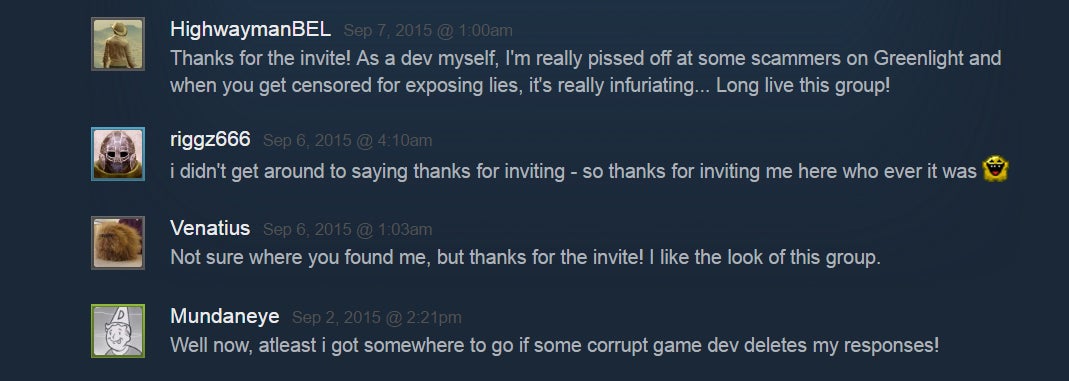
They attempt to clean up Steam by listing suspect Greenlight games and developers so that group members can report them if they’ve violated any of Steam’s guidelines. Members of the 1,433 strong group also go into games’ comments/discussions to warn away prospective upvoters. Sometimes reporting works, sometimes it doesn’t. Valve is nothing if not consistent in their inconsistency.
 But the Digital Homicides have another trick up their sleeves. Members often descend on games’ Greenlight pages, sometimes en masse. Many get straight to the point (“This game looks bad/sketchy for reasons X, Y, and Z”), but some get nasty about it, leading a number of developers to label them a hate group.
Case in point: many of the Digital Homicides’ members recently became part of the lawsuit brought forth by their namesake, the developer Digital Homicide. The suit was recently dismissed after Digital Homicide claimed they lacked the funds to continue, but its contents are telling. In the suit, the developer accused 100 Steam users—some of them members of the Digital Homicides Steam group—of stalking, harassing, and tortious interference, among other things. The Digital Homicides claim to be against this behavior, but as a group dedicated to the loose goal of improving Steam’s inconsistent system, the group’s moderators can only exercise so much control over members’ behavior. While the Digital Homicides have succeeded in getting some inappropriate games off Steam, their method also has its downsides.
Fighting fire with fire
“We are not a ‘lynch mob,’ as one developer once called us,” Tryyton, one of the groups’ heads, told me.
“We voice our opinion, and when devs are ‘caught in a lie,’ they act angrily,” he added. “But the users on Steam can check out the group and our rules and see that we’re definitely not the bad guys here.”
The Digital Homicides’ interactions paint a portrait of a well-meaning but decentralized initiative enabled by massive holes in Steam’s structure. Steam is severely lacking in both quality control and anti-harassment tools, and the resulting environment is hostile to both developers and users. Valve unintentionally created systems that pit users and developers against each other, and they’ve allowed that hazardous dynamic to mutate and metastasize over time.
 The Digital Homicides are fed up. I’ve read through hundreds of pages of comments spanning back to early 2015, and the main themes were almost always anger and incredulity. “How are these developers still submitting games?” “How did this game make it through Greenlight?” “Why hasn’t Valve done anything?”
The games that fall into the Digital Homicides’ sights run the gamut. Some games use asset-flipping, buying asset packs for an engine like Unity and selling them as a game. Others are badly-made, don’t work, or are being sold by actively hostile developers.
Given all this, there are tons of posts expressing relief that a group like the Digital Homicides exists. Finally, people feel, they can do something.

 There is no uniform approach to what ‘doing something’ looks like. “Everyone has his/her own kinda ‘list’ of red flags, I would say,” Tryyton explained. “But the use of obvious copyrighted material, stolen assets, or bad and harmful behavior of the developer are things we try to point out.”
But of course, this kind of approach raises questions. What constitutes bad behavior, or even a bad game? And how far should one or a few people’s particular red flags go? These vague guidelines, when combined with members’ frustrations, can lead to members raging at developers on games’ pages.
The Digital Homicides frequently paint targets on the backs of Steam Greenlight games they deem worthy, and members do as they please with that information. When 10 or 20 people suddenly appear in a game’s comments or discussions, a handful of them unable to contain their naked rage, it can look or even feel like coordinated harassment. That goes double for repeat offenders, like Digital Homicide (the developer) and meme game factory BMC, both of whom flood Greenlight with half-baked submissions. In those cases, the Digital Homicides bite down and refuse to let go.
 The Digital Homicides walk a precarious line between constructive criticism—their stated goal—and outright harassment. The latter is technically not allowed per group rules, but it’s difficult to prevent given that many altercations occur across countless games’ Greenlight pages. The group can’t do much to punish people. They can say that digging up ugly chunks of personal info and hurling it back at hated developers is super not-okay, but Steam’s slim toolset makes policies difficult to enforce outside the group’s own page and discussion areas.
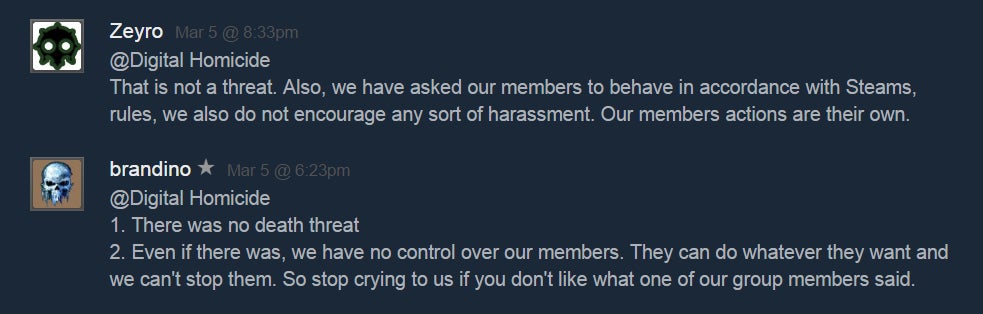
In addition, the Digital Homicides don’t have a problem with a degree of rage and spite as long as it doesn’t descend into that dreaded “personal” realm. Take, for example, the group’s response to a complaint the developer Digital Homicide personally made against a comment in one of their games’ discussions. It read, “If I had a time machine, I’d send DigiHom to Nagasaki on August 9, 1945.” Yikes! The group, however, was less than sympathetic to their longtime foe’s pleas:


 Vaguely threatening emails are also fair game, it seems:
 “Our members don’t do crappy stuff,” Tryyton told me. “They are ‘loud’ and maybe some get too emotional sometimes, but I think we have a very balanced group of very mature and educated users. When something goes too far, our awesome team of moderators are there to react to it.”
Developers subject the Digital Homicides’ attention have taken matters into their own hands as well, especially when they feel the group’s efforts have crossed a line. The sins of Digital Homicide (the developer) are well-documented, but other Greenlight developers the Digital Homicides tangle with have deleted authentic criticism or pre-ban the group’s members from discussing their games.
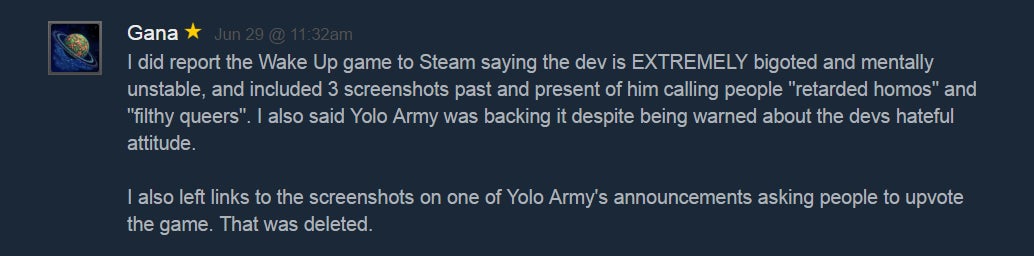 Some of the Digital Homicide’s most notorious targets have also used homophobic and racist language like “queers”and “slaves” to insult people. A couple have even joined the Digital Homicides under the guise of wanting to do better, only to start hurling abuse. Others have created their own Steam groups to impersonate or otherwise make fun of the Digital Homicides.
At some point, the lines between right and wrong blur. Some might say, “Yeah, but they started it!” or “No, they started it!” But after enough mud’s been flung, nobody comes away looking great.
To each their own
The Digital Homicides don’t want to ban people. They’re stringently anti-“censorship,” both in regards to developers deleting criticism of games and the Digital Homicides Steam group as a forum for discussion. While modern internet definitions of “censorship” are murky at best, and one person’s “censorship” is often another person’s basic forum moderation, it does make a degree of sense to keep a watchful eye on Steam developers who stuff dirty laundry under the rug.
“[Here’s] how I (and the group mostly as well, I think) define censorship: if criticism or important background information gets deleted,” Tryyton explained. “Trying to hide things is never a good sign, either. Shady devs sometimes try to get on Steam with other aliases, and knowing about that kind of info is valuable to the customer. That’s one of the things we try with the group: to educate about those and other behaviors.”
Members of the Digital Homicides are free to act as they please in service of this goal, as long as they don’t start shit in the group. “We’ve banned less than ten users so far!” Tryyton told me. “It takes quite a lot to get banned, and it’s always discussed as a team.”
 What constitutes a bannable offense is on a case-by-case basis. Big no-no’s generally revolve around joining the group to start trouble. If it seems like you’re on the Digital Homicides’ turf to troll or start fights, you’ll probably be out on your ass before long. But while Tryyton and the group’s other moderators lay down guidelines—for instance, no death threats, harassment, or digging up people’s personal information—ultimately the group members’ actions are their own.
“We don’t control what our members post,” said Tryyton. “That’s not our duty.” He explained that they instead try to only allow non-toxic people into the group, which they’ve kept relatively small and selective on purpose. Quality over quantity. “There are millions of users on Steam, though,” he added. “A lot of them far worse than anyone from our group.”
This decentralized approach can lead to incidents like the one with Digital Homicide above, where a group member left a comment that implied they wished Digital Homicide was dead. When faced with that, the group basically replied, “That’s not our responsibility.”
When you’re running a group that leverages numbers for strength, drawing lines of responsibility becomes a tricky thing. Nobody’s perfect, and in large groups, some individuals will invariably take things too far, especially when they feel like they have more than a thousand other people behind them. The Digital Homicides are clearly aware of this, and they’ve posted many stern (though non-specific) warnings in instances where somebody’s decided that outright harassment is a good idea. The moderators even had (developer) Digital Homicide’s back shortly after the lawsuit fiasco began.
 “As great as all the support is, we all have to remember [Digital Homicide developers] James and Robert are real people, as hard as it is to believe,” moderator A Flying Brick wrote in a post to the whole group. “So please don’t dogpile on their pages or post other ‘bannable content’ ie Death threats. Just don’t, guys. Death threats and harassment are not cool.”
In the heat of the moment, though, actions and their outcomes trump intentions. In many cases, the Digital Homicides’ members are not trying to harm or harass, but they exist in an environment in which toxicity is a default state, in which—as Tryyton pointed out—the Digital Homicides are hardly the most rotten banana in the bunch. Steam users act angry and toxic when they find games that seem crappy, incomplete, or scammy. Developers return the favor. Meanness begets meanness. Escalation follows, and it becomes a war of attrition on both sides. In the absence of intervention on Valve’s part, both the Digital Homicides and their detractors are doing the only things they think might work. And, to an extent, both do.
No good deed goes unpunished
“If we report copyright infringement or other things that break official rules, it works relatively often, I think,” Tryyton told me. “I get emails from Valve sometimes, after I reported something. There’s no mention about what was taken off Steam, though. It’s also still Valve’s decision how many reports they need/want before they see the need to act.”
Before Valve zapped them from Steam over the much-publicized lawsuit, Digital Homicide had more than 20 games on Steam. BMC, meanwhile, got their start relatively recently, and they already have two games, each released within one month of the other. Digital Homicide can stem the tide and warn other users, but they can’t do much beyond that. Greenlight is a user-driven system, but users can’t solve these problems. That falls on Valve, who remain so conspicuously silent that I’m beginning to think the content of the Portal series is autobiographical.
Jim Sterling’s investigation of YOLO Army.
Then there’s the issue of giveaway and booster groups. This is a semi-recent trend that both illustrates the necessity of the Digital Homicides’ mission on Steam and also casts it in something of a hopeless light. Not every Steam group that does game and item giveaways is shady, but many of them are. Some, like the infamous YOLO Army, pair their giveaways with Greenlight vote promotions. The result? Thousands of people (YOLO Army’s current membership is a hair over 68,000) blindly voting for sometimes-horrific games in hopes of winning free stuff. The Digital Homicides have recently worked to get the word out about some of these groups, but many of the people powering them don’t give a shit. They just want free stuff.
Games might get reported, but developers can just resubmit them. Games might get flagged as “incompatible” with Steam, but then they get un-flagged. Then re-flagged. Then un-flagged again. Developers might be revealed as scam artists, but they can just come back under different aliases. Their games might be bad, but they can flag negative reviews and get them taken down. Or they can sell bundles of slapdash games for peanuts and make a killing on Steam trading cards, because at that point quality is moot.
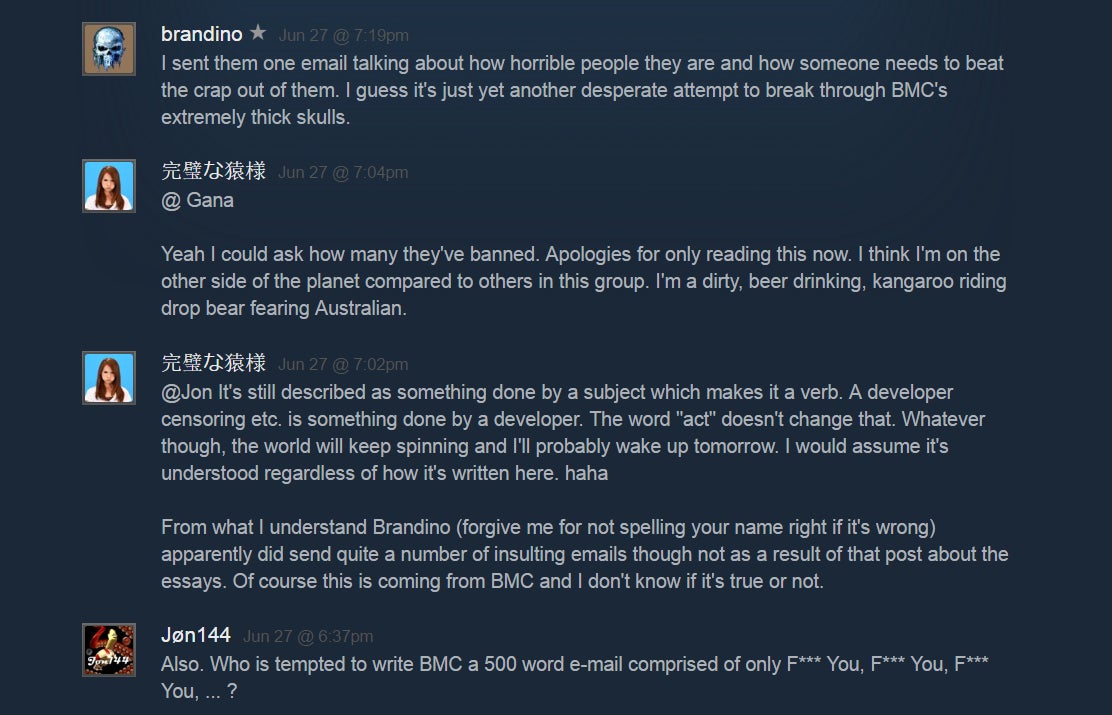
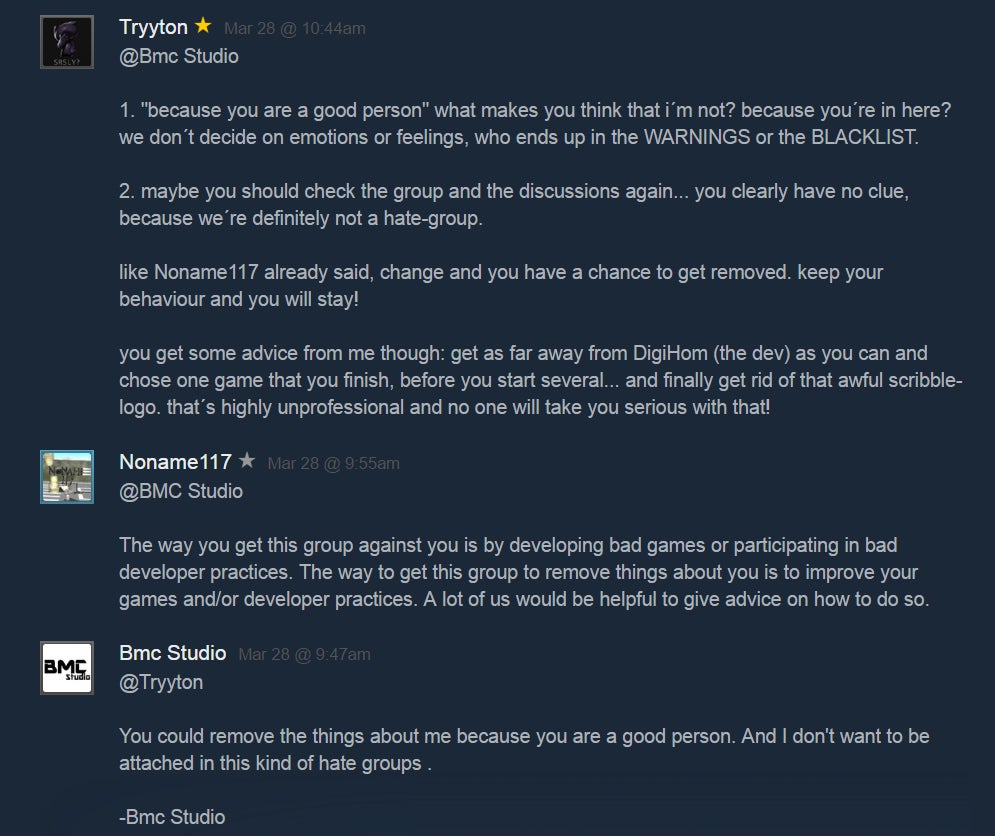
The Digital Homicides are happy to give developers advice on how to do Greenlight the right way, and a few developers even count themselves as members of the group. During our conversation, Tryyton stated multiple times that he’s happy when developers become “better” after interacting with the Digital Homicides. They’ve even tried to reach out to one of their arch-nemeses, BMC, on a few occasions. However, that didn’t exactly end well:
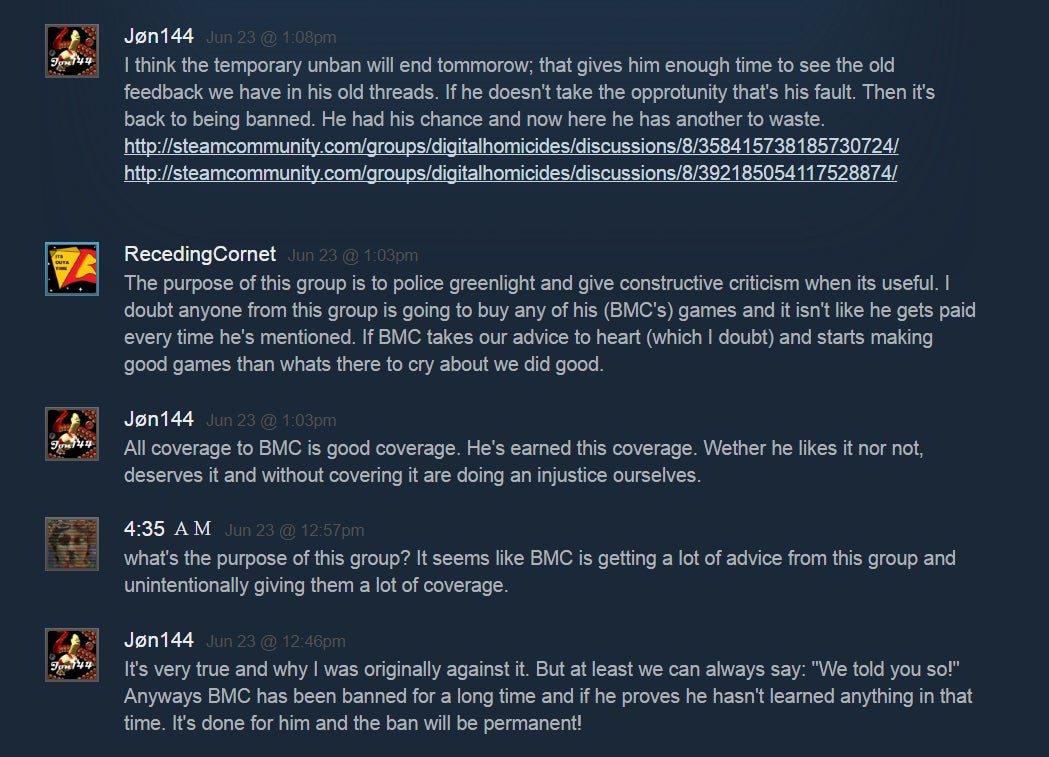 The group occasionally highlights good Greenlight games as well, although their regular GreenWatch series tends to focus on sleazy and otherwise questionable practices. That said, if you need a roadmap to help guide you through the lawless land that is Greenlight, GreenWatch is about as good as it gets.
When the Digital Homicides aren’t talking about individual games and developers, they host lengthy discussions about Steam and its pitfalls. The phrase “constructive criticism” is thrown around a lot. These are people who can see, closer-up than many, each and every crack in the foundation. As a platform, Steam is full of holes that exploitative types can worm their way into. The Digital Homicides, Steam users, and developers all want the same thing: change. Everyone can agree that it’s long overdue.
Tryyton said that he hopes to see Valve make some serious changes to Steam and Steam Greenlight, because he wants to see good smaller developers reap the rewards. “Those who would really benefit the most are the indie developers who are the needle in the haystack. The ones you hope to find and want to support. Those devs are also happy about groups like us, I think,” he said.
You’re reading Steamed, Kotaku’s page dedicated to all things in and around Valve’s wildly popular PC gaming service. Games, culture, community creations, criticism, guides, videos—everything. If you’ve found anything cool/awful on Steam, send us a message to let us know.